Why AI answer engines have a built-in language bias — and what it means for your brand's global visibility
The four signals that determine whether your brand gets cited in AI search results
How to build the content infrastructure that earns AI citations across markets
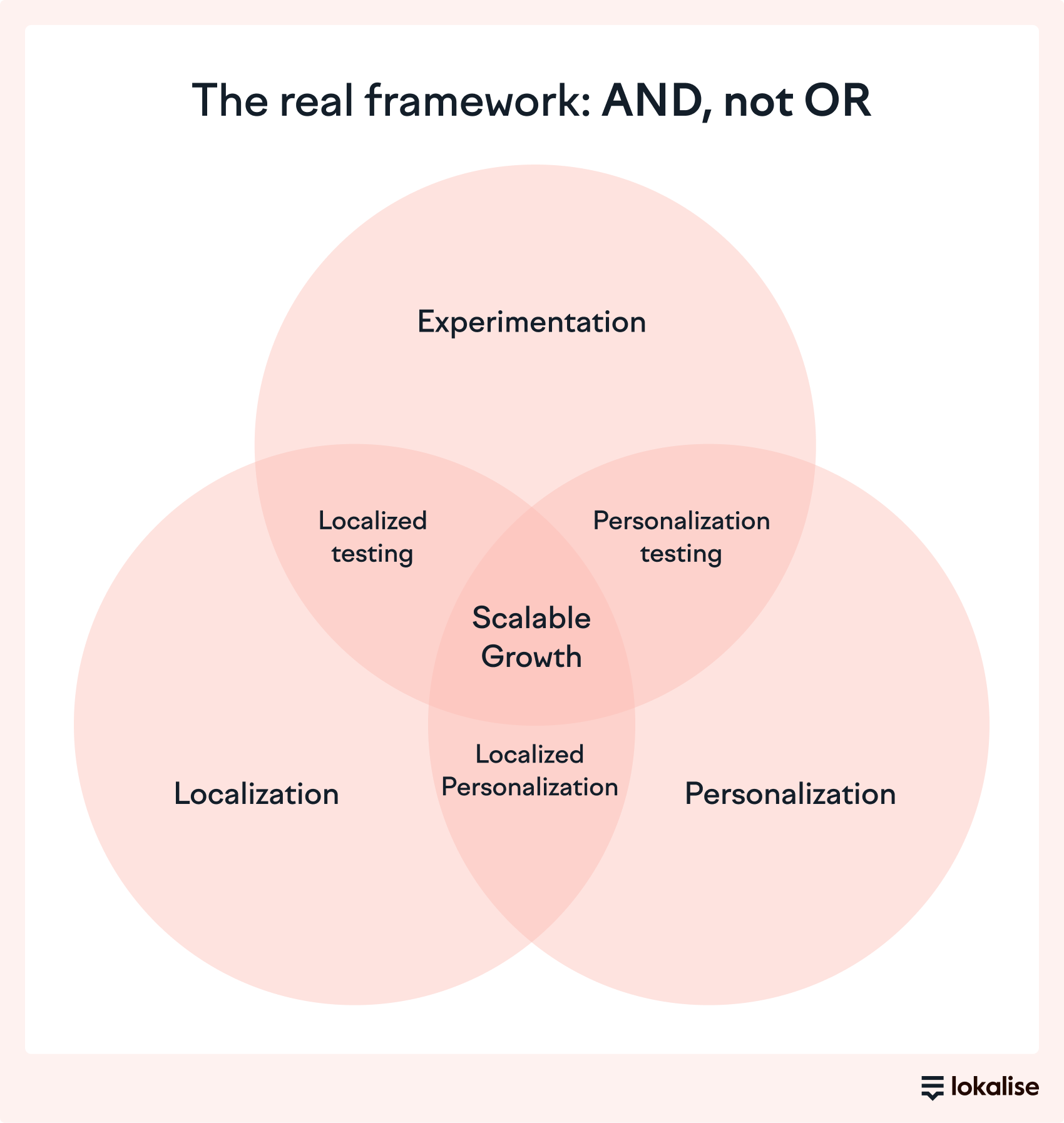
The AND framework for compounding international growth: Experiment AND Localize AND Personalize
A six-step playbook for validating demand and launching in new markets How to build localization workflows that are fast, scalable, and publication-ready
The search revolution
We get it. Everyone is saying that SEO is dead and Answer Engine Optimization (AEO) is changing digital search forever. That’s old news, and this article isn’t about that.
We want to let you in on one of the biggest secrets in search today. A massive digital land grab is happening right now, yet almost nobody talks about it. By now, most teams know that AEO reduces their carefully curated Google listings into a single AI answer. It gives users one citation and one true source, and everyone is fighting to own that top spot.
But there's one connection most marketing teams haven't made yet, and it'll cost them significant ground in six months.
4 in 5 people can’t speak English.
And even those who can, will still search, browse, and buy in their native language.
Why does this matter? AI answer engines have a built-in language bias. They prefer content that matches the exact language of the user query. If your brand offers only English content, the AI finds the best available native-language source and builds its answer from that instead.
However, Large Language Models (LLMs) look for specific signals to choose the best citation, and a quick and dirty machine translation won’t get you there. You must offer highly relevant, up-to-date and localized answers in the native language of your user.
If your brand isn’t the one AI recognizes as the source, someone else’s version of you will fill the gap. Moving first to make your content trustworthy, structured, and multilingual means owning AI-generated answers in your market, while almost all your competitors are still catching up. Here, we’ll give you the strategic framework to take action.
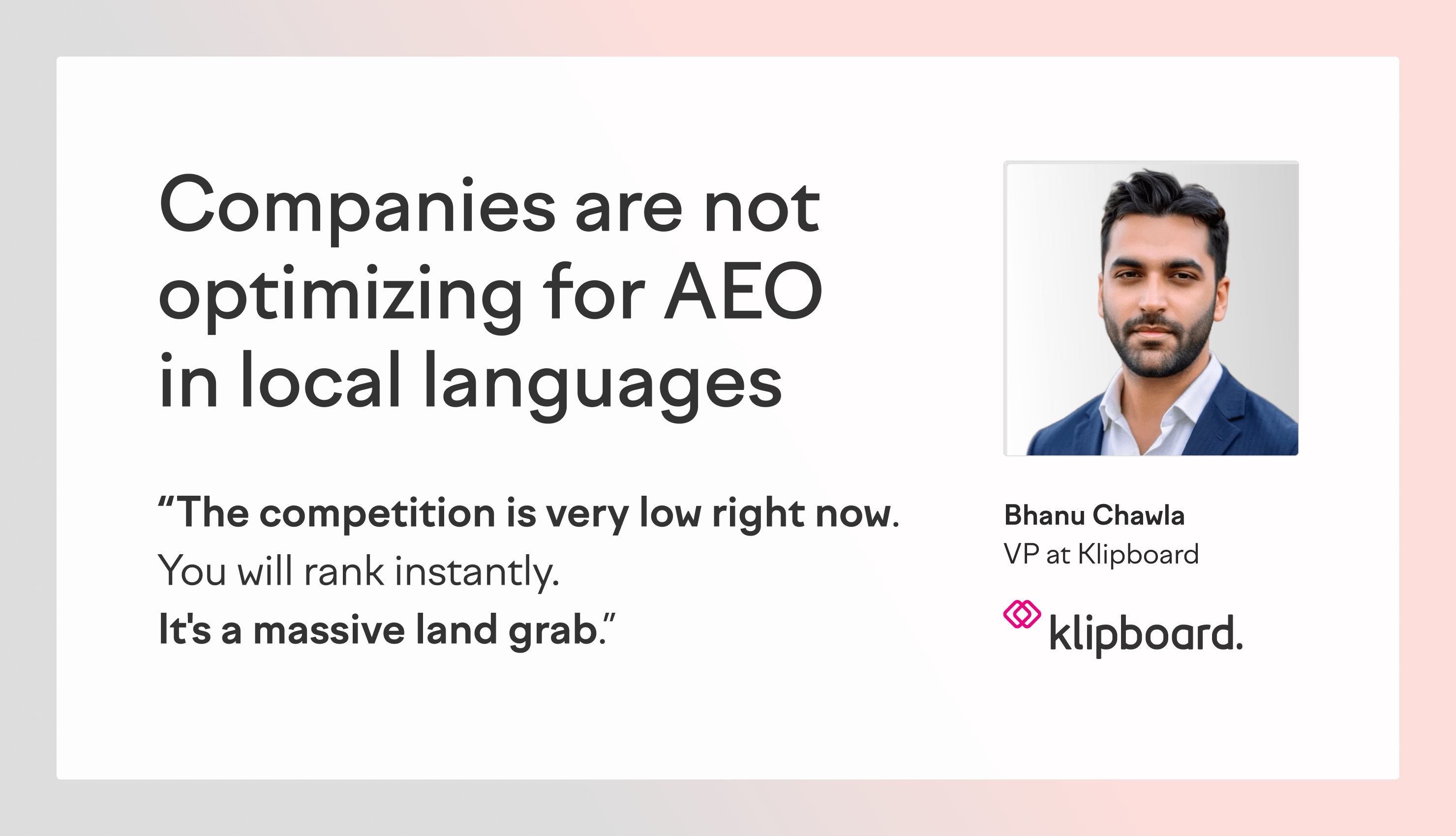
Bhanu Chawla is VP of Global Marketing at Klipboard, a PE-backed technology business with 55,000 customers across more than 10 markets. His team has seen it firsthand:
Companies are not optimizing for AEO in local languages; the competition is very low right now. You will rank instantly. Within a month, you’ll have so many prompts you can rank for. It's a massive land grab. — Bhanu Chawla, VP, Klipboard
Chawla's team saw a 3X increase in AI citations across all major AI engines after investing in localized AEO content, in a fraction of the time traditional SEO authority requires.
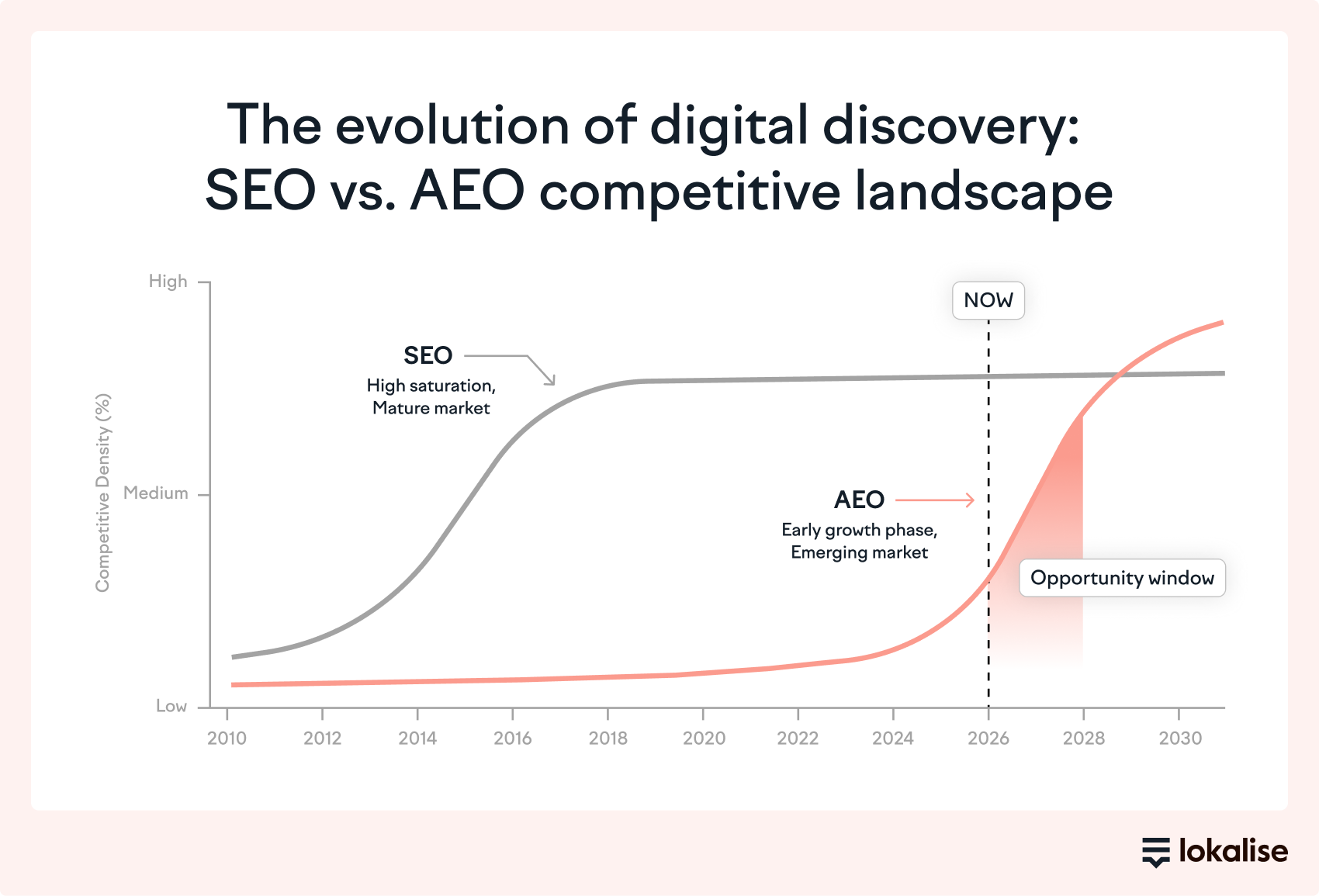
AEO is where SEO was in 2012
SEO spent nearly a decade evolving into a highly competitive channel, and by the time most brands had a mature strategy, the opportunity to gain an early-mover advantage had passed. AEO is at the beginning of a similar evolution. The competitive intensity that makes English-language SEO so difficult to penetrate has not yet emerged in AEO. In non-English markets, it remains even more open.
The language bias inside every AI answer engine
AI doesn't just find information. It constructs narratives. It synthesizes. It chooses whose facts to trust. And the criteria it uses to make that judgment are rooted in linguistic and geographic proximity. — Sophie Krishnan, CEO, Lokalise
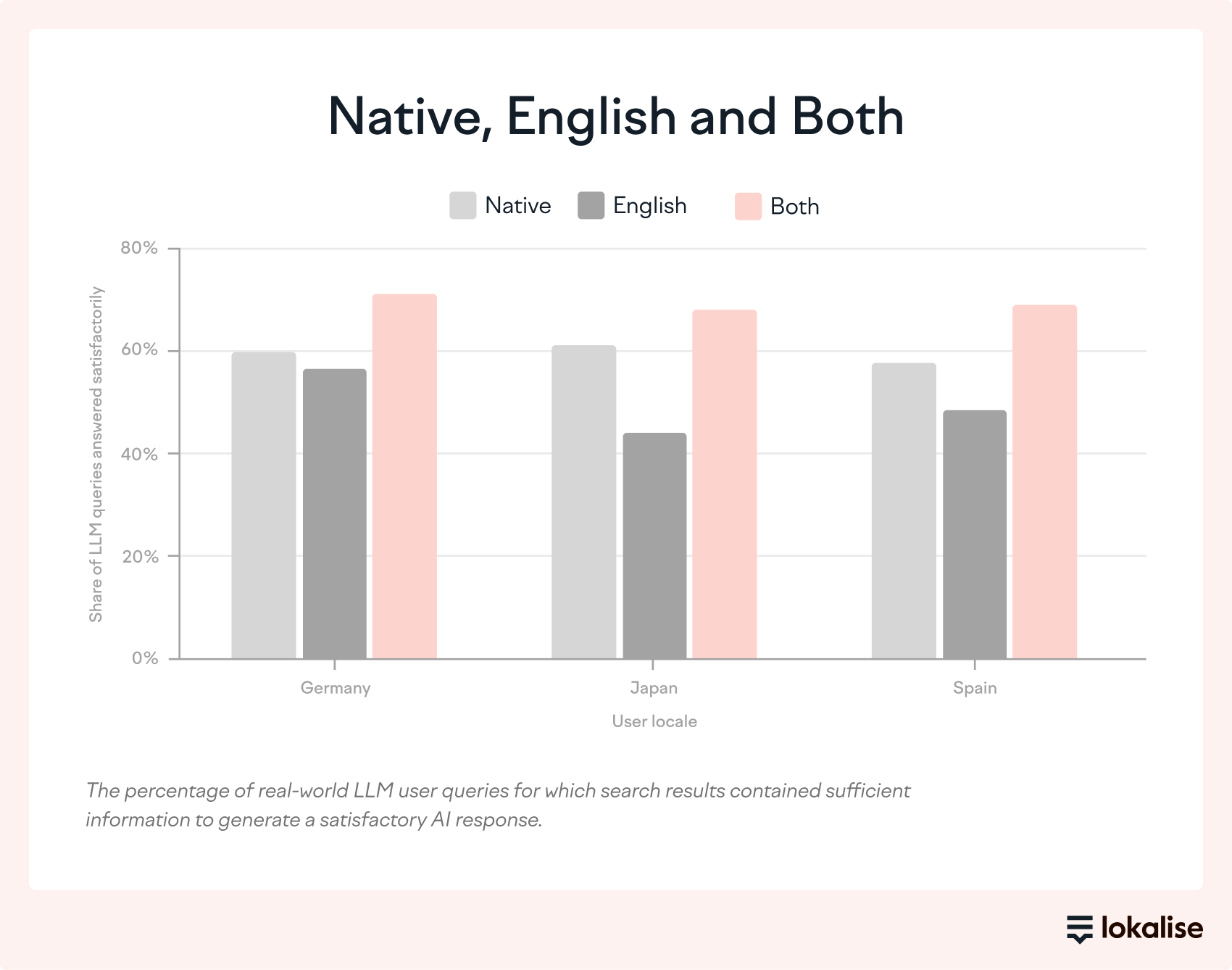
New studies are beginning to confirm exactly this. Amazon AGI researchers analyzed real-world AI search traffic across Germany, Japan, and Spain, and found that English-only content left AI systems unable to adequately answer between 44% and 56% of non-English queries. In Japan, for example, adding native-language content meant AI could satisfactorily answer 54% more queries than with English alone.
Across all three markets, a combined native-language and English content strategy outperformed English-only content by as much as 54% and native-only content by up to 20%. This suggests that the strongest gains come not from choosing one language over the other, but from investing in both.
What AI looks for, and what it takes to be found
AI search systems use specific signals to determine relevance for a given language and geography. Every one of them is within your control.
Factual and grounded. Concrete, specific claims the model can extract and reference with confidence, not vague marketing language that AI systems struggle to synthesize.
Structured. Organized in ways an AI can parse: clear headings, FAQ sections, schema markup, well-formed semantic content.
Fresh. LLMs actively favor recently updated content. A stale page, regardless of how authoritative it once was, loses ground over time to fresher, more current material.
Native. Matching the language of the query being made.
That last point is more nuanced than it sounds. "Native" is made up of four specific signals that tell AI engines whether your content belongs to a given audience:
The language of the prompt. When someone types a question in their native language, the AI looks for native-led sources to anchor its answer.
The system language of the user's device. Even when users type in a non-native language, if the device is set to a different language, it influences how the model calibrates its response.
Explicit local context within your content. Cultural references, regional specifics, local examples, and market-specific terminology signal that the content was written for this audience.
Personalized AEO signals. Indicators about the person asking that your content reflects and addresses. Not just their language and location, but also their preferences.
A simple machine-translated page won't activate any of them. The bar is a genuine localization.
The AND framework
Understanding what AI looks for is one thing. Where most global teams lose ground is in how they approach building it. It almost always comes down to the same mistake — choosing between strategies that should work together.
Localization or personalization. Scale or local relevance. Speed or quality. Brand consistency or market adaptation. Framed as trade-offs, these pairs become barriers: internal debates that slow decisions and produce half-measures that deliver neither outcome.
Bhanu Chawla frames this as the fundamental operating question for any team building for global growth:
The real use of scalable growth lies within the AND, not OR framework. You have to be a master of all trades to scale properly and grow at a level that's impactful for the company. — Bhanu Chawla
Localization and personalization. Scale and quality. Brand consistency and market-specific messaging. Modern localization infrastructure makes holding both sides of each equation achievable.
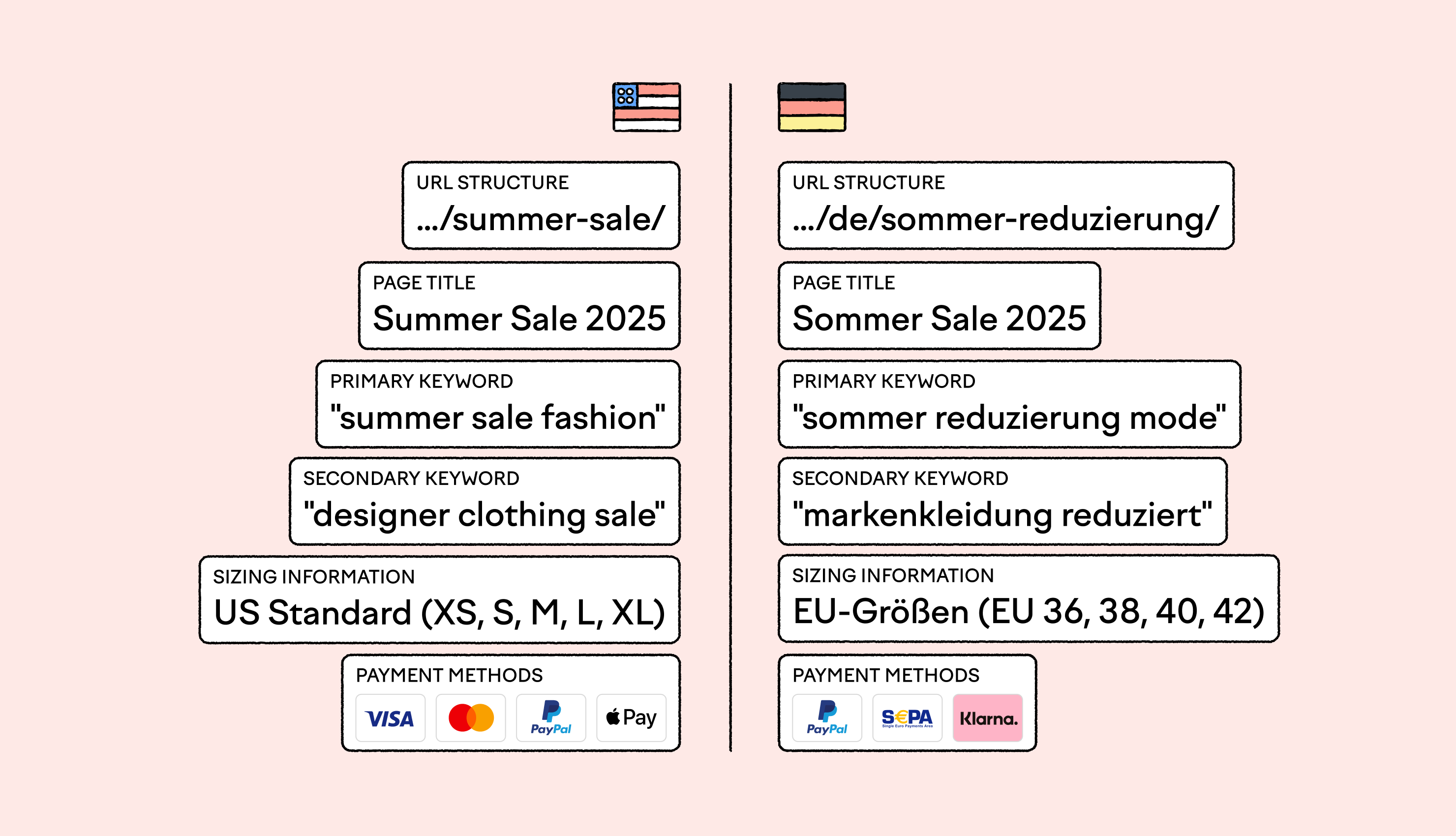
Positioning can and should be globally consistent. But the way you communicate with a specific audience in a specific market needs to be adapted. UK buyers might respond to ROI and operational efficiency arguments. Nordic buyers may prioritize sustainability and compliance. Perhaps Benelux buyers care about pan-European document transfer regulations that most UK and US marketing teams have never heard of.
If you just take English content, localize that, and put it live, the resonance will not be there. You’ll see the engagement rate drop eventually, and you'll have to come up with something that people do really care about in the market. — Bhanu Chawla
The AND Framework checklist
☐ Experiment
Test messaging and creative by market before scaling
Run component-level A/B tests, not just full page variants
Validate what resonates locally before committing budget
☐ Localize
Produce content with the quality and structure that earns AI citation
Ensure cultural relevance — not just translated English
Apply consistent terminology, glossaries, and brand voice across every market
☐ Personalize
Adapt for audience segment, geography, and buying context
Go beyond language to ICP-level relevance
Match content to where your buyer is in their journey
How to choose your markets
The AND framework is the right model. But applying it simultaneously across every market may not be realistic, and attempting to do so could dilute the strategy.
The most effective approach combines top-down strategic conviction with bottom-up data validation. The six-step framework by Bhanu Chawla below gives you a repeatable model for doing exactly that.
Intelligence. Define your target market, identify your ICP, map competitors, estimate market size, and understand the questions your buyers are actually asking. Use AI to do the initial heavy lifting, then validate and deepen with primary research where it matters.
Signal testing. Before localizing anything, commit 5 to 10% of your market budget to demand validation. Run campaigns targeting your ICP in the target geography in English. Measure not just clicks, but quality signals: time on site, page depth, and conversion rate. If you see a notable uplift in cost per click,the demand signal is real. If it doesn't, you've saved yourself significant budget before investing in localization.
Audience segmentation and localized content. Once you’ve validated the market, invest in localization — not the whole site, but specific campaign content. Typically three to five key pages, core assets, and sales materials. Define your ICP at the channel level and ensure the content speaks to local priorities.
Multi-channel launch. Expand investment to 10 to 20% of the budget. Run across your priority channels: paid search, paid social, content, events, and crucially, AEO-optimized content designed to be cited by AI answer engines. This is where local messaging nuances become critical. The message that drives conversion in the UK may not land the same way in Germany, even when the product is identical.
Measure outcomes, not activities. This is where most teams lose the thread. The instinct is to measure localization speed and content volume — how fast did we go live? How many pages did we translate? These are process metrics. They tell you about the cooking time, not the quality of the meal.
The metrics that matter: Is localized content performing at parity with native-language benchmarks? Is bounce rate comparable to your core market? Is conversion within target range? Is pipeline building at expected velocity?
Scale or pivot. If the data supports scale, increase investment and expand the content program — more pages, more channels, more depth in the market. If it doesn't, pull back, diagnose whether the issue was market selection, messaging, channel mix, or content quality, and return in six to twelve months with a revised hypothesis.
The framework in practice: Klipboard in the Netherlands
When Klipboard first targeted the Netherlands, it was a Tier 3 market on their priority list. Using this exact model and delivering content with Lokalise, they validated and scaled demand faster than any traditional approach would allow. The Netherlands has since moved to a Tier 2 market and a priority for further product investment.
The human and AI balance
Once you've chosen your market, the next question is operational. How do you actually produce localized content at the speed and quality this approach requires?
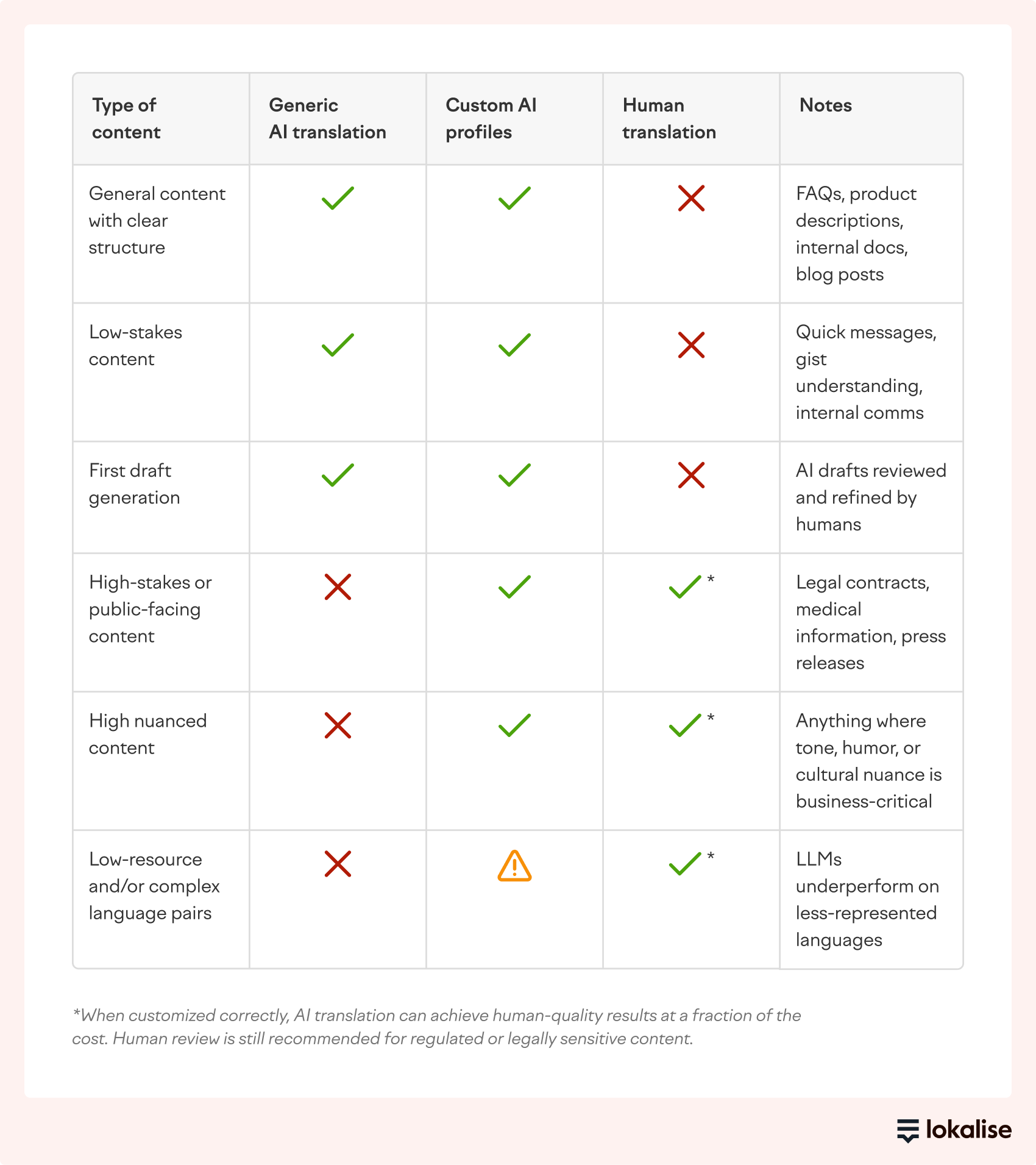
AI translation has come a long way. For ad-hoc requests and general content, it's often more than good enough. But output can still feel generic and unmistakably machine-made; missing the brand voice, the cultural nuance, and the regulatory precision that enterprise businesses can't afford to get wrong. A localization workflow delivering both speed and quality is built on a human-in-the-loop model, where AI handles volume and human review handles judgment. But the quality of that AI output depends entirely on what context you give it.
This is where Custom AI Profiles change the equation. Rather than generating output from general training data alone, it draws on your own translation memory and past approved translations as context — a process called retrieval-augmented generation (RAG). The model follows your established phrasing, terminology, and tone, not a generic approximation of them. For enterprise teams, regulated industries, or anyone where brand consistency isn't optional, this is what separates usable AI output from output that requires significant rework before it can be published.
Humans belong in the loop for brand-defining moments, compliance-sensitive content, and final strategy decisions, not for every line of translated copy. A tiered approach to content treatment looks like this:
Three things make this human-in-the-loop model work at scale:
Custom AI Profiles configure the AI to translate in your voice, not a generic one. The output reflects your brand's established terminology and tone from the first pass, reducing the rework that makes AI translation costly in practice.
Translation scoring reviews your content against the localization industry standard. We recommend that anything scored above 80 can be approved or lightly edited. Anything below gets flagged for human attention. You can focus review time and budget where it actually matters, reducing post-editing effort by up to 80%.
Deep integrations mean localization happens inside your existing workflow. Content updates in platforms like Webflow, HubSpot, Figma, or GitHub flow automatically into the translation pipeline and return ready to publish, without manual exports.
FAQs
What is answer engine optimization (AEO)?
AEO is the practice of structuring your digital content so that AI-powered answer engines — including ChatGPT, Perplexity, Google's AI Overview, and Gemini — cite your brand as their source when answering relevant queries. Unlike traditional SEO, which aims to rank on a results page, AEO aims to be the single answer an AI constructs on behalf of the user.
Why do AI engines prefer native-language content?
AI answer engines use the language of the user's query as a primary relevance signal. When a user searches in French, the model looks for French-language sources to anchor its answer. Research from Amazon AGI confirms this: English-only content leaves AI systems unable to satisfactorily answer between 44% and 56% of non-English queries across Germany, Japan, and Spain.
What is multilingual AEO?
Multilingual AEO is the practice of building AEO-optimized content in multiple languages so your brand earns AI citations across markets, not just in English. It requires high-quality, culturally relevant, structurally sound content in each target language — not machine-translated versions of English pages.
How is AEO different from SEO?
SEO focuses on ranking content on a search results page by targeting keywords and building domain authority. AEO focuses on becoming the source an AI engine cites when constructing a response. AEO rewards factual accuracy, content structure, freshness, and linguistic relevance over keyword density and backlinks.
How do I get my brand cited in AI search results?
Four controllable signals determine whether AI engines cite your brand: the language of the user's prompt, the system language of their device, explicit local context within your content, and personalized AEO signals. All four require high-quality, native-language content to activate. Structuring content with clear headings, FAQ sections, schema markup, and regular updates further improves citation rates.
Conclusion
The shift from search to answer engines has already happened. The language bias inside those systems is real and well-documented. Most brands are still treating localization as a translation task rather than an AEO infrastructure decision.
That gap won't last. The brands building multilingual, structured, citable content across their key markets now will own ground that will cost significantly more time and budget to win back in two years' time. Most of your competitors haven't started yet. That's the opportunity. It's concrete, it's measurable, and it's available right now.
Key takeaways
AI answer engines have a structural language bias. English-only content is invisible to 74.7% of the world's internet users in AI search.
There are four controllable AEO signals that determine whether your brand gets cited. All require quality localized content to activate. Multilingual AEO is the most underexplored opportunity in digital marketing right now. Most brands haven't started.
The AND framework is the model for compounding international growth. Not OR. AND. Validate before you invest. Five to ten percent of budget spent on English-language signal testing can tell you whether a market is worth localizing for, before you commit to full localization.
Measure outcomes, not activities. Conversion parity and pipeline velocity tell you whether your localization is working. Speed-to-market doesn't.
The 90% accuracy threshold is where AI localization changes the economics. Getting there requires the right context: a style guide, brand glossary, and translation memory working together.
Hello! I'm a Senior SEO Specialist and strategic consultant with years of experience focused on scaling global organic growth for high-growth tech companies. My expertise lies in blending technical SEO proficiency with advanced content strategy, ensuring marketing initiatives meet stringent engineering and data quality standards.
My career has centered on the Berlin tech scene where I drove millions of monthly users to global platforms. My experience includes working in-house for major scale-ups and startups, such as N26, JustWatch, and currently Lokalise, where I focus on transforming performance through data-driven decisions.
My specialty is in the technical and strategic application of SEO:
Global Technical SEO: Auditing and optimizing complex architectures (including headless CMS migrations and multi-region sites).
AEO/GEO Strategy: Driving organic traffic through optimization for the new AI search ecosystem (AI Overviews and LLMs).
My authority is built on tangible, cross-industry experience:
Consulting & Audits: I have acted as a strategic consultant, successfully auditing and advising complex sites in the finance, healthcare, e-commerce and media demonstrating ability to apply SEO excellence across diverse regulated sectors.
Data-Driven Focus: Holding a background in marketing, I combines commercial strategy with deep analytical rigor, making me adept at transforming raw data into measurable business growth and ROI.
Core Focus at Lokalise: I drive organic traffic and conversion quality, ensuring global content meets the highest standards of technical SEO and AI Search visibility.
Hello! I'm a Senior SEO Specialist and strategic consultant with years of experience focused on scaling global organic growth for high-growth tech companies. My expertise lies in blending technical SEO proficiency with advanced content strategy, ensuring marketing initiatives meet stringent engineering and data quality standards.
My career has centered on the Berlin tech scene where I drove millions of monthly users to global platforms. My experience includes working in-house for major scale-ups and startups, such as N26, JustWatch, and currently Lokalise, where I focus on transforming performance through data-driven decisions.
My specialty is in the technical and strategic application of SEO:
Global Technical SEO: Auditing and optimizing complex architectures (including headless CMS migrations and multi-region sites).
AEO/GEO Strategy: Driving organic traffic through optimization for the new AI search ecosystem (AI Overviews and LLMs).
My authority is built on tangible, cross-industry experience:
Consulting & Audits: I have acted as a strategic consultant, successfully auditing and advising complex sites in the finance, healthcare, e-commerce and media demonstrating ability to apply SEO excellence across diverse regulated sectors.
Data-Driven Focus: Holding a background in marketing, I combines commercial strategy with deep analytical rigor, making me adept at transforming raw data into measurable business growth and ROI.
Core Focus at Lokalise: I drive organic traffic and conversion quality, ensuring global content meets the highest standards of technical SEO and AI Search visibility.
Localization for GEO/AEO: The step-by-step guide to winning AI Overviews internationally
SEO is not dead, but traditional SEO is. While traditional SEO meant (gulp, already talking in past tense) ranking in the top 10 blue links and competing for the number one spot on the SERP, the new rules of search mean optimizing for Generative Search (GEO), also known as AI engine optimization (AEO). Users are no longer looking to click. Th
If you want your content to rank globally, direct translation won’t get you far. But SEO localization will. Provided you do it well. Localizing your SEO efforts comes down to adapting your website and content so they feel natural to local audiences and meet search engine rules in each market. That means using the right keywords, respecting the cultural context, and writing in a way that people actually search for. The challenge is knowing how to turn these principles into so
How to Win Organic Visibility with SEO Translation
You’ve meticulously translated your content into French, Spanish, and Arabic. But traffic is still flatlining across all these markets. Why? Because your website is practically invisible to search engines. The problem? You’re translating content only for linguistic and cultural accuracy, not for search engines. SEO translation modifies your content based on how people search and what search engines prefer in a local market. It maintains linguistic accuracy and cultural conte