Global expansion is back on the table for 2026. But many teams are moving into new markets faster than their localization strategy can keep up.
To see how companies are actually preparing for international growth, Lokalise surveyed 500 global business leaders. What we found was a gap between intention and execution, especially around translation quality, regional investment, and budget priorities.
For product, marketing, and growth leaders, the takeaway is straightforward: localization isn't just a supporting function anymore. It directly shapes revenue, speed to market, and your success in entering and staying in new markets.
Key takeaways
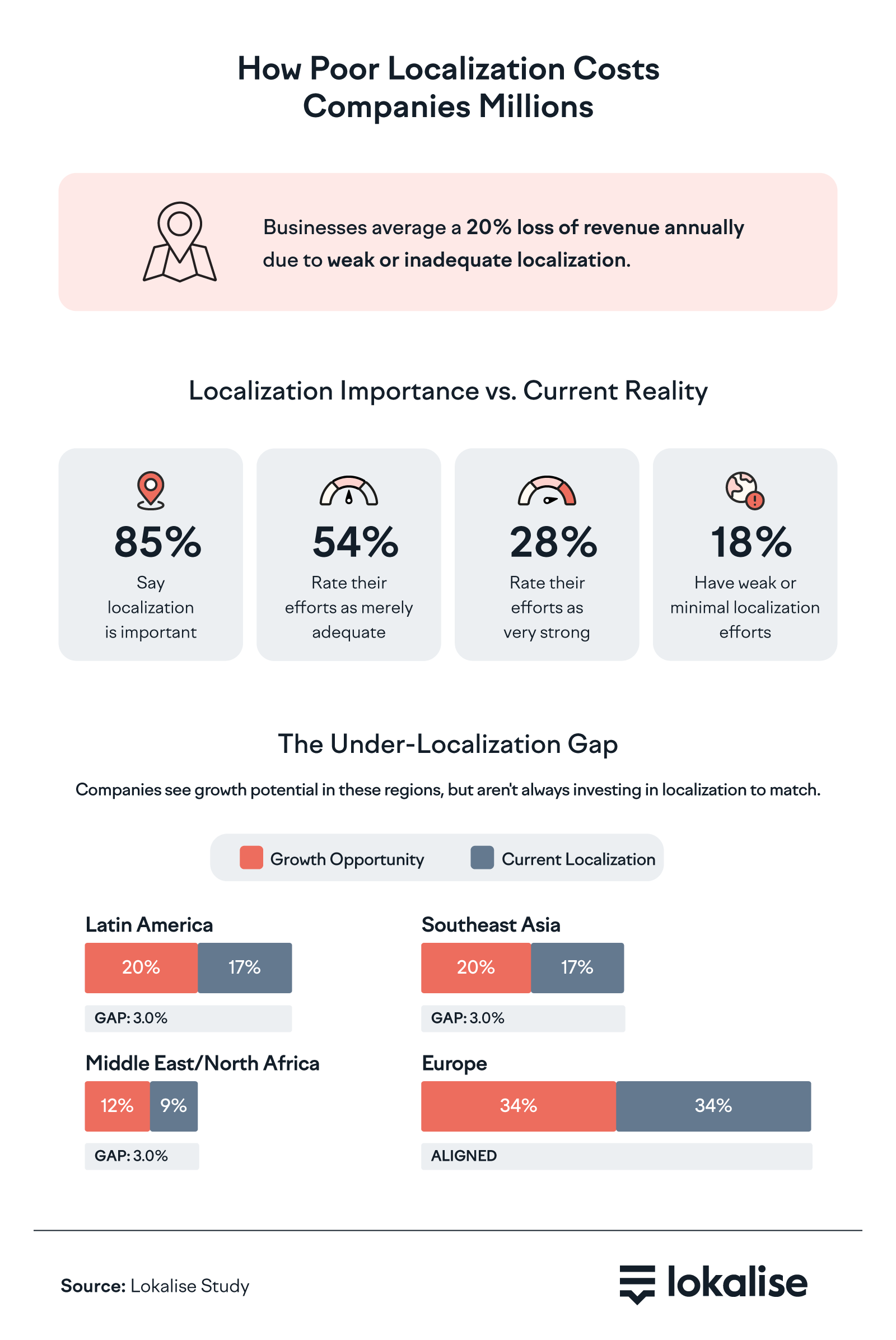
Poor localization costs global businesses 20% of potential revenue annually.
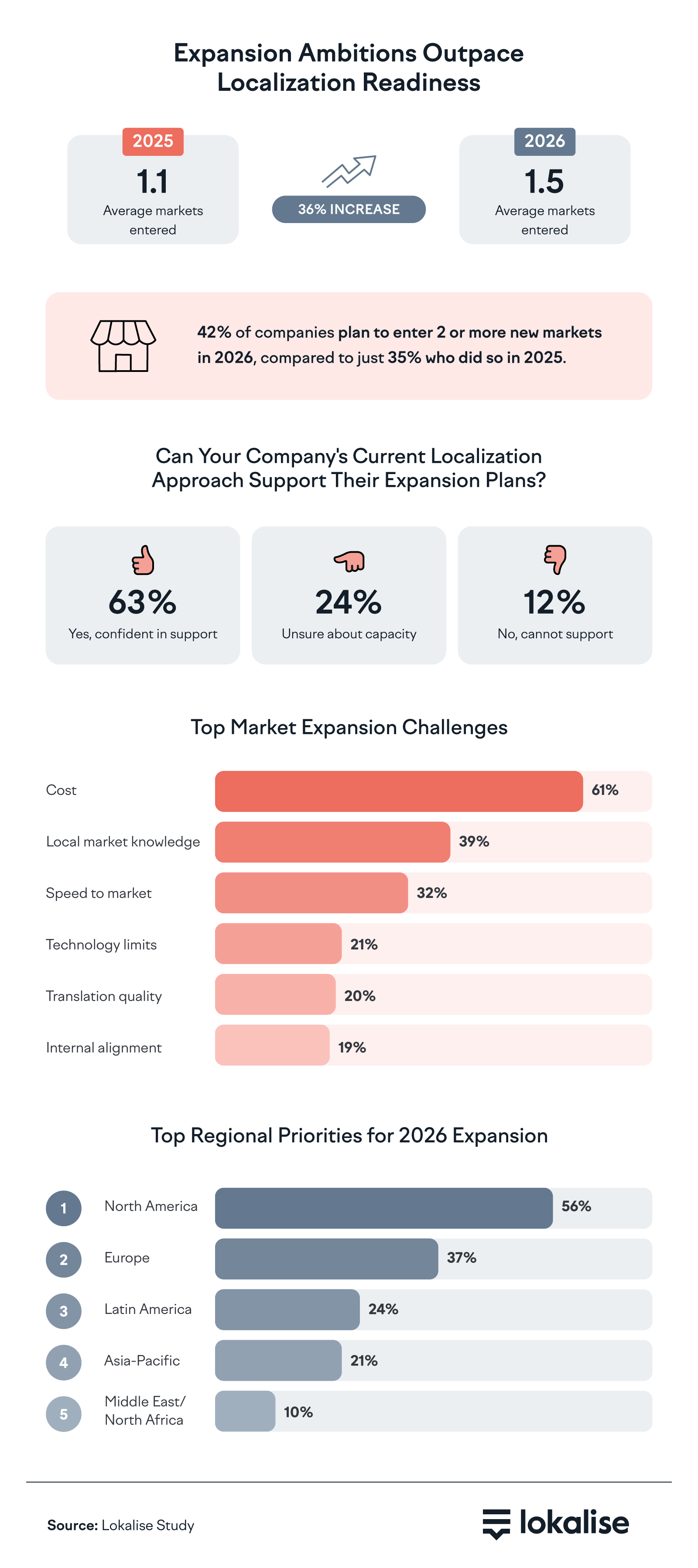
Companies plan to accelerate global expansion by 36% in 2026 (rising from 1.1 to 1.5 market expansions, on average), with 42% planning to enter 2 or more new markets.
36% of companies have delayed or pulled back from market entry due to localization challenges.
Latin America, Southeast Asia, and the Middle East/North Africa are under-localized despite companies seeing growth potential in these markets.
63% of companies now use AI-powered translation in some capacity, but accuracy concerns persist for more than half (53%).
Cost barriers prevent 61% of companies from expanding internationally.
47% would prioritize expanding into new markets if their localization budget doubled.
The localization revenue gap
Many leaders agree that localization matters. Far fewer feel they're doing it exceptionally well.
On average, poor localization costs businesses 20% of potential revenue. And while 85% of leaders say localization is important, only 28% describe their efforts as "very strong." That disconnect signals a real opportunity left on the table.
The mismatch shows up at the regional level, too. Latin America and Southeast Asia both showed 20% growth potential, yet each received just 17% of localization effort. The Middle East and North Africa saw a similar underinvestment gap (3%).
Companies see opportunity, but their localization investments don't always follow. Europe was the exception, where growth opportunity and localization investment were evenly matched at 34%.
Global growth plans vs. reality
Expansion ambitions are accelerating in 2026. But confidence in localization readiness is not universal.
Companies entered an average of 1.1 new markets in 2025 and plan to increase that to 1.5 markets in 2026, a 36% increase. Additionally, 42% plan to enter two or more new markets in 2026.
However, while 63% felt confident their localization could support those plans, 24% were unsure, and 12% were not confident at all.
Cost emerged as the biggest barrier, cited by 61% of respondents. Other major challenges included understanding local markets (39%) and speed to market (32%). Over a third of companies (36%) had already delayed or pulled back from entering a market due to localization challenges.
Budget flexibility could significantly shift priorities for many companies. If localization budgets doubled:
47% would prioritize expanding into new markets.
24% would invest in deeper cultural nuance and local partnerships.
24% would upgrade from AI-only approaches to hybrid models combining AI with human review.
When it comes to target regions, North America (56%) and Europe (37%) remained top priorities. Latin America followed at 24%, reinforcing the earlier finding that high-growth regions are not always matched with proportional localization investment.
AI adoption is accelerating, and quality is catching up
AI-powered translation has moved into the mainstream. As teams look to scale faster and enter new markets efficiently, AI is becoming a core part of modern localization strategies.
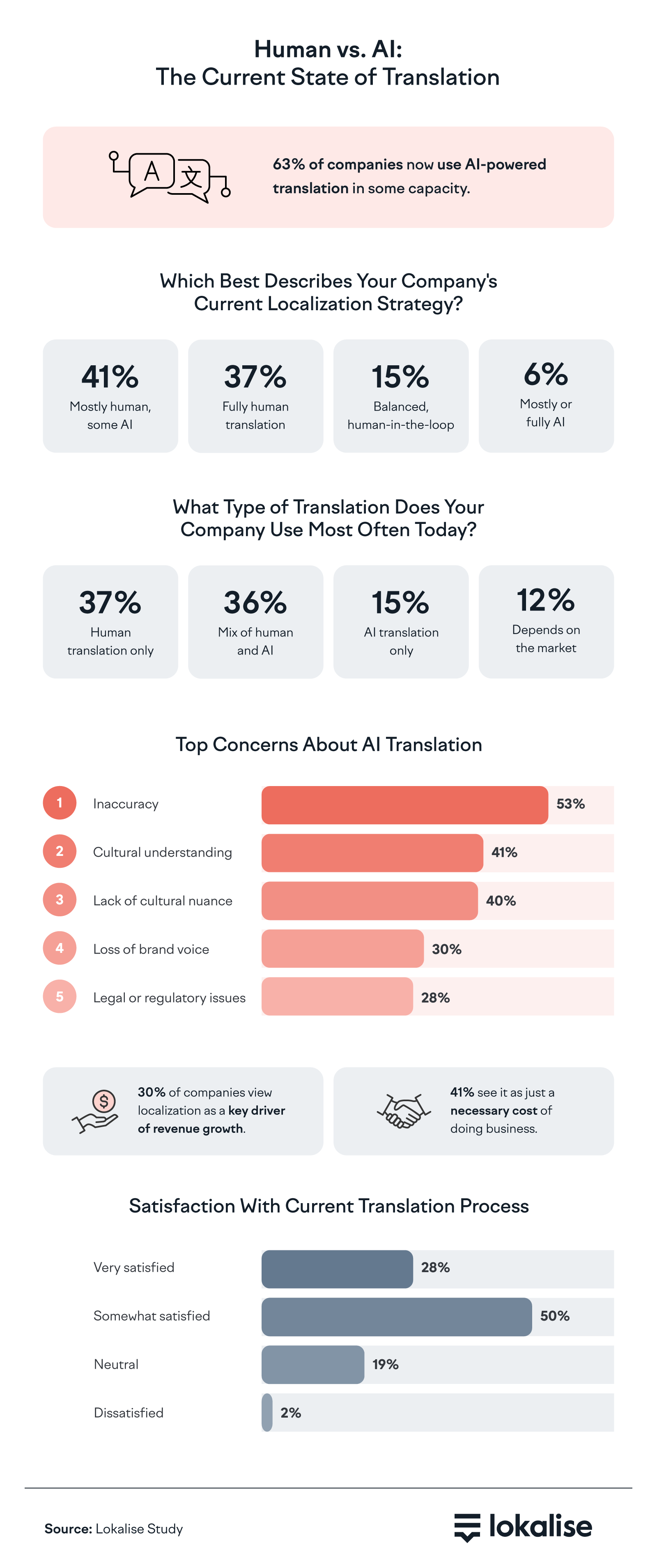
AI-powered translation was used by 63% of companies, with 36% using a mix of human and AI translation, 15% using AI only, and 12% saying use depends on the market. While adoption rates are high, some business leaders have concerns about using AI for translation, including:
Inaccuracy: 53%
Cultural understanding: 41%
Lack of cultural nuance: 40%
Loss of brand voice: 30%
Legal or regulatory issues: 28%
Despite these concerns, 78% reported being very or somewhat satisfied with their current translation process, suggesting that real-world results are often stronger than initial hesitation might imply. At the same time, strategic perception still varies: while 30% viewed localization as a revenue driver, 41% still saw it primarily as a cost.
Many companies relied on a mix of human and AI workflows for localization strategies. Just 37% used fully human localization strategies, while others used:
Mostly human localization with some AI support: 41%
A balanced 50/50 human-AI approach: 15%
Mostly or fully AI setups: 6%
The shift reflects growing confidence in AI's ability to meet quality expectations, especially when paired with the right safeguards and brand context. Modern AI translation solutions are also becoming more specialized. For example, Lokalise Custom AI Profiles generate translations tailored to a company's brand by leveraging Retrieval-Augmented Generation (RAG).
Instead of relying solely on general training data, the system pulls from past translations, terminology databases, and style guides to inform each new string. In enterprise studies, up to 95% of translations generated using Custom AI Profiles were publish-ready, demonstrating that AI quality can rival traditional human workflows when properly configured.
Closing the gap between ambition and execution
Global expansion plans are accelerating, but localization strategies are not always keeping pace. When there's a gap between ambition and execution, revenue and momentum are often the first to suffer. Treating localization as a core part of growth planning, not a last-minute step, can make all the difference.
The companies that close the revenue gap are the ones that align budget, tools, and regional investment with real opportunity. Now is the time for you and your team to evaluate whether your localization strategy is built to support the markets you want to win.
Methodology
This study is based on an online survey of 500 global business leaders conducted in February 2026. Respondents include C-level executives, vice presidents, and directors with decision-making authority over localization and international expansion strategies. Company representation spans small businesses with 1-50 employees (32%), mid-size companies with 51-500 employees (36%), and large enterprises with 501+ employees (32%).
By role, respondents include senior leaders (69%), directors of product marketing (13%), VPs of growth (5%), CMOs/VPs of marketing (4%), chief revenue officers (4%), heads of localization (2%), and VPs/directors of international marketing (2%). The sample comprises 86% North American companies, 11% European companies, 2% Asia-Pacific companies, and 1% Middle East/North African companies.
About Lokalise
Lokalise makes it refreshingly intuitive to adapt content for every market and language. As an AI-powered localization platform backed by human expertise, Lokalise is trusted by Fortune 500 companies and fast-growing startups worldwide. It removes the trade-off between enterprise-grade power and everyday usability by connecting your entire content ecosystem, translating in your brand voice, and activating every market continuously and at scale. For companies expanding globally, Lokalise transforms translation from an operational task into a strategic growth advantage.
Fair use statement
We encourage journalists and content creators to use our data and graphics, with a link back to Lokalise. For full access to the data set or to interview a Lokalise expert, please contact kip@frac.tl or nicole.franco@frac.tl.
With a background in brand and revenue marketing, Brittany helps global companies scale localization efforts that not only meet quality standards but also drive real business results.
With a background in brand and revenue marketing, Brittany helps global companies scale localization efforts that not only meet quality standards but also drive real business results.
Measuring the return on investment (ROI) of localization
There are numerous benefits of localization. But you still have to determine the impact of localization to your business to get the project approval from the various stakeholders. In this article, we'll cover how to estimate and measure the Return on Investment (ROI) of a localization project and how eff
Stolen Evenings: The True Cost of Business Demands on Our Families
At Lokalise, we wanted to explore a question that resonates with nearly every modern professional: How much personal time are we sacrificing because of inefficient workflows? We also wondered how much people could get back by using AI-powered tools at work. To find out, we surveyed 1,001 full-time employees working in highly technical roles across the U.S. and Europe. From developers and data scientists to product managers and designers, respondents shared candid insights about their wo
How to deliver global digital experiences while keeping costs in check
Global expansion brings massive opportunity and equally massive complexity. Content piles up across teams. Translation costs climb. Delivery slows. It’s no wonder that many localization programs stall before they scale. But some companies are doing it differently. They're building smarter systems upfront, using automation and AI where it matters, and focusing their efforts on what actually moves the needle.