You're optimizing for AI search. But are you doing it in every language that matters? We surveyed 1,000 global marketing, SEO, and localization leaders and found that brands investing in localized content are already seeing stronger AI search visibility. Meanwhile, companies that haven't started optimizing say budget is the biggest thing holding them back. Here's what the data shows.
Key takeaways
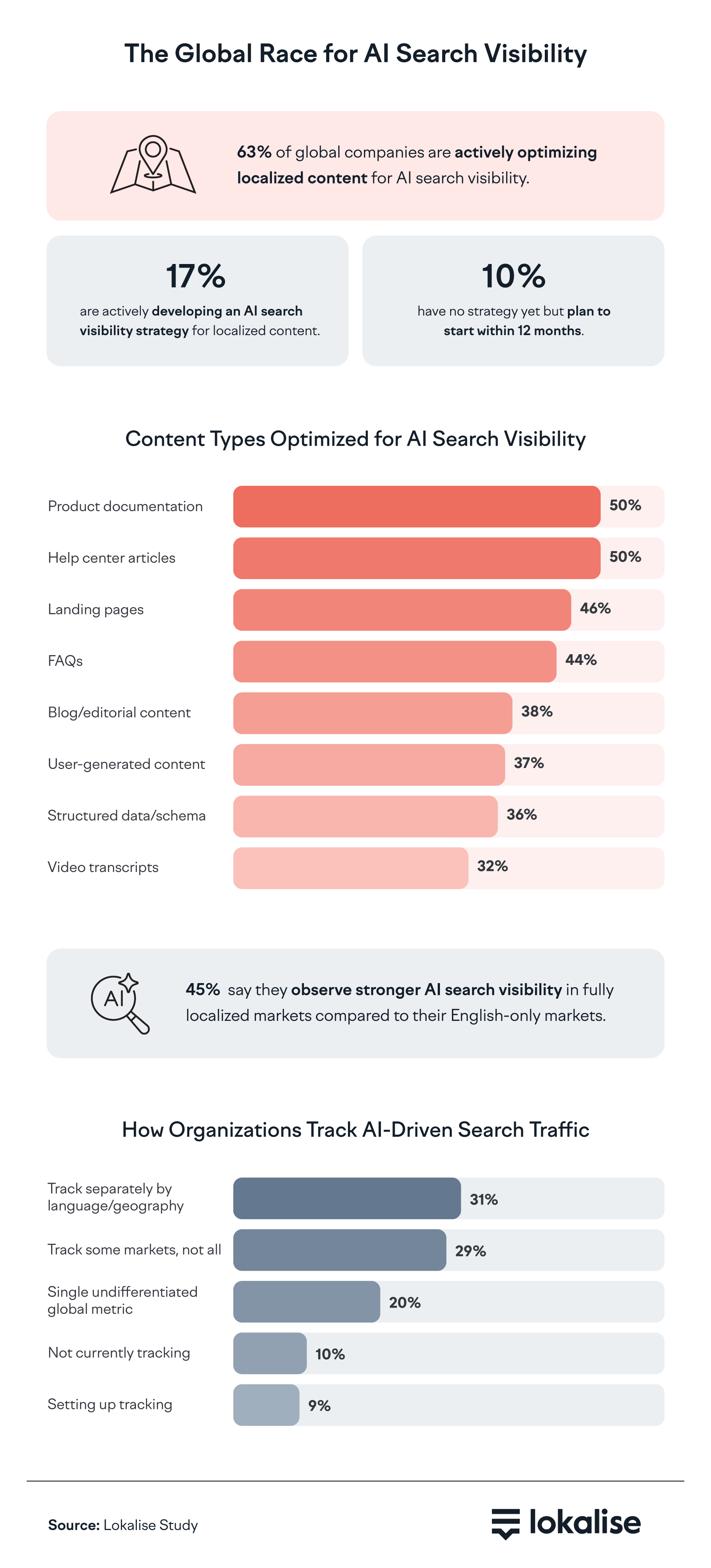
63% of global companies are optimizing their localized content for AI search visibility.
45% say they see stronger AI search visibility in fully localized markets than in their English-only regions.
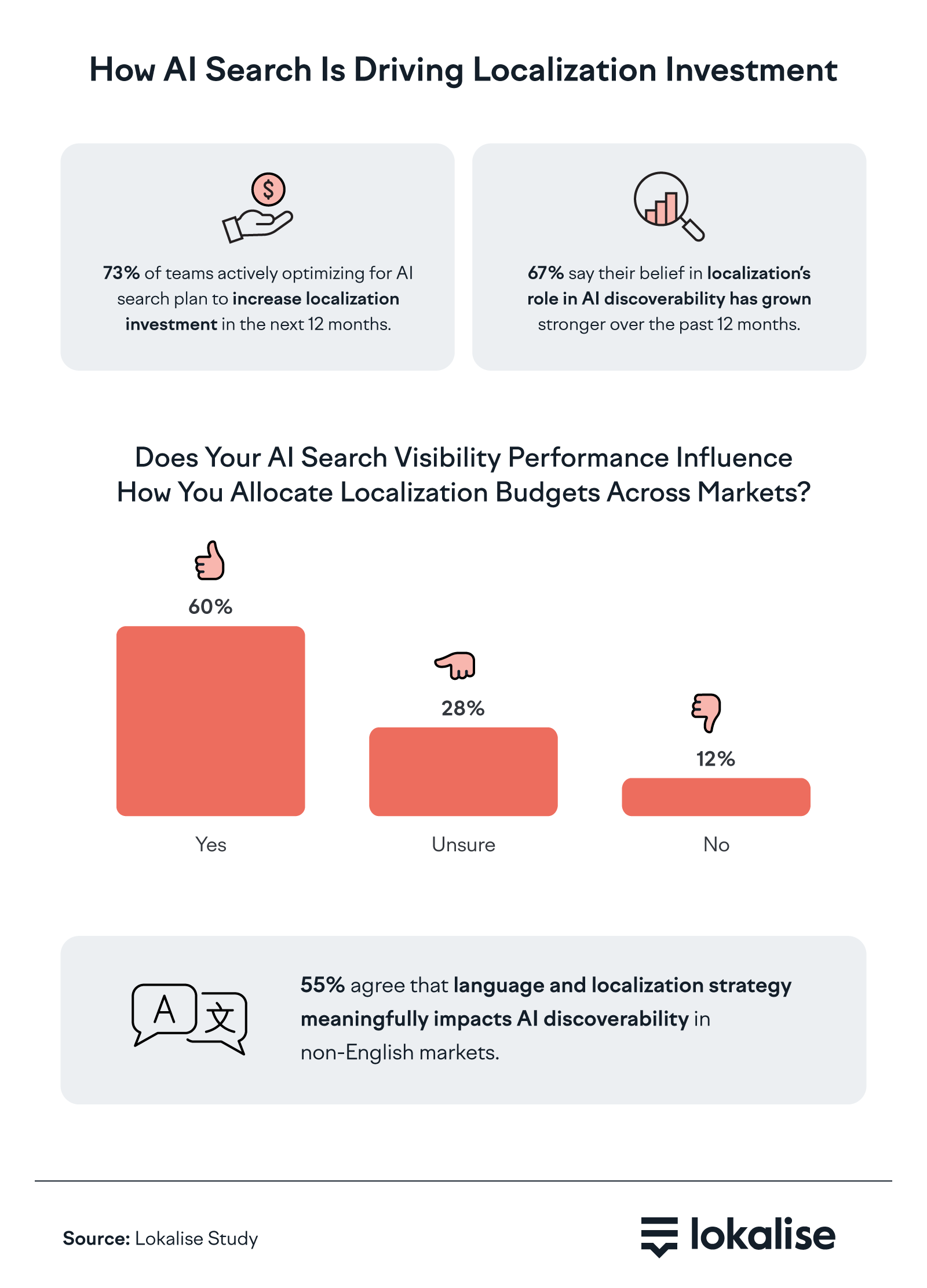
Among companies actively optimizing for AI search, 73% plan to increase their localization investment in the next 12 months.
For those not yet fully optimizing, insufficient budget (38%) is the biggest barrier standing in the way.
Localization is becoming a core driver of AI search visibility
Nearly two-thirds of global companies (63%) are optimizing their localized content for AI search, meaning they're tailoring multilingual content to surface in AI-generated answers and recommendations.
45% of global companies report better AI search visibility in fully localized markets than in their English-only regions. This suggests that multilingual content may give brands an edge in how often they surface in AI-generated results.
43% of global marketing teams saw a positive impact from Google's March 2026 Spam Update, while just 5% experienced a negative one. Another 41% noticed no change, and 11% were unsure or didn't track it.
When asked which languages or markets their brand appears in most often in AI-generated answers or recommendations, the top 5 were:
English (97%)
Spanish (24%)
French (17%)
Chinese (11%)
German (11%)
Companies that are not yet optimizing but plan to start within the next 12 months are far more likely to believe they're already losing AI search visibility (37%) than those with no plans at all (20%).
Investment in localization is rising, but barriers remain
Among companies already optimizing for AI search, nearly 3 in 4 plan to increase their localization spend within the next 12 months.
For those not yet optimizing localized content for AI search visibility, their top barriers are:
Insufficient budget (38%)
Lack of in-house talent or specialized expertise (32%)
Unclear or unproven ROI (31%)
Competing organizational priorities (24%)
Difficulty measuring by language/market (20%)
Inadequate tools or technology (17%)
Lack of leadership buy-in (16%)
Insufficient content volume in target languages (12%)
Methodology
We surveyed 1,000 global marketing, SEO, and localization decision-makers across the United States (59%), the United Kingdom (10%), Canada (10%), Australia (10%), and South Africa (10%) about their strategies for optimizing localized content for AI search visibility, their localization investment decisions, and their views on how language strategy impacts AI discoverability. Job functions included IT, marketing, product management, SEO/search, and content/localization. Data was collected in March 2026.
About Lokalise
Lokalise makes it refreshingly intuitive to adapt content for every market and language. As an AI-powered localization platform backed by human expertise, Lokalise is trusted by Fortune 500 companies and fast-growing startups worldwide.
It removes the trade-off between enterprise-grade power and everyday usability by connecting your entire content ecosystem, translating in your brand voice, and activating every market continuously and at scale.
For companies expanding globally, Lokalise transforms translation from an operational task into a strategic growth advantage.
Fair use statement
We encourage journalists and content creators to use our data and graphics, with a link back to Lokalise. For full access to the data set or to interview a Lokalise expert, please contact kip@frac.tl or nicole.franco@frac.tl.
With a background in brand and revenue marketing, Brittany helps global companies scale localization efforts that not only meet quality standards but also drive real business results.
With a background in brand and revenue marketing, Brittany helps global companies scale localization efforts that not only meet quality standards but also drive real business results.
Libraries and frameworks to translate JavaScript apps
In our previous discussions, we explored localization strategies for backend frameworks like Rails and Phoenix. Today, we shift our focus to the front-end and talk about JavaScript translation and localization. The landscape here is packed with options, which makes many developers a
Character encoding: Types, UTF-8, Unicode, and more explained
In this article, we’ll explore various types of character encoding used in the world of information technology. We’ll break down why encoding matters, explain how they function, and highlight the key differences between ASCII, UTF-8, UTF-16, and the Unicode Standard. Understanding these differences is essential for correctly handling text in any software application, especially when working with localized time and date formats that rely on proper ch
9 types of translation and how to choose the right approach
A one-size-fits-all approach to translation doesn't work anymore. A checkout flow requires a different translation than a help article. Marketing copy needs a different treatment than technical documentation. And legal contracts call for different expertise than software UI. Yet most teams tend to default to the same translation workflow for everything. Or worse, they cycle through different providers trying to find one that handles all content types well. Neither approach works.<