AI translation post-editing tools promise 40-60% cost savings. In practice, you only get those savings when AI output is controlled. This means your terminology is enforced, risky segments are flagged before they go live, and linguists only touch what truly needs human attention.
That’s why the best MTPE tools today aren’t standalone CAT tools or MT engines. They’re actually translation management systems (TMS) that orchestrate AI, terminology, and quality assurance in one place.
In this guide, we’ll look at the best AI translation post-editing tools. These TMS platforms promise to reduce post-editing effort with smart pre-translation, in-editor MTPE features, automated QA, and clear controls over cost and quality.
❓ Why read this guide
Our goal is to help you decide which setup will actually deliver the MTPE savings your forecasts rely on. By the end, you should be able to shortlist tools based on your own volumes, risk tolerance, and quality expectations instead of marketing promises.
What is MTPE?
MTPE (Machine Translation Post-Editing) is the process of reviewing and improving machine-generated translations so they are accurate, natural, and aligned with your brand’s tone and terminology.
Instead of translating from scratch, a machine produces a first draft. A human linguist then refines it. They fix errors, improve phrasing, and make sure the meaning and context are fully preserved.
There are two common levels:
Light post-editing: focuses on basic clarity and correctness
Full post-editing: brings the text to a publish-ready, native-level quality
MTPE is used to balance speed and quality, helping teams scale translation while still delivering content that feels clear, consistent, and reliable.
1. Lokalise: Best AI translation post-editing tool for orchestrating quality and cost
Lokalise is a translation management system built around AI orchestration, meaning that it works beyond just raw machine translation.
Instead of locking you into a single engine, Lokalise routes content through multiple MT and AI providers. It then scores the output for context and accuracy, and layers in your translation memories, glossaries, and style guides before a linguist ever sees the text.
As a result, most of your strings are already close to “just right,” and post-editing becomes a targeted task instead of a full rewrite.
From an MTPE point of view, Lokalise is designed to reduce post-editing effort and cost thanks to:
Workflows can auto-approve high-scoring strings while routing only low-scoring ones to human reviewers
In practice, customers see the majority of AI suggestions accepted as-is or with light edits, which is how you get closer to the 40-60% MTPE savings.
🧠 Good to know
Machine translation post-editing often involves sensitive content, so security isn’t optional. Lokalise has you covered with SOC 2 Type II and ISO 27001/27017 certification, EU-hosted data on ISO 27001-certified AWS infrastructure, and encryption in transit and at rest.
In practice, that means you can scale MTPE without spinning up a separate project just to manage data protection.
Key MTPE features in Lokalise
AI translation post-editing, orchestrated: Multiple AI and MT engines, enriched with your TM, glossary, and style guide, so linguists start from higher-quality drafts instead of raw MT.
MTPE quality assurance, built in: AI-powered translation scoring in the editor, MQM-based quality checks, plus classic QA for placeholders, numbers, tags, and terminology to catch issues before they ship.
In-editor MTPE features your team will actually use: Side-by-side editor with AI/TM suggestions, term hints, comments, and (where available) visual context, so reviewers can fix issues in seconds instead of hunting through files.
Enterprise pricing is available on request. All plans come with a 14-day free trial and include different quotas of processed/AI words, seats, and automations, so you can scale cost based on volume and complexity rather than users.
2. Smartling: Good AI translation post-editing tool for governed AI workflows
Smartling positions itself as an AI-powered translation platform, not just a traditional TMS.
For machine translation post-editing, its LanguageAI and AI-Powered Human Translation (AIHT) workflows use MT and AI to do the first pass, then you can bring human linguists in where it matters most.
The idea is to have MT and AI handle volume, and then Smartling to layer on your translation memory and glossary, and professional translators post-edit to bring output up to brand and accuracy standards.
From an MTPE perspective, Smartling is designed to cut post-editing effort while keeping quality measurable. AIHT leverages your linguistic assets and MT engines, then routes content to expert linguists.
Smartling also invests heavily in MTPE quality assurance. You can define MQM-compatible schemas with error categories and severities, sample content for review, and track quality trends over time.
Key MTPE features in Smartling
AI-powered MTPE and AIHT workflows: MT and AI generate the first draft, Smartling applies your TM and glossary, and professional linguists post-edit
Edit-effort estimation for MT output: A large language model scores MT segments against criteria like grammar, fluency, coherence, and lexical accuracy, plus checks against your linguistic assets
LQA suite for structured quality assurance: MQM-compatible LQA schemas, error categories, sampling workflows, and reporting help teams evaluate MTPE quality systematically instead of relying on anecdotal feedback.
Smartling pricing
Smartling doesn’t have publicly available flat SaaS subscription prices for its core and enterprise plans.
On top of that, translation services are billed per word, with public references to MT from about $0.0075/word, AI Translation from $0.06/word, and AI Human Translation from $0.12/word, so your MTPE cost depends heavily on volumes and service mix.
3. XTM Cloud: Good AI translation post-editing tool for predictive quality scoring
XTM Cloud is an enterprise TMS that treats AI and machine translation as core workflow components. It connects to multiple MT providers including Microsoft Translator, Google Translate, DeepL, and SYSTRAN, and also supports custom MT models via API.
This lets you match different engines to different language pairs and content types instead of forcing a single MT provider across your entire portfolio. XTM’s AI translation features sit on top of your translation memories and terminology, so drafts are pre-translated in a way that already reflects your preferred wording and style, reducing the amount of manual post-editing required.
🧠 Good to know
For AI translation post-editing, the standout capability is XTM Intelligent Score. This feature uses large language models and an MQM-based framework to evaluate translations (including MT) at segment and document level, looking at factors like fluency, accuracy, terminology use, and consistency with approved translations. It then assigns a confidence score that can drive workflow decisions.
XTM features like Language Quality Evaluation (LQE) and Language Guard use AI to detect issues such as harmful or biased language and terminology inconsistencies before or alongside human review. Together, these capabilities turn MTPE quality assurance into a structured, repeatable practice rather than ad-hoc spot checking.
Key MTPE features in XTM Cloud
Multi-engine AI translation hub: Connects to major MT engines (Microsoft, Google, DeepL, SYSTRAN) and custom models, with flexible configuration by language pair and content type
Intelligent Score for predictive quality: Uses LLMs and MQM-style criteria to score segments and documents on fluency, accuracy, and terminology use, then surfaces low-confidence content for human post-editing while allowing high-confidence content to move through with lighter checks
LQA and AI-enhanced QA checks: MQM-based LQA, integrated quality scoring, and AI checks (including harmful or biased language detection and terminology consistency) provide a structured MTPE quality assurance layer at scale
XTM Cloud pricing
XTM Cloud is positioned as an enterprise TMS with fewer, higher-priced tiers:
Team plan starts at roughly $16,500 per year (about $1,375/month) for up to 2 million processed words, unlimited users, and one connector
Business and Enterprise tiers scale word allowances, hosting options, connectors, and AI packs
There’s also a 30-day free trial so you can test workflows and AI features before committing.
4. Smartcat: Top AI translation post-editing tool for on-demand human review
Smartcat is an AI-powered translation platform with a built-in marketplace of linguists, rather than just a standalone CAT tool. It combines high-quality AI translation, translation memories, and glossaries with collaborative editing and workflow automation in a browser-based editor.
That means you can use AI translation to pre-translate at scale, then bring in human post-editors directly from the platform’s marketplace when and where you need them.
For AI translation post-editing, Smartcat leans into a hybrid AI + human model. Its MT post-editing offering is positioned as “AI translation post editing solutions” that combine AI translation with linguists from the Smartcat Marketplace.
You can run AI translation first, then click “Get professional review” to match the project with suitable linguists for post-editing, which makes it easier to scale MTPE without managing separate vendor contracts.
Inside the editor, Smartcat focuses on reducing post-editing effort and tightening QA:
Automated quality assurance checks run while translators work, flagging issues in spelling, punctuation, terminology, formatting, consistency, and even mismatches with the translation memory
AI Actions add another layer: with one click, linguists can rephrase, shorten, translate with GPT, fix punctuation, or fix grammar for a segment (on higher plans, it’s also possible to create custom prompts)
Key MTPE features in Smartcat
Hybrid AI translation + marketplace post-editing: AI translation for the first draft, then instant access to linguists from the Smartcat Marketplace
In-editor MTPE helpers and automated QA: MT/TM suggestions, glossaries, and automated QA checks for spelling, punctuation, terminology, formatting, and consistency while translators work in the editor
AI Actions to speed up post-editing: One-click AI actions (rephrase, shorten, translate with GPT, fix punctuation, fix grammar) plus custom prompts on higher plans make it faster to refine AI output into publish-ready text
Smartcat pricing
Smartcat combines a forever-free plan with paid subscriptions and usage-based “Smartwords.”
Their Basic plan is priced at $1,200/year. The key cost lever is how many “Smartwords” (AI words) you need and whether you tap into the marketplace for external linguists.
Enterprise pricing is available upon request.
5. Phrase: Good AI translation post-editing tool for MT quality estimation
Phrase is a cloud TMS that leans heavily into AI quality estimation to make machine translation post-editing more efficient.
Instead of treating all MT output the same, Phrase scores each translation with its Quality Performance Score (QPS), an AI quality estimation system trained on MQM-style human annotations. It takes source + target and predicts the MQM score a human reviewer would likely give, then expresses it as a 0-100 score per segment.
For AI translation post-editing, this matters because you can use QPS to decide where to spend human effort. For example, low-scoring, high-risk segments go to linguists for full post-editing, while high-scoring segments can get light edits or spot checks.
Phrase Language AI also acts as an MT hub, letting you plug in 30+ MT engines and LLMs and then use MT Autoselect to pick the best engine for each language pair and domain, instead of locking into a single provider.
Key MTPE features in Phrase
AI quality estimation for MT output: Phrase QPS scores every translation (MT or human) on a 0-100 scale based on MQM-style criteria, so you can quickly identify which strings need heavy post-editing and which are likely safe with light review.
Multi-engine AI translation management: Phrase Language AI connects to 30+ MT and LLM engines and uses MT Autoselect to automatically choose the best engine for a given language pair and domain.
In-editor MTPE quality assurance: Built-in QA checks catch terminology violations, tag issues, spelling errors, and formatting problems directly in the editor.
Phrase pricing
Phrase uses a mixed model with individual and team plans. For you, the team plans probably make the most sense:
Starter at $135/month
Team at $1,045/month
Business at $4,395/month
Enterprise pricing is available on request. Pricing is largely driven by volume and features, so larger teams pay for higher product volumes and advanced analytics/LQA.
Compare the best AI translation post-editing tools in a single view
Some AI translation post-editing tools are built to orchestrate MT, terminology, and QA inside a TMS. Others focus on predictive quality scoring or on-demand human review.
The table below gives you a single view of how the top AI translation post-editing tools stack up on MTPE strengths, quality assurance, and in-editor experience. This is how you can quickly see which setup fits the way your team works.
Tool
Tool type & AI focus
AI translation post-editing strengths
MTPE quality assurance
In-editor MTPE features
Pricing
Lokalise
TMS with AI orchestration (MT/LLMs + TM + terminology)
AI pre-translation enriched with TM + glossary to cut rework and MTPE effort
QA checks for tags, numbers, terminology + AI scoring for risky segments
Web editor with MT/AI/TM suggestions, term hints, context, MTPE steps
Free plan, then paid tiers: Explorer from $144/mo, Growth $499/mo, Advanced $999/mo; Enterprise custom. All with 14-day free trial.
AI/MT first draft + AI-Powered Human Translation for lower-cost, high-quality MTPE
MQM-based LQA plus LLM edit-effort estimation for MT segments
Editor with MT suggestions, terminology, QA warnings, issue tracking
No publicly available pricing
XTMCloud
Enterprise TMS with built-in AI and MT
Multi-engine MT + Intelligent Score to prioritize segments for MTPE
MQM-based LQA and AI QA (e.g., bias/harmful language, terminology)
Editor with MT/TM suggestions, termbase, QA, queues driven by scores
Team plans start around $1,375/mo; Business and Enterprise tiers scale up from there or are quoted on request.
Smartcat
AI translation platform + linguist marketplace
AI draft + “Get professional review”
Automated QA for spelling, punctuation, terminology, consistency
Editor with MT/TM, glossaries, inline QA, and AI Actions (rephrase, fix, etc.)
Their Basic plan is priced at $1,200/year. The key cost lever is how many “Smartwords” (AI words) you need and whether you tap into the marketplace for external linguists.
Phrase
Cloud TMS with AI quality estimation (Phrase Language AI + QPS)
Multi-engine MT routing + QPS to focus humans on low-quality segments
QPS + Auto LQA with MQM-style scores; QA for terms, tags, spelling
CAT editor with MT/TM suggestions, termbase hints, inline QA
Starter at $135/month Team at $1,045/month Business at $4,395/month
Choosing the right AI translation post-editing setup
When evaluating AI translation post-editing tools, start from your volumes and reviewers, not the feature list.
If you have steady product and docs releases with an in-house or LSP linguist team, a TMS-first setup like Lokalise, Phrase, Smartling, or XTM usually pays off fastest because you can orchestrate MT, terminology, and QA in one place and push only risky segments to humans.
If your biggest bottleneck is actually finding people to post-edit, a hybrid platform like Smartcat (AI + marketplace) can make more sense.
Next, look at how you want to govern quality. If you care about MQM scores, predictive quality, and audit trails, you’ll want something with proper LQA and quality estimation, not just a “translate with AI” button.
And finally, map pricing back to your own MTPE math. The “cheapest” plan isn’t the one with the lowest subscription, but the one that lets you safely move the highest percentage of your content from full human translation to light post-editing.
Also, make sure to ask the right questions
Here’s a useful list of 10 questions to ask as you weigh in your options:
Can we plug in multiple MT/LLM engines, or are we locked into one?
Can we choose engines per language pair and content type?
Can we auto-route segments based on risk/score instead of sending everything to reviewers?
Does the tool provide quality scores (e.g., MQM, QPS, Intelligent Score) for MT output?
Can we run LQA and track quality over time, not just per project?
How does the tool enforce glossaries and style guides in AI output?
Are terminology errors and inconsistencies caught automatically?
Do reviewers see MT/TM suggestions, term hints, and QA warnings in one place?
Are there AI actions (rephrase, shorten, fix grammar) that actually reduce edit time?
Does pricing match our volume and reviewer model (in-house, LSP, or marketplace)?
How much content can we realistically move from full human translation to MTPE with this setup?
You don’t have to decide everything in theory, either. If you want to see how this looks in practice, you can spin up a Lokalise trial and run a contained MTPE experiment.
Pick one product area or help center section, plug in your MT engine(s), load your glossary and style guide, and compare how much post-editing time your team actually saves.
This will give you real numbers on quality, effort, and cost before you commit to a full rollout. You’ll also get a much clearer sense of whether a TMS-first, AI-orchestrated setup is the right fit for your team.
MTPE is working when you see a high acceptance rate of AI suggestions and a clear drop in post-editing effort. In practice, teams track:
% of segments accepted as-is or with light edits
edit distance or time spent per segment
quality scores (e.g. MQM or QE) over time
If linguists are rewriting most of the content, your MTPE setup isn’t delivering value and you need to revisit it.
2. What percentage of content can realistically be handled with MTPE?
Most teams can move 60-80% of their content to MTPE, but only with the right setup. This depends on:
content type (UI and docs scale better than marketing)
quality of translation memory and terminology
how well AI output is controlled and scored
Without these, MTPE often underperforms and requires heavy editing.
3. How do you decide which content should go through MTPE?
The best approach is to match content type with risk level and quality requirements. MTPE is ideal for product UI and updates, as well as documentation and support content. Full human translation is better for brand messaging and campaigns, and legal or high-risk content.
It’s important to mention that advanced workflows rely on AI orchestration and use quality scores to automatically route content to the right level of review.
4. How do you measure MTPE quality?
MTPE quality is typically measured using structured frameworks like MQM (Multidimensional Quality Metrics) or AI-based quality estimation scores. Teams look at accuracy and meaning preservation, terminology consistency, and fluency and readability.
In practice, quality is tracked through a mix of scores, error categories, and review sampling, so you can monitor trends over time.
5. What is ISO 18587 in MTPE?
ISO 18587 is an international standard that defines how machine translation post-editing (MTPE) should be carried out when the goal is publish-ready, human-quality translations. It sets clear expectations for:
How thoroughly machine output should be reviewed and corrected
What level of quality the final text must reach
What skills post-editors need to ensure accuracy, fluency, and consistency
In practice, ISO 18587 applies to full post-editing, meaning the output should read as if it were translated by a human from scratch.
Mia has 13+ years of experience in content & growth marketing in B2B SaaS. During her career, she has carried out brand awareness campaigns, led product launches and industry-specific campaigns, and conducted and documented demand generation experiments. She spent years working in the localization and translation industry.
In 2021 & 2024, Mia was selected as one of the judges for the INMA Global Media Awards thanks to her experience in native advertising. She also works as a mentor on GrowthMentor, a learning platform that gathers the world's top 3% of startup and marketing mentors.
Earning a Master's Degree in Comparative Literature helped Mia understand stories and humans better, think unconventionally, and become a really good, one-of-a-kind marketer. In her free time, she loves studying art, reading, travelling, and writing. She is currently finding her way in the EdTech industry.
Mia’s work has been published on Adweek, Forbes, The Next Web, What's New in Publishing, Publishing Executive, State of Digital Publishing, Instrumentl, Netokracija, Lokalise, Pleo.io, and other websites.
Mia has 13+ years of experience in content & growth marketing in B2B SaaS. During her career, she has carried out brand awareness campaigns, led product launches and industry-specific campaigns, and conducted and documented demand generation experiments. She spent years working in the localization and translation industry.
In 2021 & 2024, Mia was selected as one of the judges for the INMA Global Media Awards thanks to her experience in native advertising. She also works as a mentor on GrowthMentor, a learning platform that gathers the world's top 3% of startup and marketing mentors.
Earning a Master's Degree in Comparative Literature helped Mia understand stories and humans better, think unconventionally, and become a really good, one-of-a-kind marketer. In her free time, she loves studying art, reading, travelling, and writing. She is currently finding her way in the EdTech industry.
Mia’s work has been published on Adweek, Forbes, The Next Web, What's New in Publishing, Publishing Executive, State of Digital Publishing, Instrumentl, Netokracija, Lokalise, Pleo.io, and other websites.
Can AI translation tools really replace human translators? Not quite, but they can still save you tons of time and effort. At Lokalise, we tested the top ten AI translation tools to find out which ones are worth your attention. Whether you need quick document translations, website localization, or real-time multilingual support, we’ve got you covered.
Why is it so hard to get translations that tick all these boxes? Sensitive to cultural normsIndustry-specificOn-brandAccurate If you’ve translated product copy, marketing content, or anything else in the past, you’ll know that it’s hard to get translations right—at least the first time around. This is where many begin asking: what is AI transl
AI vs human translation cost: How to cut localization costs by up to 97%
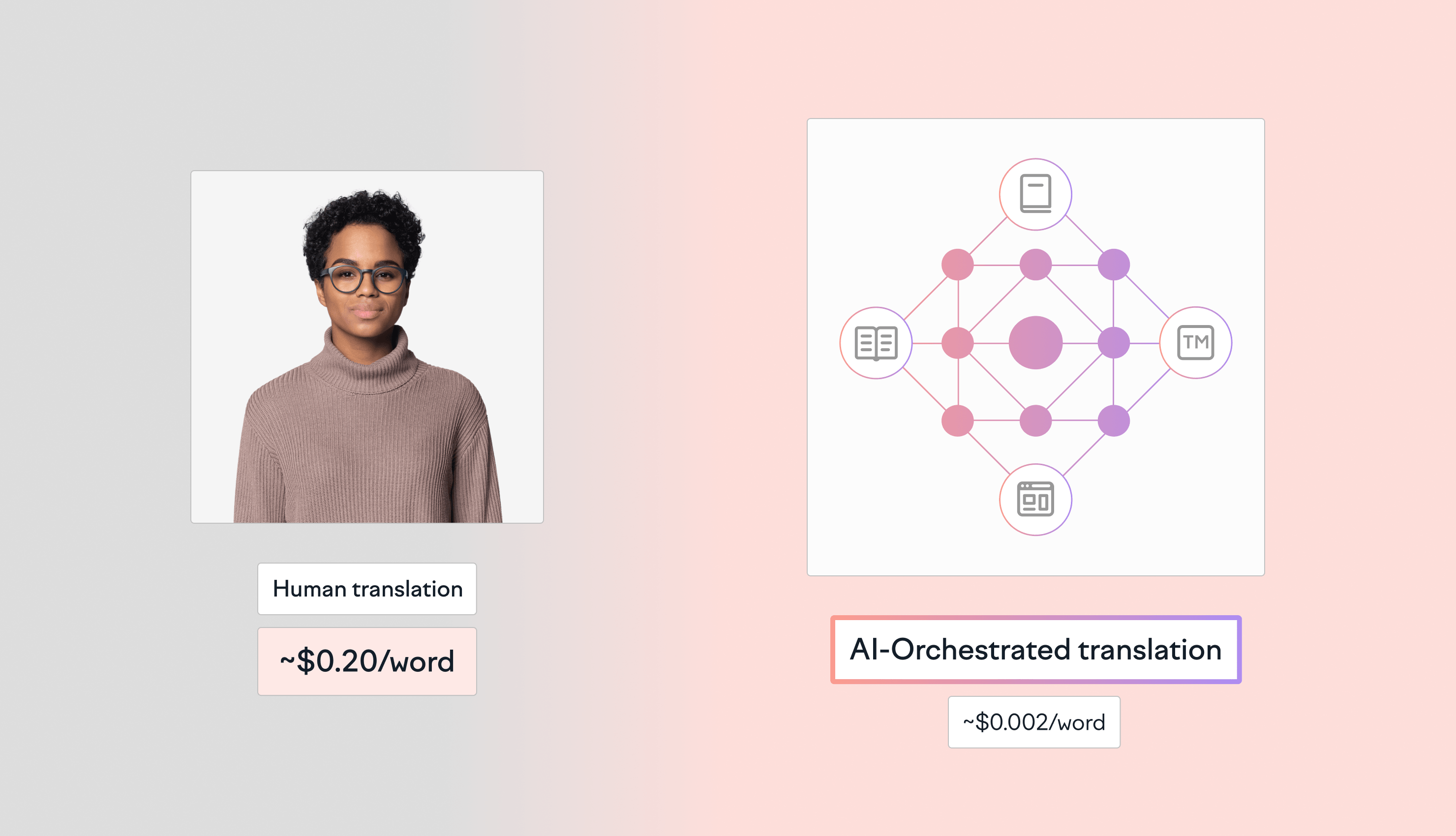
As of 2026, the Total Cost of Ownership (TCO) for enterprise localization has shifted from a per-word human model (~$0.20/word) to an orchestrated AI model (~$0.002/word). This 100x efficiency is driven by AI Orchestration, which automates context retrieval (RAG) and eliminates manual project management overhead. This shift comes from AI orchestration. These systems combine large language models with retrieval-augmented context, terminology databases, translation memory, and automated q