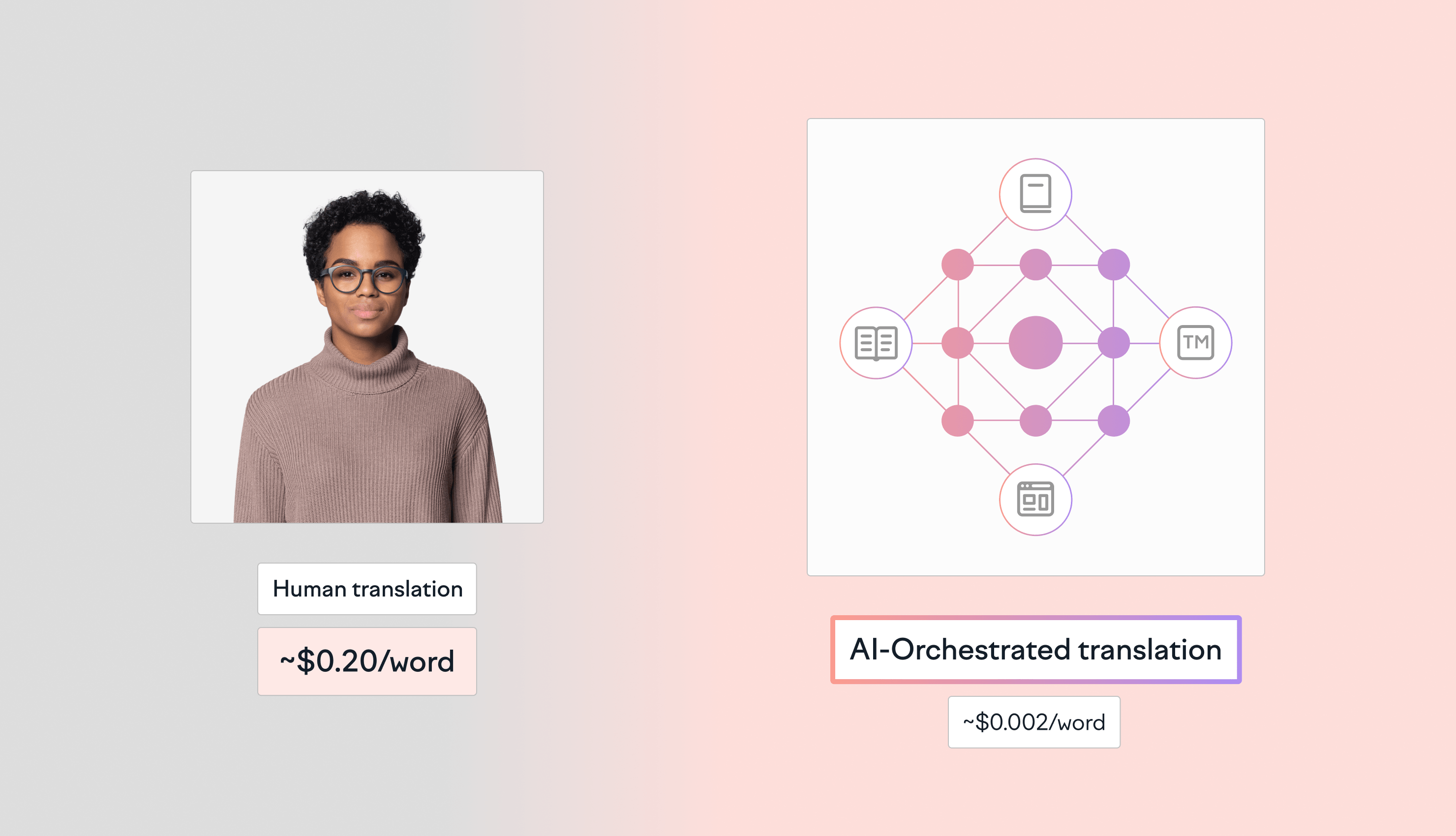
As of 2026, the Total Cost of Ownership (TCO) for enterprise localization has shifted from a per-word human model (~$0.20/word) to an orchestrated AI model (~$0.002/word). This 100x efficiency is driven by AI Orchestration, which automates context retrieval (RAG) and eliminates manual project management overhead.
This shift comes from AI orchestration. These systems combine large language models with retrieval-augmented context, terminology databases, translation memory, and automated quality scoring.
Modern localization workflows no longer rely on humans translating every sentence. Instead, humans design the context and rules that guide AI.
Lokalise research and customer data show how dramatic the shift can be. A traditional human translation workflow costs roughly $150,000 per million words, while an orchestrated AI workflow with contextual grounding can reduce that cost to about $5,000. That’s a 97% reduction in total localization costs.
In this article, we break down the real cost difference between AI and human translation, explain what total cost of ownership (TCO) means in localization, and show how AI orchestration reduces long-term costs. The analysis is grounded in Lokalise research and ongoing cost modeling based on how enterprise teams actually run localization.
What are the three translation models defining 2026 economics?
The three translation models defining 2026 economics are human translation, raw AI translation, and AI-orchestrated translation. Each model comes with a different cost structure, quality level, and role for human input.
For years, localization followed one dominant economic model: human translators handled every string, and organizations paid per word. That model still exists, but it now sits alongside two newer approaches powered by AI.
Understanding these models explains why AI orchestration is disrupting traditional translation economics.
Human translation
Human translation follows the traditional localization workflow. Professional translators translate content manually and reviewers check the output before it is published. This approach delivers reliable quality and works well for highly nuanced content such as marketing campaigns or legal material. However, it is also the most expensive and slowest model because every word requires human effort.
Typical enterprise translation costs range between $0.08 and $0.25 per word, depending on language pair and complexity. At scale, this means translating one million words can cost around $150,000.
For global companies localizing product interfaces, documentation, support content, and marketing materials across multiple languages, this model quickly becomes difficult to sustain.
Raw AI translation
Raw AI translation uses machine translation engines or large language models to generate translations instantly.
The cost per word is extremely low, which is why many teams experiment with tools like ChatGPT or other AI models for localization. However, raw AI translation lacks structured context. The model generates translations without access to approved terminology, previous translations, or brand guidelines.
This leads to inconsistent terminology, fluctuating tone, frequent human corrections during review, and unplanned costs.
Over time, these issues create what localization teams often call inconsistency debt. Content must be retranslated or standardized later. This increases the long-term cost of maintaining multilingual content.
Cheap AI output can therefore create expensive operational cleanup.
🤖 Not all AI translation tools are made the same
Raw AI translation may be cheap, but without context it produces inconsistent results. Orchestrated AI combines models with terminology, translation memory, and quality signals to deliver reliable translations at scale. Read more about the best AI translation tools in 2026 and their pros and cons.
Orchestrated AI translation
AI orchestration disrupts traditional translation economics by grounding AI translation in structured context.
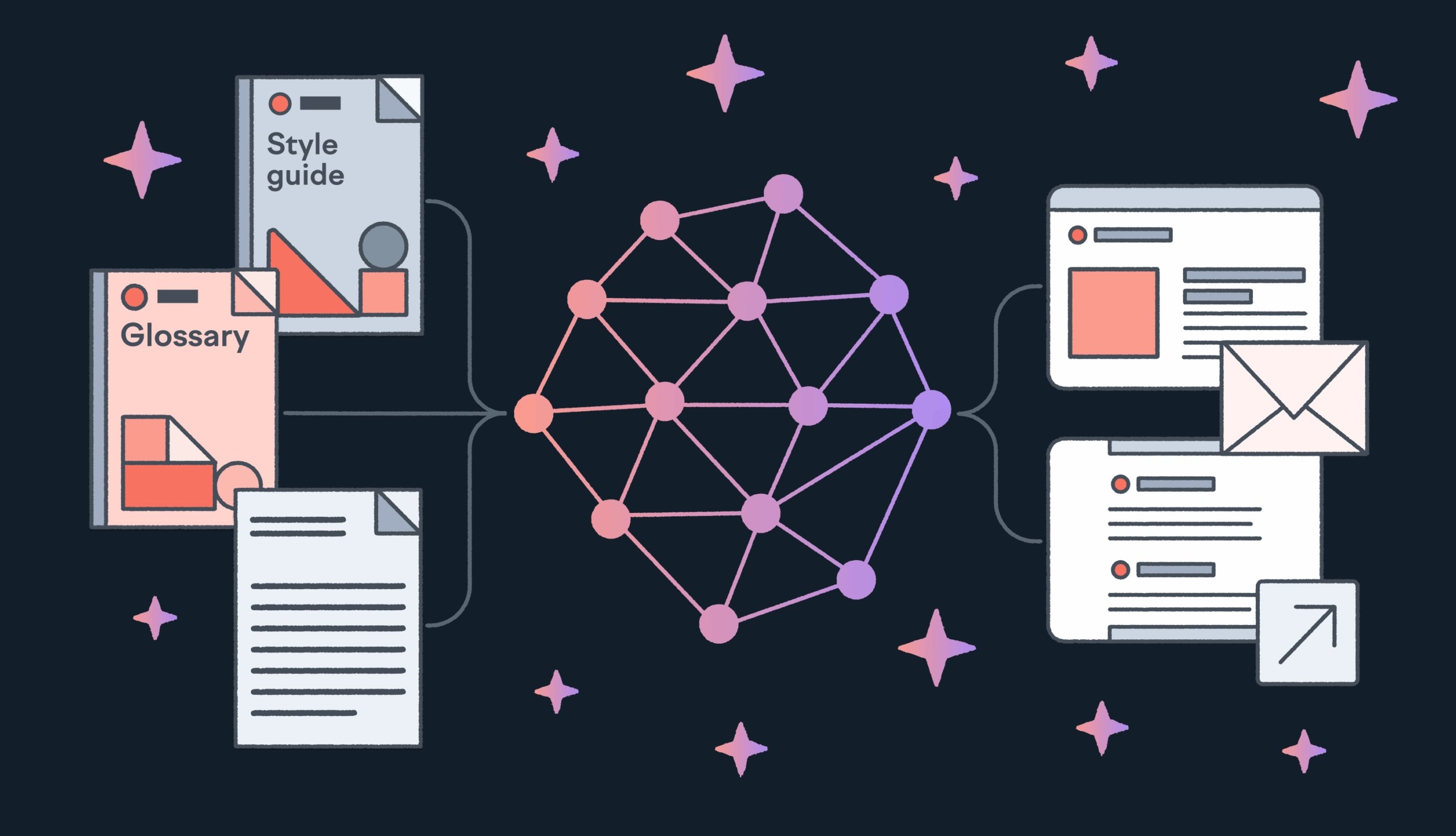
Instead of generating translations in isolation, the AI retrieves relevant knowledge before generating the translation. This typically includes translation memory, terminology databases, style guides, and previously approved content.
This architecture is known as AI orchestration. It combines large language models with retrieval-augmented generation (RAG), automated quality scoring, and workflow automation. In this model, humans no longer translate the majority of content. Instead, they define the context that guides the AI. Translators become architects of terminology, style, and quality rules rather than manual producers of every sentence.
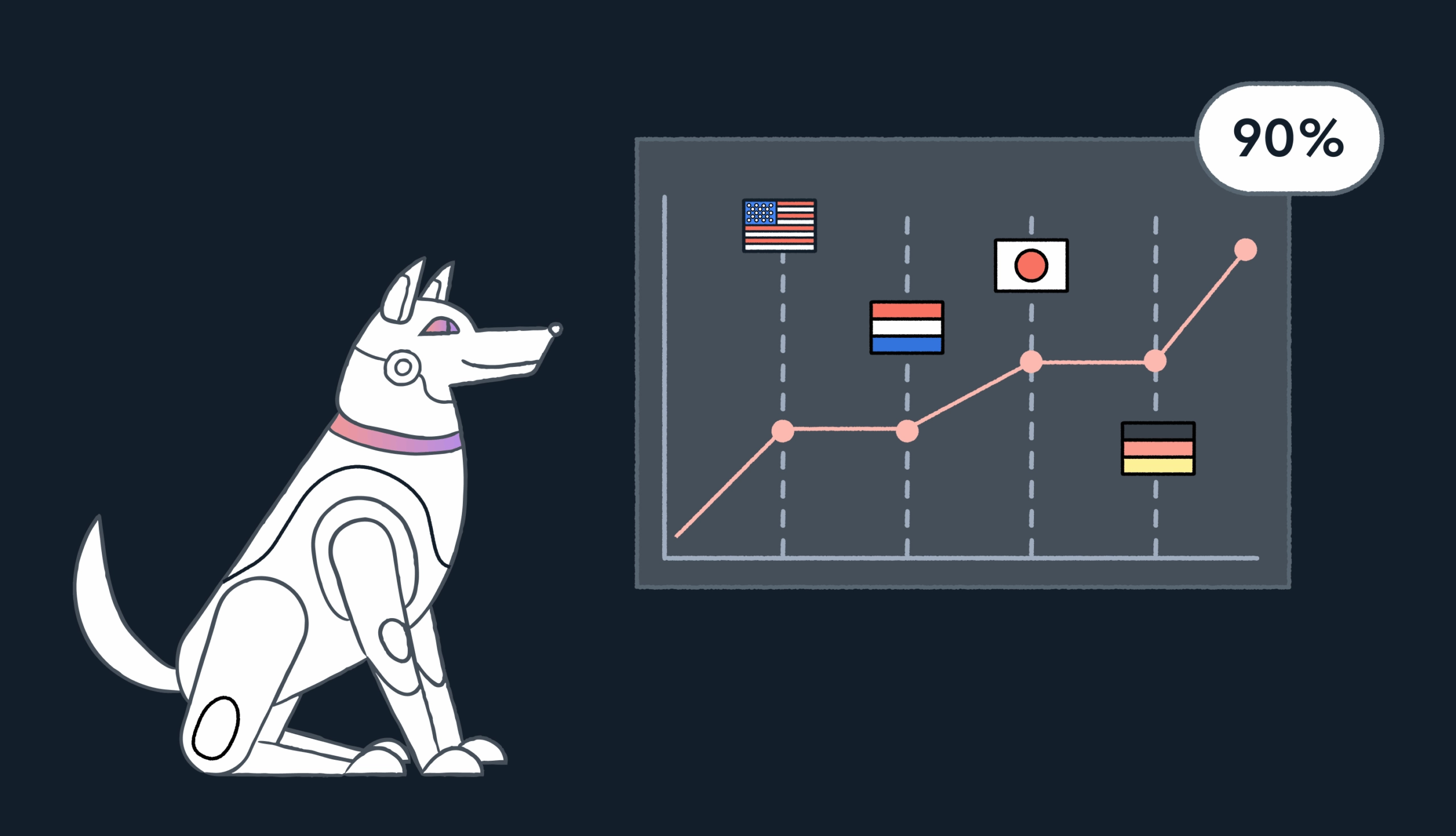
Lokalise research and enterprise customer data show how significant the economic impact can be. When AI orchestration is applied to localization workflows, total translation costs can drop by an average of 90% or more, compared to fully human workflows.
This is the point where localization economics change. AI orchestration replaces the traditional per-word cost model.
AI vs human translation cost comparison
Most discussions about translation costs focus on price per word. But this number hides the real economics of localization.
What actually matters is total cost of ownership (TCO). TCO includes the full cost of translating, reviewing, managing projects, fixing inconsistencies, and maintaining multilingual content over time.
Lokalise data shows that AI-orchestrated localization workflows can reduce total cost of ownership (TCO) by up to 97%
Our research modeled several common translation workflows to understand how costs change depending on how AI is used. The results show that the biggest savings come not from raw AI output, but from AI orchestration that reduces review effort and project management overhead.
Translation workflow
Estimated costs per 1M words
% of costs compared to human translation
Human translation
$150,000
100%
Standard AI / MT + human review
$105,000
70%
Pro AI + scoring + human review
$53,750
36%
Pro AI + RAG + scoring + human review
$23,750
16%
Pro AI + RAG without human review
$5,000
3%
When context retrieval, terminology management, and automated scoring are combined in a single system, most translations no longer require manual review.
Human effort shifts from translating content to designing the context that guides AI output. That is what enables localization teams to dramatically reduce translation costs.
Why cheap AI translation can create inconsistency debt
But when AI operates without structured context, the long-term cost often increases.
Raw AI models generate translations based only on probabilities. They do not automatically know your product terminology, brand voice, or previously approved translations. As a result, the same phrase may be translated differently across documentation, product interfaces, and marketing content.
Over time, this creates inconsistency debt.
Localization teams must review more translations, fix terminology conflicts, update previously translated content, and maintain multiple versions of the same phrase across languages. These corrections require additional human work and increase operational complexity.
The initial savings from cheap AI output can therefore disappear through expensive cleanup.
This is why enterprise localization teams increasingly move toward AI orchestration instead of raw AI translation. Translations are grounded in terminology databases, translation memory, and style guides.
Instead of fixing inconsistencies later, teams maintain a single source of truth that guides every translation.
How AI orchestration reduces localization costs
AI orchestration reduces localization costs by grounding AI translations in structured context and automating large parts of the translation workflow.
Instead of translating every sentence manually, the system retrieves terminology, translation memory, and previously approved content before generating translations. Here’s how it works.
AI retrieves context before it translates
Raw AI translates in isolation. That is why it often sounds right but still gets key details wrong, like product terminology, UI labels, or brand voice. AI orchestration changes the input. Before the model translates, the workflow automatically retrieves the context that usually lives across different systems and people’s heads, such as:
Translation memory
Terminology databases and glossaries
Style guides and brand rules
Previously approved translations and project history
Optional string-level context, like screenshots or instructions
This is typically done through retrieval-augmented generation (RAG). The practical effect is that the model is no longer guessing. It is translating with guardrails.
When context retrieval happens upfront, translations come out more consistent across files, teams, and languages. That reduces both review effort and the need to revisit content later.
Quality scoring reduces how much humans need to review
In traditional workflows, every translation gets reviewed because there is no reliable way to know what is safe to publish.
Orchestrated workflows use automated scoring to decide what needs human attention. That changes review from a blanket requirement to a targeted intervention.
A typical approach looks like this:
High-confidence translations move forward with minimal or no review
Medium-confidence translations get light review
Low-confidence translations go to expert review
This has two cost impacts:
Fewer segments require review
The segments that do require review are the ones where human time actually changes the outcome
Instead of spending time scanning obvious translations, reviewers focus on edge cases, ambiguity, and high-risk content.
Humans shift from translators to context architects
In an orchestrated model, humans are still essential, but the job changes.
Instead of translating or rewriting bulk content, human experts maintain the system that makes AI output consistent and reusable. This usually includes:
Defining and maintaining terminology and preferred translations
Updating style guidance by content type (product, docs, marketing, support)
Improving translation memory quality and reusability
Reviewing only edge cases, sensitive content, or low-confidence output
This shift is where the economics change. The organization stops paying humans to produce every sentence and starts using human expertise to enforce standards and protect quality at scale.
How Lokalise ties these pieces into one workflow
AI orchestration only works when the workflow has a single place to store context and apply it consistently. Otherwise, teams end up with fragmented glossaries, scattered style notes, and inconsistent approvals.
Lokalise supports AI orchestration by connecting AI translation with the systems that keep output grounded and governed.
Translation memory and terminology management in one place
Lokalise centralizes the content that decides what correct looks like, including preferred terms, approved translations, and past decisions. This gives AI and reviewers the same reference point, which reduces back-and-forth and prevents the same arguments from repeating across projects.
Custom AI Profiles that enforce how translations should sound and behave
Instead of relying on one-size-fits-all prompts, Custom AI Profiles let teams define translation behavior by content type and risk level. For example, product UI might prioritize consistency and brevity, while marketing copy prioritizes tone and persuasion. This is where humans shift into the context architect role. They encode standards once, then apply them across workflows.
Context workflows that support RAG using approved sources
RAG is only valuable when the retrieved context is curated and reliable. Lokalise helps teams ground translations in approved assets such as terminology, translation memory, and style guidance, so AI is not guessing or inventing equivalents. The outcome is fewer corrections later and stronger consistency across releases.
Automated scoring and selective review workflows
Instead of reviewing everything, Lokalise supports workflows where quality signals help decide what needs human attention. Review capacity goes to edge cases and sensitive content. That is how orchestration reduces the human hours per word problem that drives localization costs.
Collaboration and governance across teams and markets
Localization rarely fails because coordinating people across teams is hard. Lokalise brings translators, reviewers, developers, and marketers into one workflow with shared context. This helps teams standardize terminology and decisions across languages, products, regions, and business units.
AI vs human translation cost: Final verdict
The conversation about AI translation vs human translation cost often starts with comparing cost per word. That matters, but it does not capture what drives costs in localization programs.
The biggest cost driver is the amount of human effort required to keep multilingual content accurate and consistent over time. Traditional workflows require human translation and review across most content. That approach delivers quality, but it becomes expensive as volume and language coverage grow.
AI translation changes the cost structure, but only when it runs inside an orchestrated workflow.
What is the cost difference between AI and human translation?
The cost difference between AI and human translation can be significant. Traditional human translation typically costs $0.08-$0.25 per word, depending on language pair and complexity. AI-powered translation workflows can reduce this cost to around $0.002 per word when orchestrated with the right context and automation. However, these savings depend on how AI is implemented. Raw AI translation without context can create inconsistencies that require additional human review and cleanup.
What is TCO in localization?
Total cost of ownership (TCO) in localization refers to the full cost of managing multilingual content over time. TCO includes more than translation itself. It also covers:
Translation and review work
Project management and coordination
Terminology management
Fixing inconsistent translations
Updating previously translated content
Maintaining translation memory and style guidance
Because these operational costs accumulate over time, TCO is a more accurate way to evaluate AI translation vs human translation cost than price per word alone.
How does AI orchestration reduce translation costs?
AI orchestration reduces translation costs by grounding AI output in structured context and automating parts of the localization workflow.
Instead of generating translations in isolation, orchestrated workflows retrieve relevant context before translation. This typically includes translation memory, terminology databases, and style guidance.
Is AI translation cheaper than human translation?
Yes, AI translation is generally cheaper than human translation. AI models can translate large volumes of text instantly at a fraction of the cost of manual translation.
However, the total cost depends on the workflow. AI used without context often requires significant human review and correction. When AI runs inside an orchestrated localization workflow with terminology management and translation memory, the cost savings become much larger.
What is AI orchestration in localization?
AI orchestration is a localization workflow that connects AI translation models with contextual data and automation tools.
Instead of translating text in isolation, orchestrated systems retrieve relevant context before translation and automate parts of the review process. These workflows often include:
translation memory
terminology databases
style guidance
automated quality scoring
selective human review
AI orchestration helps localization teams produce consistent translations at scale while reducing the amount of manual work required.
Why does raw AI translation create inconsistencies?
Raw AI translation generates text based only on probabilities and the prompt it receives. It does not automatically know a company’s approved terminology, product naming conventions, or previous translation decisions.
This can lead to multiple translations of the same phrase across different files and languages. Over time, localization teams must correct these inconsistencies, which increases review effort and operational costs.
Orchestrated workflows prevent this by grounding AI output in approved context.
Mia has 13+ years of experience in content & growth marketing in B2B SaaS. During her career, she has carried out brand awareness campaigns, led product launches and industry-specific campaigns, and conducted and documented demand generation experiments. She spent years working in the localization and translation industry.
In 2021 & 2024, Mia was selected as one of the judges for the INMA Global Media Awards thanks to her experience in native advertising. She also works as a mentor on GrowthMentor, a learning platform that gathers the world's top 3% of startup and marketing mentors.
Earning a Master's Degree in Comparative Literature helped Mia understand stories and humans better, think unconventionally, and become a really good, one-of-a-kind marketer. In her free time, she loves studying art, reading, travelling, and writing. She is currently finding her way in the EdTech industry.
Mia’s work has been published on Adweek, Forbes, The Next Web, What's New in Publishing, Publishing Executive, State of Digital Publishing, Instrumentl, Netokracija, Lokalise, Pleo.io, and other websites.
Mia has 13+ years of experience in content & growth marketing in B2B SaaS. During her career, she has carried out brand awareness campaigns, led product launches and industry-specific campaigns, and conducted and documented demand generation experiments. She spent years working in the localization and translation industry.
In 2021 & 2024, Mia was selected as one of the judges for the INMA Global Media Awards thanks to her experience in native advertising. She also works as a mentor on GrowthMentor, a learning platform that gathers the world's top 3% of startup and marketing mentors.
Earning a Master's Degree in Comparative Literature helped Mia understand stories and humans better, think unconventionally, and become a really good, one-of-a-kind marketer. In her free time, she loves studying art, reading, travelling, and writing. She is currently finding her way in the EdTech industry.
Mia’s work has been published on Adweek, Forbes, The Next Web, What's New in Publishing, Publishing Executive, State of Digital Publishing, Instrumentl, Netokracija, Lokalise, Pleo.io, and other websites.
AI translation quality achieves human parity: Is this the end of language barriers?
To paraphrase Captain Kirk, AI has boldly gone where no machine has gone before: it has finally reached human-level translation quality. But this doesn’t mean we’re done with AI translation. Far from it. We’re only just getting started, and the possibilities are both endless and exciting. After decades of clunky, error-prone, and literal-sounding machine translation, we’ve reached a pivotal moment where automated translation matches human quality. When fed t
Read more AI translation quality achieves human parity: Is this the end of language barriers?
RAG vs the buzz: How Retrieval-Augmented Generation is quietly disrupting AI
As a Product Manager leading AI innovations at Lokalise, I’ve been closely following the latest AI news and filtering out the noise that inevitably comes with a revolutionary tech boom. AI has moved incredibly fast since ChatGPT exploded into the mainstream in late 2022, what I like to call ‘the GPT moment’. We’ve seen major model releases roughly every few months, from GPT-3.5 through GPT-4, GPT-4o, and most recently GPT-5 with its integrated reasoning capabilities launched in Au
Read more RAG vs the buzz: How Retrieval-Augmented Generation is quietly disrupting AI
AI translation vs. human translation: Breaking down the trade-offs
You’re thinking about how to translate content quickly, at scale, and within budget, and naturally—AI comes to mind. But can AI really match the quality and nuance a human translator brings? And if you choose to use it, when is it worth bringing a human into the mix? That’s where the real decision lies. Let’s take a look at the AI translation vs. human translation debate, and see which one makes the most sense for your content, timeline, and goals.
Read more AI translation vs. human translation: Breaking down the trade-offs
Case studies
Behind the scenes of localization with one of Europe’s leading digital health providers