Full transcript
Welcome and introductions
Victoria Milton: Hello, everybody, and welcome to this webinar today. While we're waiting for a few people to join, feel free to go into the chat and tell us where you're joining from. We're a very international team and we love meeting people from all over the world.
Sasho Savkov: Hello, my name is Sasho. I'm the engineering manager on the AI translation team. I have a background in natural language processing, a PhD in NLP, and ten years of AI-related experience in industry. I've been with Lokalise for one and a half years now. And with me is Magnus.
Magnus Slind-Naslund: Thank you, Sasho. My name is Magnus, and I'm the CTO at Lokalise. I've been at Lokalise for a little more than two and a half years now.
Before I joined Lokalise, I was actually a customer, a very happy customer, using the Lokalise product to localize an app that we released across Europe. Before that, I spent almost five years at Spotify, where I was managing global expansion and launching Spotify across the world. An important step of that was, of course, localization, to make sure we had good product-market fit in every market where we launched.
Victoria Milton: Before we get started, we have a quick poll: what's your favorite LLM, and why? Maybe Sasho and Magnus, you could share yours while we launch it.
Magnus Slind-Naslund: I tend to use all of them, because I constantly want to test and evaluate how they're performing. But in the end, I tend to go to the Claude models when I want to get something real done with good quality. So I would say Claude is my favorite.
Sasho Savkov: I'm going to say the same as Magnus, because it's kind of my job to do this. Opus is probably the best model around at the moment, and I use it a lot. It's interesting, though: I recently tried Meta's models, so if you're looking for something new that you might not have tried, the new models are pretty interesting.
Victoria Milton: Let's get started. Welcome to today's panel talk on build versus buy in the context of AI technology and localization. We hope to answer the question of when it makes sense to build your own solution in-house, as opposed to leaving it to localization experts.
As a customer success manager here at Lokalise, it's a question my customers have had to field over the last year, especially as AI expertise has continued to develop internally. But is it as easy as some may think, and when is it worth the investment? That's what we're here to talk about today.
If you have any questions at all, please use the Q&A box and we'll do our best to answer as many as we can at the end.
Why calling the model is the easy part
Victoria Milton: Magnus, you've joined calls with some of our customers who ask: when does it make sense to just call the model ourselves? What do you think they're right about?
Magnus Slind-Naslund: I think they're right about just that: they can call the model themselves. Uploading a file to an AI model today is not hard. Anyone can upload a file and get it translated with an LLM, and LLMs are good at translation as they are.
But what's important is everything around the model itself. The first thing is context. If you just upload something, send it to an LLM and ask it to translate it, it's not going to sound like you. It's going to be a standard translation. The context around what you're translating, and the context you pick to send to the LLM, is the really important piece.
On top of that is the challenge of getting consistent quality over time. Doing it as a one-off is typically not that hard. You collect the information you want to send, write a simple style guide, and ask the LLM to translate. But doing that consistently over time, with the same vocabulary and the same voice, staying on brand, is really hard, especially as your company and your context change.
The other hard thing is verifying the quality of the response. When the LLM has given you a translation, how do you know whether it's good or not? That's where you need orchestration around it: quality scoring, human review in some cases, and so on. That's also a really hard part of getting to the quality you're looking for in the end.
Context matters more than the model
Victoria Milton: Sasho, customers often ask me exactly which models we use. My understanding is that it's actually the setup that matters more for achieving good-quality translation. What did you find in your team's testing?
Sasho Savkov: I'll essentially repeat what Magnus said: context is essential for a successful translation. You can use different models and optimize which model is best for a particular language pair, because not all models translate equally well into every language. But most models are really, really good at translating the most common languages, where there's a lot of training data.
Where they differ is in low-resource languages, where there isn't much data on the internet for them to train on, so we see bigger variations there. But the most common languages that most of our customers target are languages where the models have already reached their peak. The only way we can do better is by adding more context and guiding the translation toward what the customer actually wants to say, rather than just what the literal translation is.
We've tested this empirically. We've seen edit rates cut by 20 to 57 percent in side-by-side experiments with and without context. So it's pretty clear in the data, as well as making sense in general.
Why glossaries are harder than they look
Victoria Milton: One of the foundational parts of this setup is linguistic assets. My customers expect AI to reliably use their own industry or brand terminology. What actually makes that difficult?
Sasho Savkov: This one is quite deceptive, because we all think: it's just a list of words we want to translate from language A into language B. It's a table, we replace words, and it's a simple task, especially for an LLM.
But glossaries are how the industry enforces terminology, and glossaries contain terms. Terms are very often inflected. English is very simple; there's very little inflection. But languages like Russian, Arabic or Finnish have a ton of inflection: lots of cases, gender, different types of plurals, countables, and so on. So first of all, it's very complex to have a glossary that maps to the right word on the other side, in the right context, explicitly and comprehensively.
The second problem is that if you don't do this well enough, you lose consistency in your brand voice. That's one of the most important things, especially in software localization. It might be less important in marketing or long-form content, but in software it's really important that your terminology and your brand name look the same across your entire product.
And the last part is that if you don't get this right, your AI translation is going to copy what you do. It's going to replicate it and spread it, and it will end up being detrimental to your quality rather than positive. So it's something you really need to get right almost from the start.
When a perfect-looking translation breaks production
Victoria Milton: Can you share an example of an AI translation that read perfectly fine during human review, but still caused a problem in production?
Sasho Savkov: There's a really interesting example of growing pains from more than a year ago, while we were still building our Pro AI functionality. There was a string, something like "Active members:" followed by a placeholder, and the LLM dropped the placeholder. If you looked at the translation, it was perfectly fine. It looked right, because it still had the colon at the end.
The human reviewers passed it, because it looked okay. They didn't dig into whether something was missing. And that ended up breaking the customer's software when it was deployed to production. They came back upset about us causing an incident with poor quality.
Obviously, that's something we've overcome since. We now have multiple checks and guardrails, using both LLMs and deterministic methods. So it is something you can overcome, but it's an example of the growing pains you'll have to go through if you build your own system, because these things are going to come. It's complex as it is.
The most underestimated linguistic asset
Victoria Milton: Magnus, the feedback I hear from early adopters usually isn't that the AI produced a mistranslation. It's that it doesn't sound enough like them. So I'm constantly reiterating the importance of glossaries, style guides, key context and translation memory. Which of these four assets do you think is most underestimated, and why is the upkeep so difficult?
Magnus Slind-Naslund: It's a very good question. First of all, all of them are important. You can't neglect any of them. It's important to provide the right key context, and to have a style guide and glossary in place. But the one I'd pick as most important, and that people don't always think about, is translation memory. Translation memory is the one where we see the biggest impact on the quality and tone of your translations.
It's also the hardest one to manage, because it's typically vast amounts of data across every single language you translate into. It degrades over time and becomes obsolete: you change your vocabulary, you might change your brand, you change a lot of things. It's important to keep your translation memory consistent and up to date so it provides the right context.
The hard bit is also picking the right context from it. Say you have a million translations sitting in your translation memory. From there, you want to pick the best examples and give them to the LLM when you translate, to get the right tone and vocabulary. That is really hard, and it's what platforms like Lokalise help you with: picking the piece of context that will really make an impact on quality.
Victoria Milton: I'd agree. Translation memory is usually a bit of a project in itself to maintain.
Trusting quality in languages you don't speak
Victoria Milton: Most of our customers also ship in languages they don't have native speakers for internally. How can they trust the quality of their content, and of their translation memory, when they can't check it themselves?
Magnus Slind-Naslund: I'd say that's the normal case. Most companies don't have people speaking 50 different languages when they start translating. But it's definitely possible to manage.
First, you use the tools built into platforms like Lokalise. AI quality scoring tells you whether a translation is good or not. It gives you a numerical score, so you get a good understanding of the actual quality, and on top of that you get qualitative insights into what's wrong: is it a grammatical problem, a spelling mistake, or does it just not match the vocabulary you want to use?
The next step is to build a workflow around it, so that when something doesn't meet the quality threshold you've set, a human takes a look. If you don't have someone internally who speaks that language, that's something Lokalise and our partners can help with. You can get a professional linguist to review the translations we flag as lower quality, and post-edit them so they come out exactly as you want.
Victoria Milton: Good shout-out to our partnerships team there. Thank you, Magnus.
How Lokalise tests new AI models
Victoria Milton: Sasho, going into the technical details a bit more: how do we decide which models to integrate into Lokalise? Can you talk us through what happens before a model touches our Pro AI?
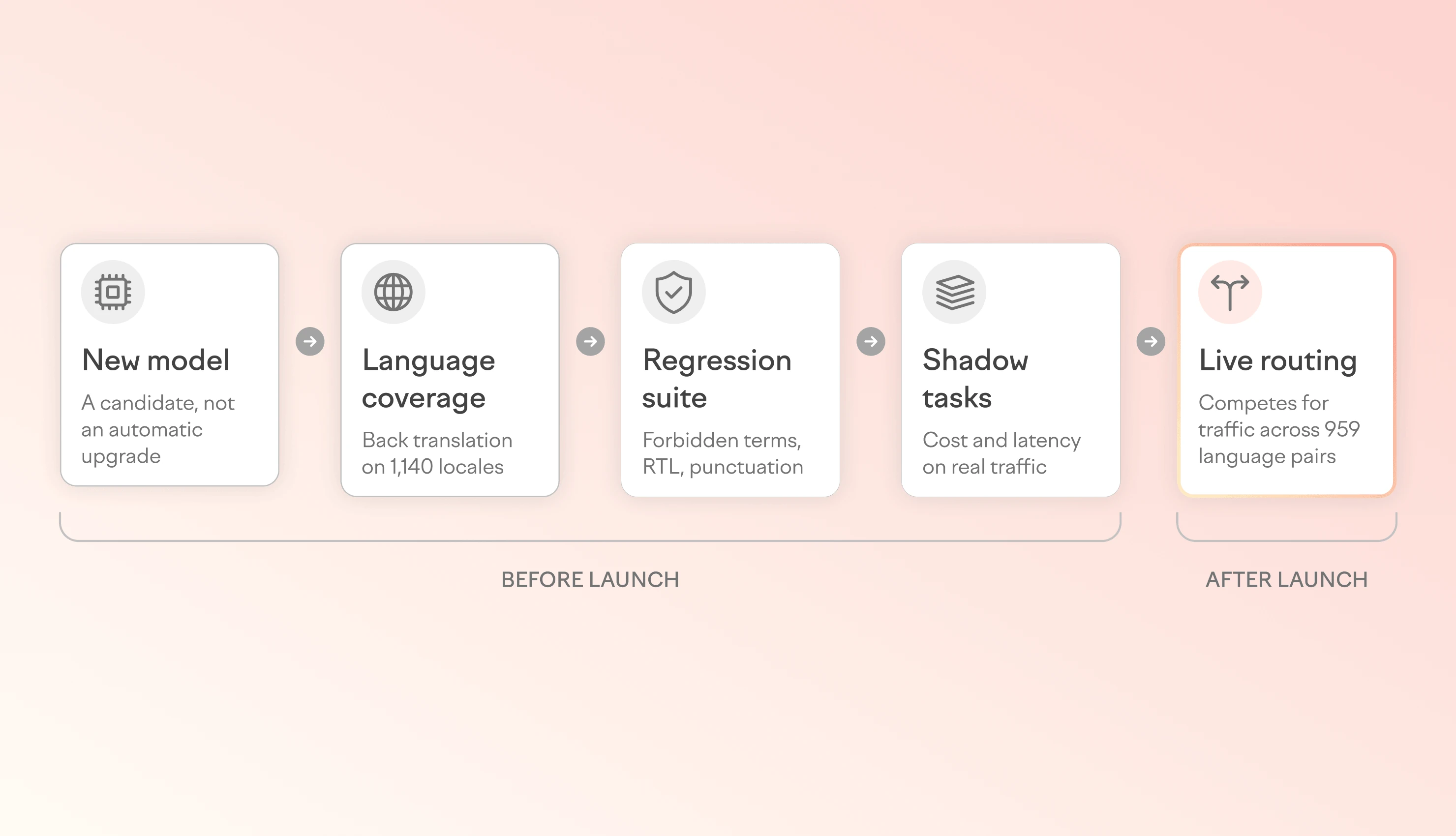
Sasho Savkov: There are a ton of public benchmarks that tell us about models, their properties and how good they are. Usually it's a very good story about how every model achieves really good results. We do look at these; that's our starting point. But what matters much more to us are our internal tests, which check what we really care about: translation, back translation, and specific aspects of translation quality. It happens in several stages.
The first stage is something we call language support. It's a test where we translate from English into a language and back into English, and then decide whether the back translation is good enough. That tells us whether the translation into a language we don't speak is good enough, because it measures the noise introduced in the round trip. We run it on over a thousand languages from English, and it tells us whether the model generally has good coverage. There's a set of languages we need to support, so a model fails if it doesn't support those to a certain threshold. Then there are lower-resource languages, where some gains and some small losses can be acceptable.
The second stage, after passing language support, is more structural. I gave the example of the dropped placeholder earlier. That's one structural thing we check: we simulate those cases and look at how often models make mistakes like that, or don't follow the punctuation we've asked for. French has very particular punctuation, so does Russian, and numbers are formatted differently in different languages. All of this instruction following for formatting is checked in a regression test suite.
Once a model passes all the structural tests, we move to our final test, which is essentially our traffic. We run the model in the background on actual queries and look at its behavior: how many tokens it spends, how fast it responds, how much it will cost to run, and so on. Once that's complete, the model graduates or not.
Victoria Milton: So every time a new model is released, you follow the same process?
Sasho Savkov: Yes. If there's a new version, we treat it as a new model and run it through the entire test. It's important to say that models very often don't improve uniformly across all dimensions. Sometimes it's a trade-off. Some versions are more expensive, some cheaper. Some are better at structural instruction following, some are more creative, some spend more tokens. So it is a trade-off.
Who makes the call on a new model
Victoria Milton: Magnus, when we're looking at a model update, who actually makes the judgment call on behalf of our customers about whether to add it to our mix?
Magnus Slind-Naslund: As Sasho said, it's always a judgment call. We've never seen a model that's the best at everything. We do a comprehensive benchmark across a number of dimensions, and in the end we make the call on behalf of our customers by looking at the full package of results. We also have the experience to know which aspects matter most: what cannot go wrong, and what's okay if it's a little worse than another model.
But we would never just release a new model or version straight into production. We always do a dark launch, or shadow launch, on the side, where we benchmark and test the model on real translations live before we decide to switch it into real translation. So we always have good verification that the quality is there, and that we get what we expect, before we switch over.
Routing languages across different models
Victoria Milton: In the customer conversations I've had, they typically have access to one primary model, maybe two, and route all their languages through it. Sasho, from your data-driven experience, is it worth routing different languages through different LLMs?
Sasho Savkov: I would say yes, although it depends on how many languages you have. If you only have German, maybe less so. But most customers have more languages than that, and even among European languages there's a decent gain in accuracy to be had from understanding which model is best for the language you're translating into. That's even more true for low-resource languages, where some models simply don't support a language. They'll just repeat the English when trying to translate into it, while others will actually translate.
So it's definitely worth having more than one model. We do this for our customers with a machine learning model called smart routing. It selects the best model for a particular language pair in a very automated way: it keeps exploiting the best decisions of the past while still exploring, because new models and releases keep coming in, and customers' content changes.
I have an analogy for how this works. Say you move to a new town with three restaurants. You go around and figure out which one is best for pizza and which for sushi. Then you keep going back to the same places. But every now and then, you try the pizza at another restaurant, take a risk, and maybe switch. Now imagine the entire town is doing this, using the same ledger: every time somebody takes a risk, they make a note, and everybody knows. That's exactly what we're doing. The restaurants are the model providers, the menu items are the language pairs, and the customers are our customers. If you use smart routing with us, you get the benefit of shared exploration, which you wouldn't get otherwise. You'd have to try a lot more on your own.
Victoria Milton: I like that analogy. I'm going to use it on some of my customer calls.
Catching model drift before your customers do
Victoria Milton: Magnus, playing devil's advocate: imagine a customer has built their own solution, and then a model update shifts the tone of voice, so it's no longer consistent with their historical content. Who catches that, and how can a company avoid it when they own it themselves?
Magnus Slind-Naslund: In the case of Lokalise, we're the ones catching that. That's why we do the comprehensive regression testing and benchmarking of every new model and version that Sasho talked about. In rare cases, we've also seen drops happen in the middle of a model's lifecycle. So it's not just about testing new models as they come out. You need to keep a constant eye on model performance so you can take action if something happens. We have the dynamic routing Sasho described, which automatically moves to a different model if we see degradation in one language or another.
Every time there's a new model, you need to test it properly, and that's not easy. You need to test it comprehensively across a number of dimensions to verify it performs at the same level as the previous version or another model. It's definitely something you shouldn't underestimate. You can start with a benchmark on artificial data, but after that you want to test on real production data. That's what we do with the dark launches, to verify the quality is always there.
When building in-house is the right call
Victoria Milton: Taking into account everything we've talked about today, customers are sometimes asked internally: can't we just build this ourselves? Magnus, when would you say building is the right call, and does the size of the organization make a difference?
Magnus Slind-Naslund: That's the million-dollar question. There are a few scenarios where it makes sense to build it yourself. The easy one is if you're a small startup, say a team of five to ten people. It probably doesn't make sense to get a comprehensive language intelligence platform, because you don't have the complexity in your organization to need that orchestration layer. You can probably use an LLM's API directly. The context you need isn't hard to find, because it's in the team in front of you. At that stage, you'll probably optimize for speed rather than quality, and it can be totally fine if some translations aren't perfect, because you don't yet have a mature marketing function that has defined exactly the tone of voice and vocabulary you should use.
The other case is if you have really strict policies, say you're in a highly regulated industry, and your software has to be deployed in a certain way, run within your own infrastructure or your own cloud. With that kind of complexity, it can also make sense to build it yourself.
But for everything in between, it's probably better to take something off the shelf. If you decide to build it yourself, especially once you have many teams localizing who all need to be consistent in branding and tone of voice, it's a real investment. And it's not just the upfront investment to build it. It's also the ongoing investment to maintain it: keeping your context well maintained, integrating with every new content management system and channel where your content goes out, and updating all of those integrations when they change. There's real maintenance behind it to make sure everything keeps working.
Sasho Savkov: We have a customer who wanted to move really fast, but also had regulatory requirements, so they had to be responsible with what they were doing. The engineer responsible for localization on their side had already built a system like this at a previous company, and made the conscious decision to choose Lokalise. We gave him all the infrastructure he would otherwise have had to build and maintain, and he knew exactly how much effort that is. He wanted to focus on quality, speed and hitting those regulatory requirements, rather than saving on cost. So that's another example of where it makes sense to buy, so you can move faster and more safely.
Victoria Milton: That's a great example. One of my main takeaways is that there's an awful lot going on under the hood, more than even I was fully aware of. And appetite for risk is one of the main factors I see among my customers: it's all very well building these things yourself, but who's going to maintain them and keep them up to date with changing requirements and models? Thank you both for your insights. Let's jump into the Q&A.
Q&A
Victoria Milton: First question: how do you connect the models to different CMSs or other content repositories?
Magnus Slind-Naslund: One of the beauties of a platform like Lokalise is that everything is decoupled in the architecture. One part of the platform, which we call the content exchange platform, connects to all the places where you have content: your CMSs, the API, files, or any other source of content or context.
The other part of the platform connects to the models. That's the piece Sasho and his team work on: all the connections to the different models, deciding which model to use based on the language pair, and which context to provide to it. The two are completely decoupled, so we can keep adding integrations with new content management systems, and all of them automatically get access to all the models we use for translation, plus dynamic routing that always picks the best model for that specific case.
Victoria Milton: Question two: I get a lot of pressure from our CFO to just use existing AI tools to keep costs down. How do I convince them to invest in tooling?
Magnus Slind-Naslund: What's important is to think about the whole package. It's easy to look only at the initial translation cost. You see that you can use, say, a Claude model directly, or go through a platform like Lokalise, and if you compare that cost side by side, the CFO will push and ask why you don't use the one you already have a budget or contract for.
But it's easy to miss the full package there. The real cost is the cost of quality. If you don't have a platform to verify quality, it can end up much more expensive. That's the bigger discussion to have: explaining how the orchestration works, how you verify quality, and how you manage everything end to end before you publish your content.
Victoria Milton: If a team builds in-house, which part of the stack do they usually underestimate most?
Sasho Savkov: I'd say glossary is very underloved in software localization. You could say translation memory as well, but glossary is where we see the clearest and fastest improvement. It's also the one where, if you get it wrong, you get immediate bad results that propagate. People don't pay enough attention to it, and it's easy to miss.
For long-form content, it's a different one. A style guide is much more effective at keeping longer text coherent and consistent. Glossary is still important, but long-form text is much more diverse, so its effect is more limited. In long-form contexts like marketing materials and advertising, we really see the style guide as the more important asset for translation.
Victoria Milton: One tip from some of my AI-first customers is to use AI to help generate and maintain your glossaries and style guides. I'd definitely recommend it, because as you say, we see the impact in the actual translations.
A few more questions, we've got quite a few coming in. How do you deal with languages that predominantly use English terms for software, because that's the main source online, when you actually need to translate into the local language?
Magnus Slind-Naslund: That's a very interesting question. Being in Sweden, I think this is actually the case for Swedish: it's very common to use English terms for everything, even when there are local Swedish terms. The risk, as the question points out, is that the LLM trains on public material that uses English terms, and ends up picking English terms for you even when you want a proper local term.
The easy answer is your glossary. Specify in your glossary that, in Swedish for example, this word should be translated this way, so you give the LLM the context that it should use a specific term. Over time, that goes into your translation memory and gets picked up by the system, so quality goes up. But glossary is really important for cases like that.
Sasho Savkov: I'd add that you should also use a style guide. A glossary is something you have to define explicitly, while with a style guide you can instruct the LLM to use local terminology consistently. If certain terms need to stay in English and others need to be in Swedish, glossary is probably the way to go, but a style guide can handle the general rule.
Victoria Milton: Magnus, coming back to an earlier question: is there a case at the other end, where you're a very large organization and it starts to make sense to build your own again?
Magnus Slind-Naslund: We've definitely seen that. We have a few customers we say have graduated from us, really big tech companies. If you're a tech company with ten or fifteen thousand employees, you probably have a machine learning or AI team that's bigger than all of Lokalise. In those scenarios, you might have the resources to build a platform like this yourself.
But it's still a priority decision. It will still take a lot of resources, even in an organization like that, and it costs the same kind of money to build the platform. So even for the biggest companies, if you look at the economics, it's probably not the right decision to build it yourself. It's probably better to buy a solution. In many of those cases, other things drive it: internal policies about running their own infrastructure, or principles about building everything in-house to manage risk. In those cases, building it yourself might be the right decision.
Victoria Milton: We have time for one final question. If you use different models for different languages, how do you keep data security consistent across all of them, and does that drive which model you choose? Maybe this one is for you, Sasho.
Sasho Savkov: We try to adhere to the same floor of data security with all models. In some cases we get better terms, but we make sure we cover the same floor, so it's something we can offer regardless of which model is used. That said, we have some flexibility if customers have specific requirements, and we can do something more custom.
Our general approach is to get the best setup possible, uniformly for all customers. For example, we always have a data retention policy of at most 30 days, which keeps us compliant with GDPR, so there are no legal constraints around this. We also have some models with zero data retention, which is great. If someone needs that as an internal requirement, we can guide them to set up those models in particular, and you can also choose your own models if you require.
Wrap-up
Victoria Milton: That brings us to the end. Thank you to Magnus and Sasho for a great conversation today. We'll be emailing the recording, along with the white papers Sasho has written. That's a wrap. Thank you very much for joining us, and enjoy the rest of your day, everybody.