

AI Translation

How to get data-backed proof that AI translation works — on your own content

Sasho Savkov,Updated on September 9, 2026·12 min read
AI translation quality.webp

Here's a stat that should make every localization leader uncomfortable: 57% of localization teams say their number one barrier to using AI more is that they don't trust the quality.

Not that the quality is bad. That they don't trust it.

The distinction matters. AI translation has improved dramatically. Models are better, context-aware systems like Retrieval-Augmented Generation (RAG) produce near-human output, and the cost-speed-quality triangle that defined localization for decades has fundamentally collapsed. Yet most enterprise teams are still stuck in one of three modes: trusting AI blindly and hoping nothing breaks, paying thousands for external linguistic audits that take weeks to deliver, or simply not adopting AI and falling behind competitors who have.

None of these are sustainable. And the root cause isn't the technology — it's the absence of proof.

At Lokalise, we built a feature called Proof of Value specifically to close this gap. It lets you test AI translation quality against your own approved translations, on your own data, and get measurable results in minutes — no human review required.

In a recent webinar, I walked through the technical architecture behind this feature alongside Marta Puerto from our Product Marketing team and Alesia Nikalaichyk from our Product team. This article distills the key ideas from that session into something you can act on today.

Watch on demand | AI translation quality, measured: Prove it on your content

See how to evaluate AI translation quality on your own content — in 15 minutes, inside Lokalise.

Watch now

The AI trust ladder: four steps from doubt to confidence

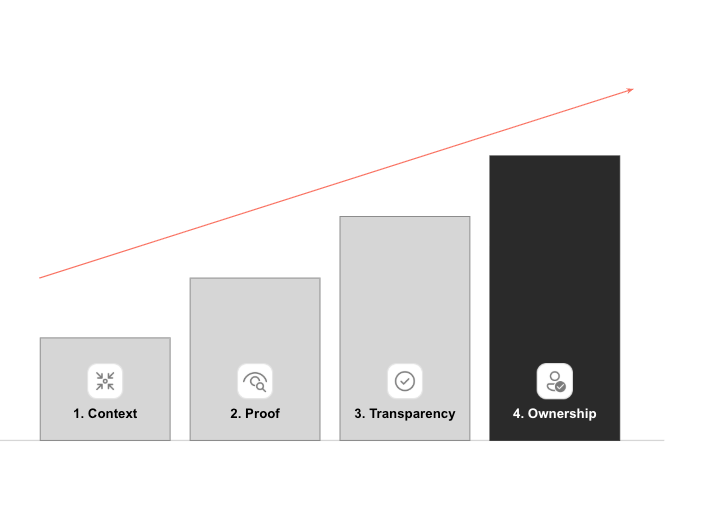
Before diving into the product, it's worth understanding the framework Marta introduced during the webinar — what she called the AI Trust Ladder. It maps the four stages every team goes through when moving from “Can AI translate?” to “We trust it enough to ship.”

The AI trust ladder: four ascending bars labeled 1. Context, 2. Proof, 3. Transparency and 4. Ownership, with an upward arrow showing growing confidence in AI translation

Step 1: Context

Does the AI know your brand, or is it starting from zero every time?

Without a strong context layer — glossaries, style guides, tone of voice instructions, past approved translations — every AI output is a fresh guess. The result is translations that are technically correct but sound flat. Generic. Off-brand.

Real readiness starts with feeding the AI your accumulated knowledge instead of treating every translation as a cold start.

Step 2: Proof

Can you verify AI works on your content — not someone else's benchmark?

This is where most companies stall. They either skip verification entirely, roll out AI on faith, or lean on a vendor's benchmark that doesn't reflect their actual content, terminology, or quality bar. Real proof means testing AI against your own historical, approved translations and getting a measurable answer.

Step 3: Transparency

When you get a quality score, can you understand why?

A good number alone won't build trust — it just relocates the doubt. Teams trust systems they can inspect. You need to see the reasoning, the side-by-side comparisons, the edge cases. Not “this score looks fine,” but “I understand it well enough to defend it to my VP.”

Step 4: Ownership

Who makes sure the system keeps working as your data evolves?

This is the step most organizations skip — and it's exactly where governance breaks down. Someone needs to own the process: watching for drift, reproving value as usage grows, and making sure that a massive new translation job doesn't silently degrade your AI context.

Context first: why generic AI sounds flat (and how RAG fixes it)

Alesia opened the product walkthrough with an analogy that stuck with me. A generic LLM translating your content is like onboarding a junior translator. They're competent. They'll produce decent work. But they don't know your product, your style preferences, or the terminology your team spent years refining.

A Custom AI profile powered by RAG is the senior translator who's worked with you for years and knows exactly how you want things to sound.

Here's how that plays out in practice. Take a simple string: “Create a support ticket,” translated into Polish. A generic LLM produces Utwórz bilet wsparcia — technically correct, but generic. Your team, however, has consistently translated “support ticket” as zgłoszenie do pomocy technicznej across your product. With RAG, the AI retrieves that pattern from your translation memory and produces output that matches your established terminology.

The mechanism is straightforward. RAG doesn't retrain the model (which is slow and expensive). Instead, it retrieves relevant past translations from your translation memory at inference time and uses them as context for the new translation. The more you translate and review, the more context the AI has — and the better it gets. It's a flywheel, not a one-time setup.

Custom AI profiles in Lokalise let you control this context precisely:

  • Choose your LLM routing. For the AI Proof of Value evaluation, we pin the model so the comparison is deterministic rather than based on a non-deterministic model choice. For other translation workflows, you can use Lokalise's intelligent routing (which selects the best-performing model per language pair and content type) or lock to a specific model if your organization has compliance requirements.
  • Select which languages provide context. Translation memories aren't always homogeneous. Choose only languages with reliable, up-to-date translations. If your German TM is pristine but your Italian TM has legacy quality issues, exclude Italian until that data is cleaned or replaced; otherwise, those lower-quality examples can teach the profile the wrong patterns.
  • Filter by date. If recent translations are higher quality than older ones (common after switching vendors), you can limit context to newer TM entries.
  • Create multiple profiles. Your legal content, marketing copy, and product strings each have different quality standards and terminology. Separate profiles mean each content type gets the right treatment.

All of this is powerful. But it raises the obvious follow-up question: how do you know it's actually working better?

Proving the value: testing AI on your own data

This is the problem Proof of Value was built to solve. And it's the part Alesia demonstrated during the webinar.

The feature runs a controlled experiment on your own data. It takes a set of your approved, high-quality translations as the reference standard. Then it retranslates the source content three different ways:

  1. Custom AI profile — your RAG-powered profile, using your translation memory as context.
  2. Base AI profile — a standard LLM with glossary and style guide support, but without access to your existing translations.
  3. Google Translate — a general-purpose machine translation baseline.

It then compares all three outputs against your approved translations and shows you, quantitatively, how similar each one is to your established quality bar.

The entire evaluation runs in minutes. No human reviewers needed. No external audit. No waiting weeks for results.

In the demo, the results for one customer's French and Russian content showed that the Custom AI profile produced at least 13% more edit-free translations (perfect matches) than the base profile — and 31% less editing effort overall. For some longer, more complex translations, the Custom profile produced output that was identical to the human-approved reference. Zero edits required.

That's not a benchmark from a research paper. That's a customer's own data, evaluated against their own quality standard, in their own Lokalise project.

How to set up an evaluation

The setup is deliberately simple:

  1. Select the project you want to evaluate.
  2. Choose your trusted reference translations. Because translation memories can contain mixed-quality content, Proof of Value asks you to specify which translations represent your quality bar. You can filter by review status or by tag (e.g., a “quality-example” tag your team has applied to verified translations).
  3. Select target languages. The feature shows you which languages have enough reference data for a meaningful evaluation.
  4. Run it. You'll get a notification when results are ready — typically within a few minutes.

💡 Pro tip

For teams that want even more granular control, you can create additional profiles that use only tagged or reviewed translations as AI context (rather than your full TM). This is useful when your TM has mixed content types — say, creative marketing copy alongside strict software strings — and you want to evaluate each separately.

Under the hood: how the metrics work

As the engineer who built much of this system, I want to be transparent about what the numbers mean and, just as importantly, what they don't.

We use four metrics, each telling you something slightly different.

MetricWhat it measuresHow to interpret it
Perfect matchExact character-for-character agreement with the approved reference.34% means 34% of translations are identical to the approved reference. Other translations may still be perfectly good.
BLEU and chrFSubword and character similarity between the AI output and the reference.Useful for ranking models, but less intuitive when viewed alone.
Translation Edit Rate (TER)Estimated human editing effort needed to reach the reference translation.0 means no edits; a low value means minor corrections; above 1 means substantial rewriting.

How we split the data

When you provide your trusted dataset, we divide it into two sets:

  • Reference set: the “exam.” All three models translate these source strings, and we compare their output against your approved translations.
  • Context set: the “study material.” Only the RAG-powered Custom AI profile can access this set during translation — because that's exactly how RAG works in production.

We keep these sets separate by key ID to prevent data leakage.

💡 Pro tip

We require a minimum of 500 keys for tag-based and review-based evaluations, and 200 project keys plus 500 TM keys for TM-based evaluations. Below those thresholds, noise starts to dominate and the results lose meaning.

What the results tell you (and what they don't)

A deliberate design decision: we don't label results as “good” or “bad.” We rank the models and show you the delta.

Why? Because absolute interpretation depends on too many factors — the target language, the content type, the length of your strings, the quality of your reference data. What we can tell you objectively is which model performs best on your data, and whether the gap is meaningful.

We also can't project exact cost savings from choosing one model over another. The evaluation is a snapshot — a controlled comparison at a point in time. Your real-world data will vary, your TM will grow, and performance will shift accordingly. That's why we built the re-evaluation capability: run it again after a major translation job, a TM cleanup, or a vendor switch to see how the landscape has changed.

Data quality is everything

I have to be direct about this: the quality of your input data determines the quality of your results. Bad data hurts the evaluation in two ways.

First, it teaches the RAG model the wrong patterns. If your TM contains inconsistent or incorrect translations, the Custom AI profile will faithfully replicate those mistakes. If you see a suspiciously small gap between Custom and Base profiles, your context data may be the problem.

Second, it corrupts the judge. Your reference translations are the source of truth in this experiment. If the reference says “apple” should be translated as “peach,” every model that correctly translates “apple” will score poorly. If all three models show unusually low scores, it's worth questioning the reference data before questioning the models.

Share of AI translations identical to your approved reference. Higher is better. Custom ahead in 7/7 customers (32/32 pairs), median gap +12.5 pts

CustomerPairsStandard MTBaseCustomGap vs. baseSpread across pairs
Fintech broker
de
17%11%52%+40.3single pair
Lending marketplace
lv
215%15%38%+23.1+9.9 to +36.2
Games studio
es, pt-BR, de
323%28%51%+19.0+15.0 to +26.0
Education provider
de, pl
225%42%60%+18.0+6.0 to +30.0
Staffing platform
da, es, pt
1041%40%54%+12.5+9.1 to +33.3
Consumer tech
13 languages including ja, ko, zh-TW, th
1328%42%55%+10.8+6.8 to +19.2
Delivery app
es-US
127%42%53%+10.6single pair

Values are each customer's median across their language pairs. The spread shows the minimum-to-maximum custom-vs-base gap across pairs. Every production evaluation, April–August 2026. Standard means generic machine translation; base and custom profiles ran the identical model, so the gap isolates the customer's own data.

Proof of Value vs. Analytics: different questions, different tools

Alesia made an important distinction during the webinar that's worth reinforcing: Proof of Value and Lokalise's Analytics feature serve different purposes. Conflating them will confuse your stakeholders.

Proof of Value answers: Which AI approach works best for my content? It's a controlled experiment — same source strings, same moment in time, three different translation methods, compared against the same reference. It's the tool you use to justify adopting (or upgrading) a Custom AI profile.

Analytics answers: How is my chosen AI performing in production? It shows live data on editing rates, acceptance rates, and effort over time. It's the tool you use to prove ongoing value to stakeholders — “here's how much effort our localization program is saving this quarter.”

Analytics will never give you a reliable apples-to-apples comparison between AI approaches, because production conditions constantly change: different glossary states, different TM sizes, different reviewers, different project instructions at different points in time.

💡 Pro tip

Use Proof of Value to make the decision. Use Analytics to prove the decision is paying off.

Real results: what customers are seeing

One example from the webinar stands out. A European FinTech company ran Proof of Value on their German and Italian engagement communications — their most personalized, culturally nuanced content. The kind of content that typically requires a three-cycle human review process.

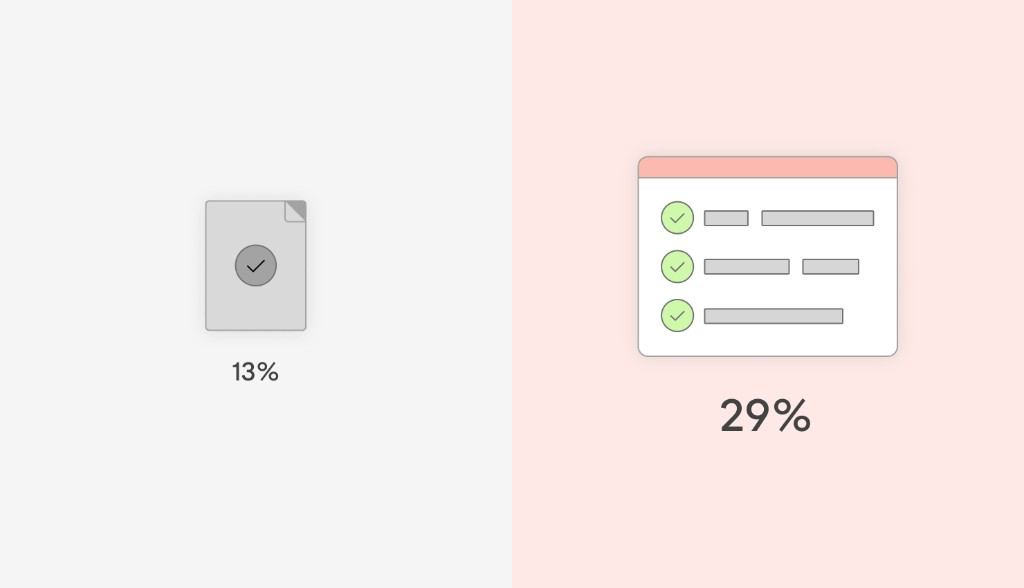
The result? A 49% perfect match rate with a Custom AI Profile, compared with 13% using generic AI.

This is counterintuitive. You'd expect AI to struggle most with highly creative, heavily localized content. But the logic makes sense: the more personalized your content is, the more nuance exists in your approved translations — and the more signal RAG has to work with. When your human translators have invested effort in getting the tone exactly right, that effort becomes the AI's best training data.

For content with minimal human editing, the gap between Custom and Base is smaller — because there's less nuance for the AI to pick up. The takeaway: Custom AI profiles add the most value precisely where the stakes are highest.

Here's what customers are reporting:

  • “The results were definitive. AI with RAG clearly outperformed generic AI — it would be silly not to use it.” - Senior Localization PM, European fintech
  • “The AI profile really calmed down a lot of issues our linguists were having. The more we translate, the more it adapts to preferences, and we stop making the same post-edits repeatedly.” - Technical Writer, Supply Chain Management
  • “It's getting closer to our preferred style. Once corrections are made, the AI seems to accept the changes and starts producing the correct format in similar cases.” - Localization Lead, Consumer mobile app

What this means for your team

The bigger point isn't the feature — it's the shift in how localization teams can operate. For years, the conversation around AI translation quality has been stuck in a loop of subjective impressions, vendor benchmarks that don't reflect your reality, and expensive external audits that deliver results too late to influence decisions.

Proof of Value breaks that loop. It gives you an objective, repeatable, data-backed answer to the question your leadership is already asking: Does this actually work for us?

Here's how I'd recommend approaching it:

  1. Start with your highest-value content. Don't test on throwaway strings. Run the evaluation on the content where quality matters most — that's where the delta between Custom and Base will be most meaningful, and where the business case is strongest.
  2. Invest in your reference data. Tag or review your best translations. The evaluation is only as good as your reference set. If your TM is messy, clean a subset first — even 500 high-quality keys are enough to get meaningful results.
  3. Re-evaluate after major changes. Ran a large translation job? Switched vendors? Cleaned up your TM? Run the evaluation again. Your AI's performance landscape shifts with your data.
  4. Use the results to build your business case. A 13% improvement in edit-free translations or 31% reduction in editing effort isn't abstract — it's directly translatable to time saved, cost avoided, and faster time to market. Pair Proof of Value results with Analytics data to tell the complete story.

The gap between “AI can translate” and “we trust AI to translate our content” isn't a technology problem anymore. It's a measurement problem. And now you have the tool to close it.

Proof of Value is available on high tier plans. Contact your CSM to get started, or speak with Lokalise about running your first evaluation directly from the AI Profiles section in your Lokalise project.

AI Translation

Author

Sasho.webp

Engineering Manager, AI

I'm Sasho, Engineering Manager at Lokalise where I manage the AI team, which mostly means I get to argue about evaluation metrics for a living and occasionally ship something that translates the internet slightly better.

Before this I spent a bunch of years in clinical NLP, including a PhD at Sussex teaching computers to read doctors' notes — which back then took years of research and is now roughly a weekend and a good prompt. Somewhere in there I picked up a handful of papers and patents, mostly on things like evaluating medical note generation and measuring how similar two sentences really are.

These days at Lokalise I help build the AI behind translation quality — RAG-based translation, evaluation pipelines, the unglamorous plumbing that keeps the AI-harness in check. It's going fine, mostly.

I studied Computational Linguistics at the University of Tübingen before my PhD at the University of Sussex, and I've spent 14 years across NLP research and AI engineering, with stops in academia, clinical AI, and now localization.

You can also find me at sasho.io and on Google Scholar.

AI translation quality evaluation: Looking beyond human review

AI translation quality evaluation: Looking beyond human review

The meeting is going well. Translation costs are down, turnaround times are shorter, and AI is taking on more of the work. Then your VP asks a question: “How do you know the quality of AI translations is good enough?” Most localization teams can confidently measure speed and cost, but measuring quality is far less straightforward. Reviews, spot checks, and a handful of examples help, but they don't provide a consistent basis for deciding where

Read more AI translation quality evaluation: Looking beyond human review

MCP for localization

MCP for localization: How to connect AI agents to your translation workflow

You're in Cursor, working on a new feature, and you need to add a localization key. That means leaving your IDE, opening your TMS, navigating to the right project, making the change, and coming back. Then, doing this all over again the next time you need to check untranslated strings, create a task, or touch anything localization-related. Model Context Protocol (MCP) removes this context-switching loop entirely. Instead of bouncing between tools, your AI coding assistant can inter

Read more MCP for localization: How to connect AI agents to your translation workflow

AI tools for localization teams

7 AI tools your localization team needs to master in the GenAI era

GenAI isn’t just changing how translations are produced. It’s reshaping the entire localization workflow. Most teams didn’t build their workflows for this shift. They’re still relying on a mix of spreadsheets, standalone MT engines, and manual file handoffs. It’s familiar, and for a while, it worked. But it was never designed for the scale teams are dealing with now.

Read more 7 AI tools your localization team needs to master in the GenAI era

Stop wasting time with manual localization tasks.

Launch global products days from now.

  • Lokalise_Arduino_logo_28732514bb (1).svg
  • mastercard_logo2.svg
  • 1273-Starbucks_logo.svg
  • 1277_Withings_logo_826d84320d (1).svg
  • Revolut_logo2.svg
  • hyuindai_logo2.svg