
AI Translation

7 AI tools your localization team needs to master in the GenAI era

Mia Comic,Updated on May 5, 2026·12 min read
AI tools for localization teams

GenAI isn’t just changing how translations are produced. It’s reshaping the entire localization workflow.

Most teams didn’t build their workflows for this shift. They’re still relying on a mix of spreadsheets, standalone MT engines, and manual file handoffs. It’s familiar, and for a while, it worked. But it was never designed for the scale teams are dealing with now.

Content volumes are expected to grow 5X in the next three years. At the same time, AI adoption in localization has surged, with 72% of teams exploring new AI investments and many already integrating AI into their workflows.

Growth now means entering new markets, keeping pace with ongoing product updates, and managing content across multiple channels. The challenge is to translate faster while staying consistent, accurate, and on-brand.

GenAI makes speed possible, but without the right setup, it also makes inconsistency easier to scale. Teams need a new toolkit to keep up. And more importantly, they need the right combination of tools working together.

Here are the 7 tools your localization team needs to master.
 

🤖 A realistic look at AI localization tools for teams

At scale, localization breaks down in predictable ways. Teams struggle with duplicated work, inconsistent terminology, slow review cycles, and rising costs. These issues show up constantly and they point to the same root cause: disconnected tools and inefficient workflows. Luckily, both are fixable.

The 7 AI tools your localization team needs to master

Modern localization teams rely on a set of AI localization tools that work together. Each solves a specific part of the workflow, from translation to quality control.

If you’re evaluating the best localization tools in 2026, this is the stack to understand. These are the core GenAI tools for translation teams that turn fragmented workflows into scalable systems.

1. Translation management system (TMS)

A translation management system (TMS) is a centralized platform that manages all localization workflows—from content ingestion and translation assignment to review, quality assurance, and publication.

As AI tools for localization teams speed up translation, the challenge shifts to coordination and control. Content moves faster, but without a system to manage it, teams face problems that could have been avoided.

Issues that compound across projects and markets include:

  • Terminology drifts across teams and languages, especially when glossaries aren’t consistently applied
  • Context gets lost between tools, so translators and reviewers work without seeing how content is used
  • Duplicate work increases, because previously approved translations aren’t reused effectively
  • Review cycles slow down, with no clear ownership or structured workflow
  • Quality becomes inconsistent, with no centralized QA or visibility into what’s ready to publish

A TMS solves this by acting as the operating layer for your entire localization workflow. It connects your localization tools, structures the process, and ensures every piece of content moves through defined steps, from translation to QA to release.

How Lokalise helps

Lokalise is built as an AI-native TMS designed for the GenAI era. It brings together key AI localization tools for teams in one platform—automating content ingestion, running AI pre-translation, routing content for review, and applying quality checks without manual handoffs.

AI localization tools Lokalise
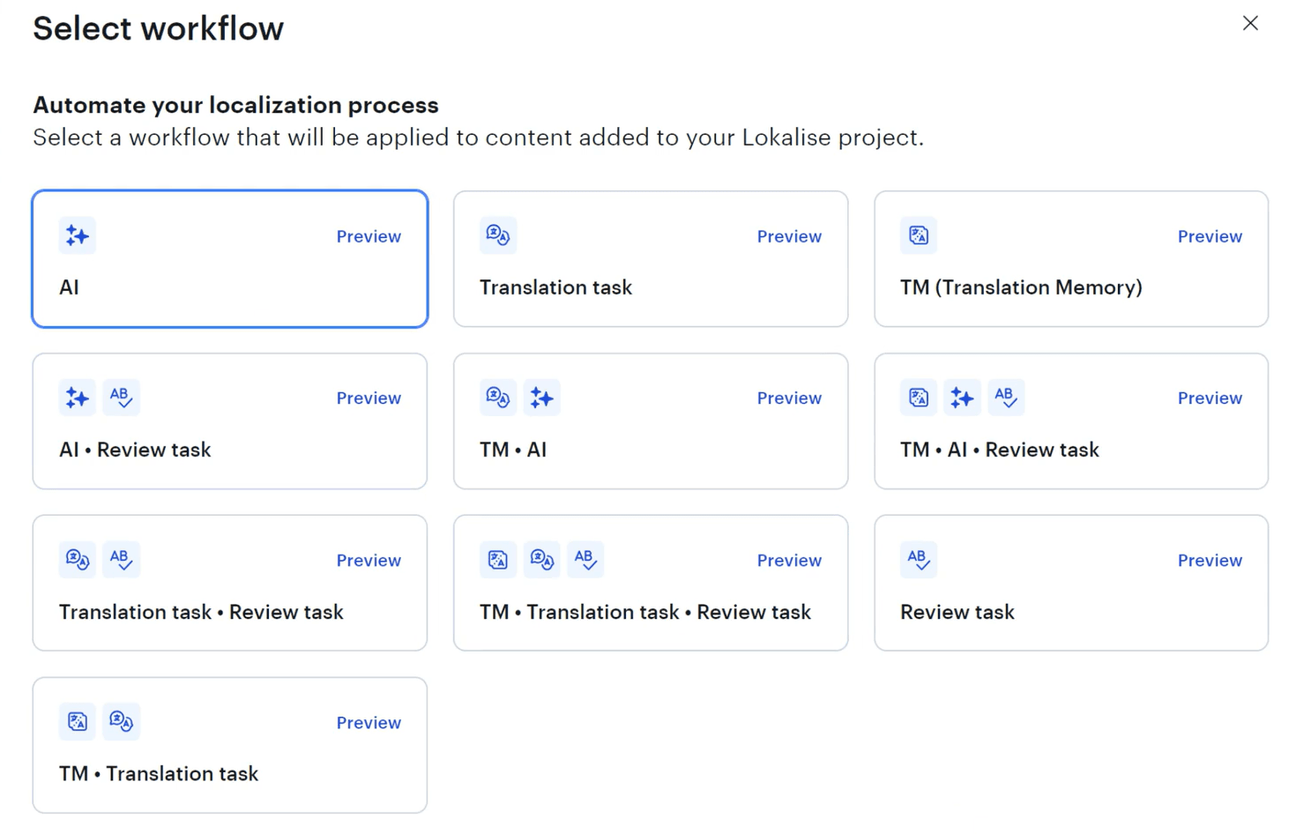
With Lokalise, you can create your own no-code automated workflows or customize these existing options based on your needs.

Instead of switching between tools, your team works in a single system that scales with your content and keeps everything consistent.

2. AI orchestration (multi-LLM smart routing)

AI orchestration in localization is the automated process of dynamically selecting the best-performing large language model (LLM) for each translation task based on language pair, content type, and contextual inputs.

Not all AI models perform equally. Some handle marketing copy better while others are stronger with technical content. Performance also varies by language pair. Relying on a single engine (or choosing models manually) means you’re potentially not optimizing for quality, speed, and cost savings.


AI orchestration in localization

Without orchestration, teams run into predictable issues:

  • Quality varies across languages and content types, depending on which model is used
  • Manual model selection slows teams down, especially at scale
  • Costs increase unnecessarily, when higher-cost models are used for simple content
  • Performance insights are lost, with no system tracking which models work best in which scenarios

AI orchestration solves this by turning model selection into an automated, data-driven decision. Each piece of content is routed to the model that performs best for that specific task, without requiring manual input from the team.

How Lokalise helps

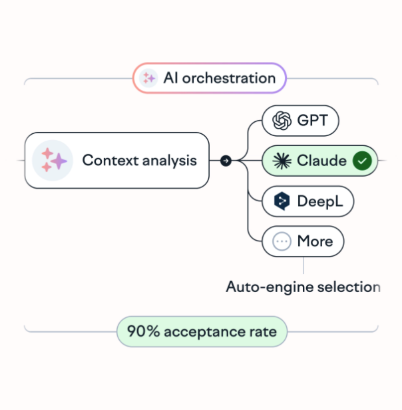
Lokalise’s AI orchestration automatically routes translations between models like GPT, Claude, and others based on real performance data, language pair, and content type. The result is consistent quality without the need to manage models manually. 

The impact is measurable:

  • Up to 80% of translations are ready to publish without post-editing
  • Translation cycles are up to 10× faster compared to traditional human workflows
  • Costs are reduced by up to 80% on average, compared to professional human translation

💰 AI can reduce total localization costs by 97%

In the most efficient localization teams, humans design the context and rules that guide AI. Lokalise research and customer data show how dramatic the shift can be. 

A traditional human translation workflow costs roughly $150,000 per million words, while an orchestrated AI workflow with contextual grounding can reduce that cost to about $5,000. That’s a 97% reduction in total localization costs. 
 

3. Translation memory (TM)

Translation memory is a database that stores previously approved translations and automatically reuses them when similar or identical content appears in future localization projects.

Translation memory has always been a core part of localization team software. In the GenAI era, it becomes even more important because it acts as the foundation for context.

AI models generate fluent translations, but without grounding, they default to generic output. That’s where TM comes in. It ensures that what your team has already approved continues to shape every new translation.

When TM isn’t properly integrated into your AI localization tools, teams run into familiar problems:

  • Approved translations get rewritten unnecessarily, creating inconsistency
  • Terminology and phrasing drift over time, especially across markets
  • Post-editing effort increases, because AI output doesn’t reflect past decisions
  • Costs rise, as teams spend time fixing work that should have been reused

How Lokalise helps

Lokalise integrates translation memory directly into its AI capabilities using a RAG (Retrieval-Augmented Generation) approach. At runtime, the system retrieves relevant TM matches and injects them into the AI generation step.

As a result:

  • Repeated content is automatically reused instead of retranslated
  • AI output aligns with your existing terminology and phrasing
  • Post-editing time drops significantly

💡 Pro tip

If you’re evaluating AI localization tools for teams, this is a key capability to look for. Without translation memory, scaling consistency becomes nearly impossible.

To make the most of TM in Lokalise, enable the “Pre-translate 100% TM matches” option. This is how Lokalise will automatically apply already-approved translations before AI processes any new content.

4. Glossary and terminology management

A localization glossary is a structured list of approved terms and their translations, ensuring consistent use of brand terminology, product-specific language, and industry jargon across all markets and AI tools.

AI models generate fluent text, but they don’t inherently know your product language, brand voice, or market-specific nuances. Without a controlled glossary, even strong translations can introduce subtle inconsistencies or incorrect terms.

These issues tend to show up quickly at scale:

  • Key product terms are translated differently across markets, creating confusion for users
  • Brand voice becomes inconsistent, especially in marketing and UI copy
  • Industry-specific language gets simplified or misinterpreted, reducing clarity and trust
  • Review time increases, as linguists spend time correcting terminology instead of refining meaning

A well-maintained glossary solves this by acting as a source of truth for terminology. It ensures that every translation, human or AI-generated, uses the same approved language.

How Lokalise helps

Lokalise integrates glossary and terminology management directly into its AI capabilities. Through its RAG-based approach, glossary terms are automatically retrieved and applied during the translation process. Teams can upload, approve, and manage terminology in one place, and AI consistently follows those rules as it generates translations.

This ensures:

  • Consistent terminology across languages, teams, and content types
  • Reduced review effort for linguists
  • Accurate, on-brand translations at scale

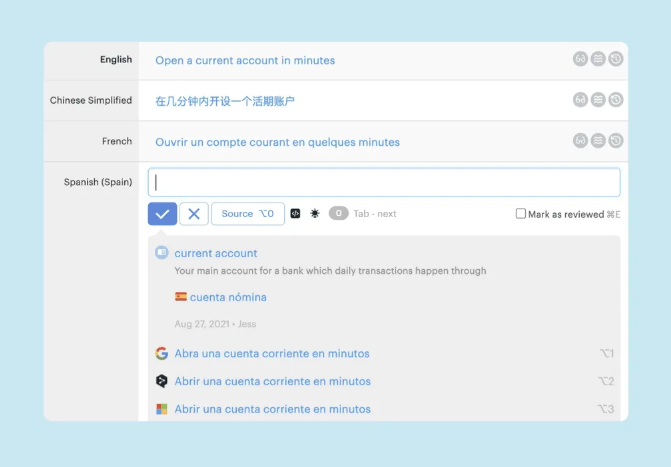
Let’s say you’re localizing a digital banking app. It includes a lot of industry-specific terminology, along with product feature names that shouldn’t be translated at all. Now take the term “current account.” It might need to be translated into Spanish as “cuenta nómina” for a specific market.

AI tools for localization teams

Without a glossary, AI might default to a more generic or incorrect equivalent. With a glossary in place, that choice is enforced every time.

5. AI translation quality scoring (LQA)

AI translation quality scoring (LQA) is an automated system that evaluates translation quality against linguistic standards, categorizes errors, and flags low-confidence segments for human review—eliminating the guesswork from localization QA.

As AI localization tools for teams speed up translation, quality becomes the main bottleneck. The challenge lies in knowing what’s good enough to publish and what still needs attention.

Without a scoring system in place, teams face a difficult tradeoff:

  • Review everything, which slows down delivery and creates unnecessary work
  • Review selectively without clear criteria, which risks errors slipping through
  • Rely on intuition instead of data, leading to inconsistent QA decisions

I used to stress that wrong machine translations were released before anyone could review them… Since last month, it's over. AI automation provides 90% translations right the first time.

~ Roman Dagan, Senior Product Manager at Florence

At scale, this doesn’t hold. Teams need a way to prioritize review effort and make quality decisions based on clear signals. You can learn more about LQA by watching the webinar below.

AI translation quality scoring turns QA into a structured, data-driven process. Instead of treating all content equally, it identifies which segments are high confidence and which require human review. In modern GenAI tools for translation teams, this becomes a key layer of control.

How Lokalise helps

Lokalise's Translation Scoring flags which translations need human review and which are ready to publish. It relies on the MQM (Multidimensional Quality Metrics) framework, a widely used standard for evaluating AI translation quality. This is how Lokalise automatically detects and categorizes linguistic issues, suggests corrections, and integrates directly into workflows.

That means:

  • High-scoring translations can move straight to publication
  • Low-scoring segments are automatically routed for human review
  • Teams focus their time where it actually adds value

The impact is immediate. With Lokalise’s AI capabilities, only around 20% of content requires post-editing, allowing teams to scale output without scaling review effort.

📚 Further reading

Discover the best tools for AI translation post-editing and learn the pros and cons of each.

6. Custom AI profiles (powered by RAG)

Custom AI Profiles are personalized LLM configurations that adapt AI translations to a brand’s specific voice, tone, terminology, and past approved translations using Retrieval-Augmented Generation (RAG).

AI models are good at producing fluent translations. But fluency isn’t enough. For localization teams, the real requirement is consistency. This means using the right terminology, matching brand voice, and aligning with how content has been translated before.

Without that layer, teams run into familiar issues:

  • Translations sound generic, especially in marketing and customer-facing content
  • Brand voice shifts across markets, depending on how the model interprets tone
  • Previously approved phrasing is ignored, even when similar content already exists
  • Review effort increases, as linguists rewrite content to match brand standards

How Lokalise helps

Lokalise’s Custom AI Profiles use a RAG-based approach to retrieve relevant translation memory, glossary terms, and style rules at runtime. That context is injected into the LLM before it generates the translation. The result is output that reflects your brand voice, terminology, and past decisions, consistently.

Normally, the overall process would have taken a minimum of 2 months and up to 3, depending on resources. Of course, I had to train the AI with our glossary and style guide and everything, but it was amazing. We finished and we were able to get to the finish line despite all the holidays.

~ Joaquín Muñoz, Localization Manager @ Life360

Custom AI Profiles Lokalise

For localization teams, this significantly reduces the gap between AI-generated content and human-reviewed quality.

The impact is clear:

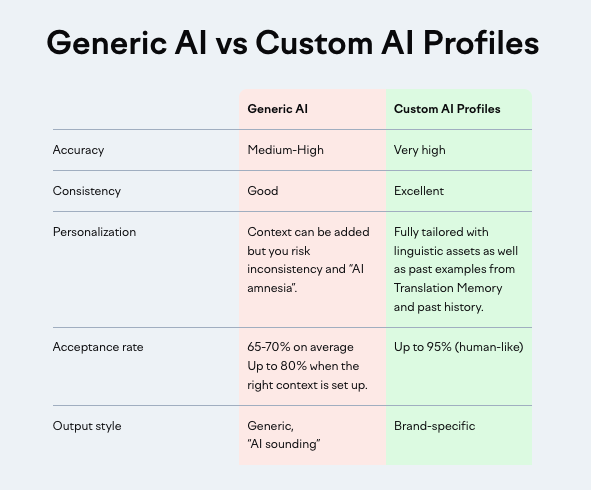
  • Custom AI Profiles achieve ~90% acceptance rates from human reviewers
  • Separate word quotas allow teams to manage usage independently from standard AI translations

By leveraging translation memory and AI translation for repetitive content and email templates, DepositPhotos cut email translation costs by 90%.
~ Tetiana Rublova, Localization Manager @ DepositPhotos


If you’re evaluating AI localization tools for teams, this is a key differentiator. Custom AI Profiles allow you to scale translation without losing the consistency and quality your brand depends on.

7. CAT tools for human linguists

Computer-assisted translation (CAT) tools are software environments that help human translators efficiently review, edit, and approve AI-generated translations using translation memory, glossary, and in-context previews.

Even with the best AI localization tools in place, human review is still mandatory. AI can handle volume and speed, but it doesn’t fully replace judgment. Especially when nuance, tone, and cultural context matter.

In practice, most teams see 80–90% of AI translations accepted as-is. The remaining 10–20% still needs human input. That’s where machine translation post-editing (MTPE) plays a key role.

Without a structured CAT environment, teams run into friction:

  • Review happens across disconnected tools, leading to copy-pasting and version issues
  • Context is missing, making it harder to assess how translations will appear in the product
  • Terminology and past decisions aren’t visible during review, reducing consistency
  • Linguists spend time on low-impact edits, instead of focusing on what actually needs attention

CAT tools solve this by giving human linguists a dedicated space to review and refine translations with full context. Instead of translating everything from scratch, linguists focus on:

  • Validating AI-generated content
  • Refining tone and cultural nuance
  • Reviewing high-stakes content like UI, legal, and marketing copy
  • Ensuring final quality before publication

This is what “humans in the loop” looks like in practice. AI handles scale while humans focus on quality.

How Lokalise helps

Lokalise’s editor functions as a built-in CAT tool within its localization platform. Linguists can review, edit, and approve AI-generated translations directly in the same environment where content is managed, without switching tools or breaking the workflow.

That means:

  • No copy-pasting between systems
  • Full visibility into translation memory and glossary during review
  • In-context previews for better decision-making
  • A seamless transition from AI output to final approval

For localization teams, this keeps human review efficient and focused, without becoming a bottleneck.

Is your localization team set up for the GenAI era?

Use this checklist to quickly assess where your current workflow stands:

  • A centralized TMS to manage your full localization workflow
  • AI orchestration that routes translations to the best-performing model
  • Translation memory integrated into your AI workflow to reuse approved content
  • A glossary that enforces consistent terminology across all markets
  • AI translation quality scoring to identify what needs review and what’s ready to publish
  • Custom AI profiles that align translations with your brand voice and past decisions
  • CAT tools that support efficient human review and machine translation post-editing (MTPE)

If you’re missing even one of these, your workflow likely has gaps, whether that’s slower delivery, inconsistent output, or unnecessary costs.

If you’re checking all seven, the next question is how well they work together.

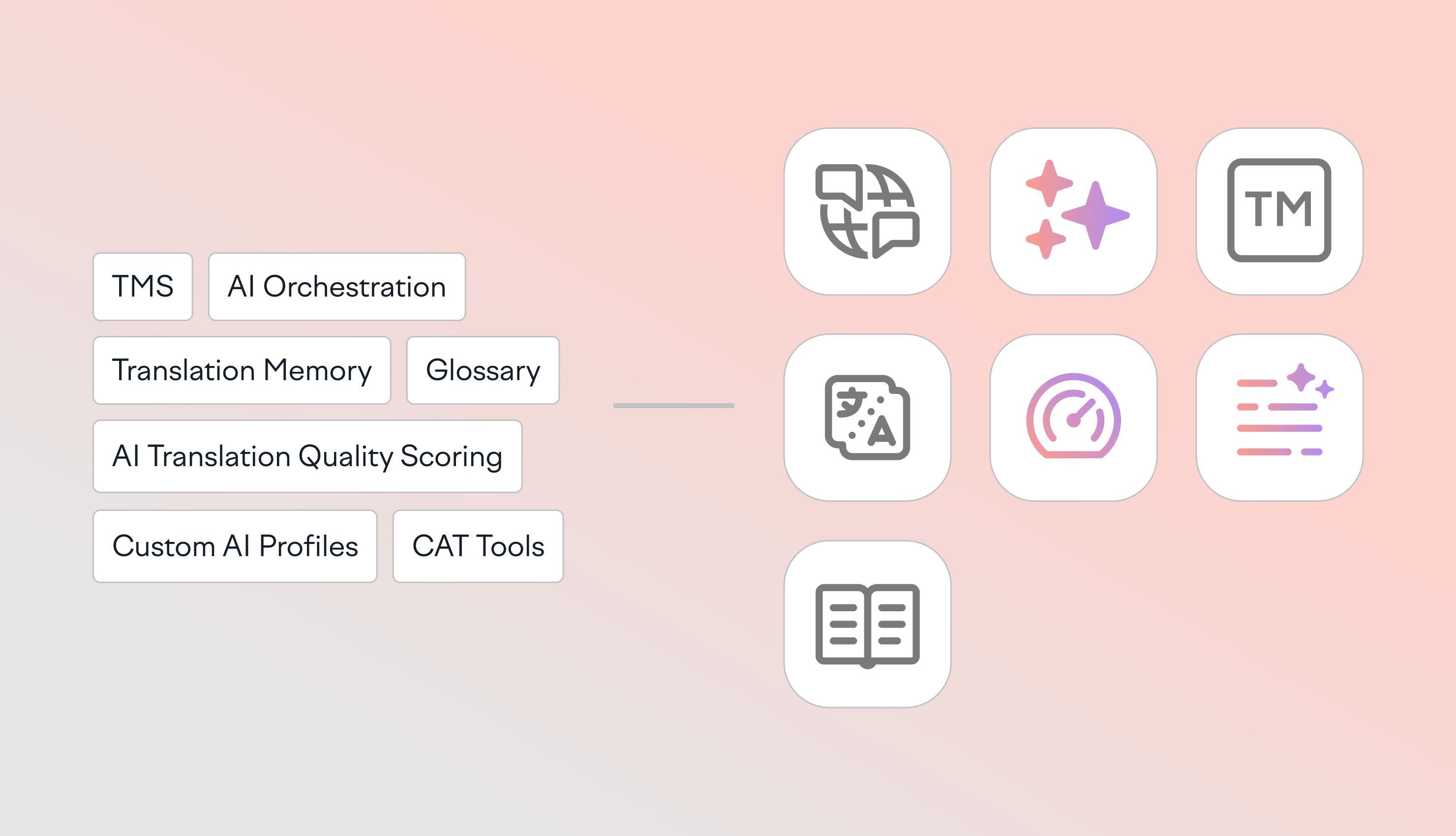
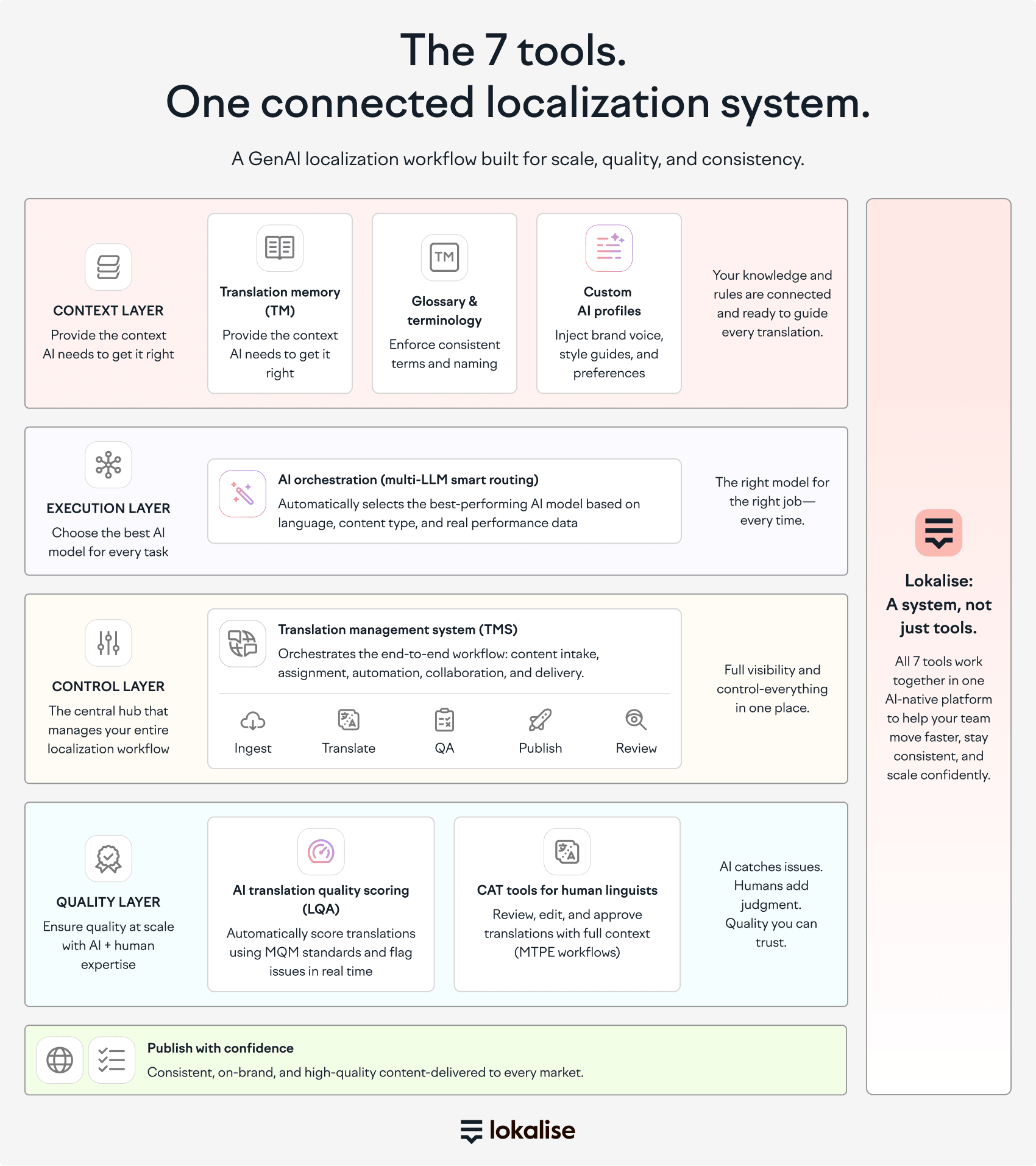
A GenAI-ready localization workflow depends on how context, automation, and quality controls connect. The visual below shows how these seven tools come together as a single system.

The 7 tools..webp


How to build a GenAI-ready localization stack

A GenAI-ready localization stack works as a system. Each tool that’s part of the system plays a specific role, and the value comes from how they connect.

Tool nameWhat it doesAI-native featureHow Lokalise handles it
Translation management system (TMS)Manages the full localization workflow from content ingestion to publicationCentralized workflow automation and orchestrationLokalise acts as the hub for all localization processes, with built-in AI workflows, automation, and full visibility across projects
AI orchestration (multi-LLM routing)Selects the best AI model for each translation taskDynamic model routing based on language pair and content typeLokalise automatically routes content between models like GPT and Claude using real performance data
Translation memory (TM)Reuses previously approved translationsContext injection into AI via RAGLokalise retrieves TM matches at runtime and injects them into the translation process to avoid rework
Glossary and terminology managementEnsures consistent use of approved termsTerminology enforcement during AI generationLokalise applies glossary terms automatically during translation through its RAG pipeline
AI translation quality scoring (LQA)Evaluates translation quality and flags issuesAutomated quality scoring using MQM standardsLokalise scores translations in real time and routes low-quality segments for human review
Custom AI profiles (RAG-powered)Adapts translations to brand voice and past decisionsContextual grounding using TM, glossary, and style rulesLokalise Custom AI Profiles inject brand-specific context into AI outputs for ~90% acceptance rates
CAT tools for linguistsEnables human review and post-editingStructured human-in-the-loop workflows (MTPE)Lokalise provides a built-in editor where linguists review, edit, and approve translations without leaving the platform

At the center is the translation management system (TMS). It acts as the hub where all localization workflows are managed. On top of that sits AI orchestration, which routes each task to the best-performing model based on language pair and content type.

From there, translation memory, glossary, and Custom AI Profiles provide the context layer. They ensure every translation reflects approved terminology, past decisions, and brand voice so AI output stays consistent across markets.

Next comes translation quality scoring, which acts as the quality gate. It determines what’s ready to publish and what needs human review, allowing teams to focus effort where it matters.

Finally, CAT tools enable human linguists to review, refine, and approve translations efficiently, closing the loop between AI speed and human judgment.

Together, these seven tools form a single, continuous workflow inside Lokalise. Content moves from ingestion to translation, review, and publication without switching systems or losing context.

Lokalise gives your team all 7 tools in one AI-native platform. Start your free 14-day trial or book a demo with a localization expert.


Frequently asked questions

What tools does a localization team need in the age of AI?

What is the difference between a TMS and a CAT tool?

What is AI orchestration in localization?

What is Translation Memory and why does it matter for GenAI localization?

Do localization teams still need human translators with GenAI?
 

What is RAG and how is it used in localization?

Why aren’t traditional localization tools enough in the GenAI era?

AI Translation

Author

mia.jpeg

Writer

Mia has 13+ years of experience in content & growth marketing in B2B SaaS. During her career, she has carried out brand awareness campaigns, led product launches and industry-specific campaigns, and conducted and documented demand generation experiments. She spent years working in the localization and translation industry.

In 2021 & 2024, Mia was selected as one of the judges for the INMA Global Media Awards thanks to her experience in native advertising. She also works as a mentor on GrowthMentor, a learning platform that gathers the world's top 3% of startup and marketing mentors. 

Earning a Master's Degree in Comparative Literature helped Mia understand stories and humans better, think unconventionally, and become a really good, one-of-a-kind marketer. In her free time, she loves studying art, reading, travelling, and writing. She is currently finding her way in the EdTech industry. 

Mia’s work has been published on Adweek, Forbes, The Next Web, What's New in Publishing, Publishing Executive, State of Digital Publishing, Instrumentl, Netokracija, Lokalise, Pleo.io, and other websites.

Guide to AI localization

AI localization: Definition, benefits, and best practices

We’ve all used machine translation tools, like Google Translate and DeepL, and know that they don’t always hit the mark. The translations can be amusing if you’re translating for yourself, but they could make for a poor customer experience in a business context. This is where understanding what is AI translation becomes important—it offers more advanced, context-aware solutions that go beyond basic word-for-

Read more AI localization: Definition, benefits, and best practices
Best translation tools

The best AI translation tools in 2026

Can AI translation tools really replace human translators? Not quite, but they can still save you tons of time and effort. At Lokalise, we tested the top ten AI translation tools to find out which ones are worth your attention. Whether you need quick document translations, website localization, or real-time multilingual support, we’ve got you covered.

Read more The best AI translation tools in 2026

Tools for AI Translation post-editing.webp

The 5 best tools for AI translation post-editing (MTPE)

AI translation post-editing tools promise 40-60% cost savings. In practice, you only get those savings when AI output is controlled. This means your terminology is enforced, risky segments are flagged before they go live, and linguists only touch what truly needs human attention. That’s why the best MTPE tools today aren’t standalone CAT tools or MT engines. They’re actually translation management systems (TMS) that orchestrate AI, terminology, and quality assurance in one place.

Read more The 5 best tools for AI translation post-editing (MTPE)