

AI Translation

AI translation with glossary support: Deterministic terminology for LLMs

Shreelekha Singh,Updated on April 26, 2026·6 min read
AI translation with glossary

LLMs are fluent in generating outputs, but they're not faithful to your brand.

When a general-purpose LLM translates your product UI into 15 languages, it doesn't know which terms are trademarked, which phrases have legal restrictions, or which features are deprecated. It makes a statistical guess. At scale, this guesswork can lead to major inconsistencies, compliance risks, and a post-editing overload.

The challenge: AI models’ probabilistic outputs are not ideal for your deterministic brand requirements. 

The solution: You need a constraint layer in your AI translation workflow that shapes models’ outputs to align with your brand guidelines. This is where your translation glossary can provide critical context for producing deterministic, brand-authoritative translation. 

In this guide, we’ll explain how AI translation delivers better output with glossary support. We’ll also share best practices for building an effective glossary.

What is AI translation with glossary support?

AI translation with glossary support is the process of integrating a defined terminology database into LLM or MT workflows. This ensures brand-specific terms, technical jargon, and forbidden words remain consistent across languages, preventing AI hallucinations and maintaining brand authority in the Answer Economy.

Why general-purpose AI models get brand translations wrong

A general-purpose LLM is trained on broad web data. It has no knowledge of your product naming conventions, legal disclaimers, and tone of voice, among other brand attributes. Plus, this model doesn't know your market either.

This is the context deficit problem. It’s a structural gap between what a generic model knows and what consistent, compliant translation actually requires. And you can’t fix this deficit by writing detailed prompts. 

Telling an LLM to “use these terms” leads to probabilistic compliance. That means, you might get a good output in a few test runs. But when you run the same prompt across 10,000 strings or a larger content volume, you’ll likely receive inconsistent results.

Fixing this problem would require:

  • Auditing every output
  • Re-queuing all translation strings
  • Bearing a high post-editing cost 

A more effective solution at the structural level is to move terminology control out of the prompt entirely and turn it into a dedicated constraint layer. That’s where your translation glossary comes into play.

💡 Automate context management at scale

Context is a prerequisite for producing deterministic translation output. But providing context at scale for thousands of strings and files can take up days or weeks. 

Learn how to automate context management for large translation projects to produce accurate output for every campaign.

How a translation glossary constrains LLM output

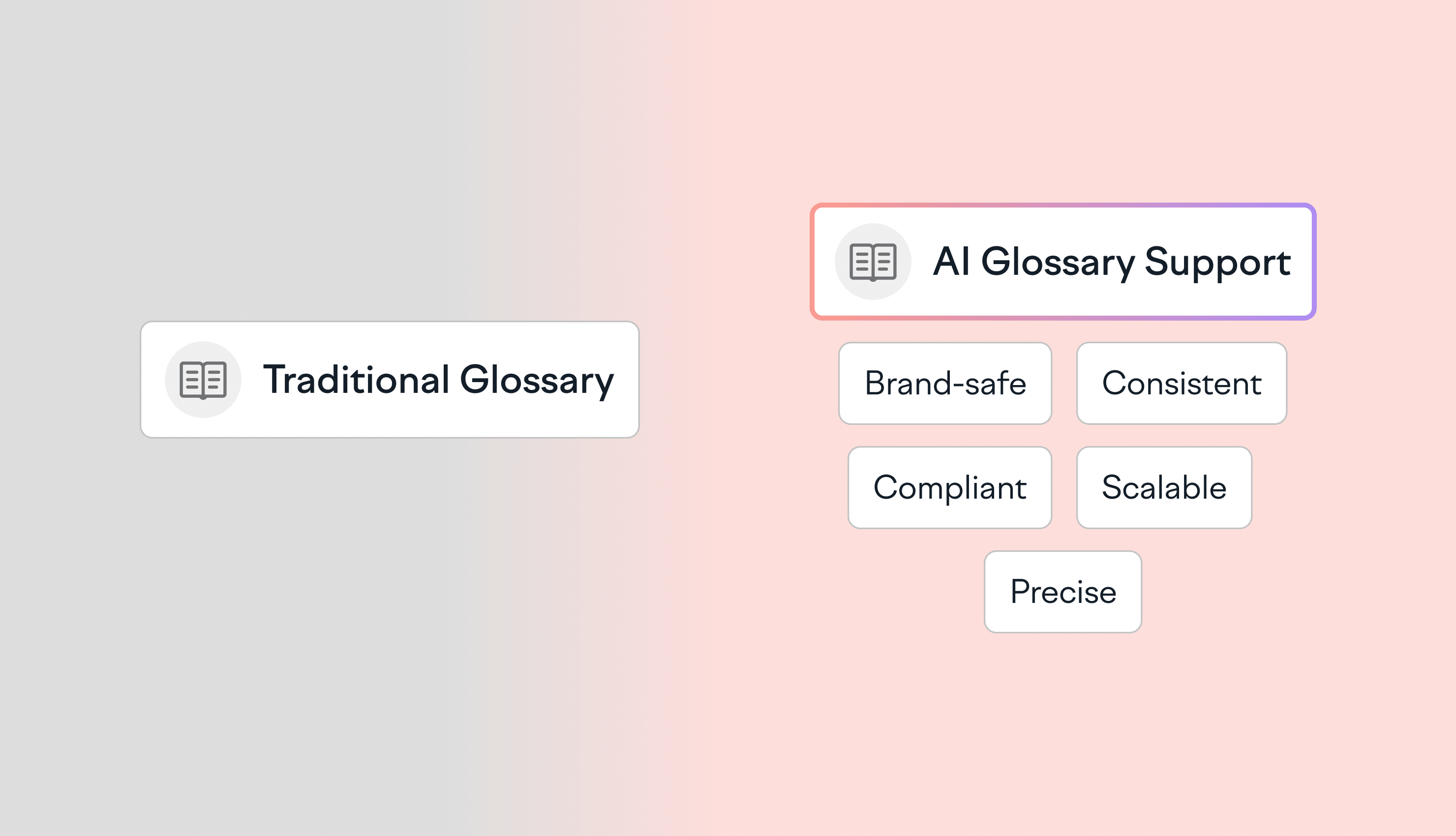
Traditionally, a translation glossary worked as a reference document in the form of a PDF in a shared folder, a tab in a spreadsheet, or a brief attached to a translation project. Linguists would refer to this tool passively when needed. 

Today, an airtight AI translation workflow uses the glossary as a critical guardrail for LLMs. Your translation glossary serves as a structured termbase with machine-actionable fields that LLMs use as hard constraints during output generation.

Here’s an overview of how the translation glossary has evolved with AI:

DimensionTraditional glossaryAI glossary support
ApplicationManual, translator-initiatedAutomatic, context-injected
ConsistencyVariable per translatorDeterministic per output
ScaleBreaks at volumeScales with AI throughput
GovernanceUndifferentiated listTyped fields: forbidden, non-translatable, case-sensitive
ScopePer-projectShareable across all team projects
AuditabilityLowFull term-level tracking (added by, date, tags)

Let’s understand how this works in a translation management system (TMS) like Lokalise.

Lokalise uses AI orchestration to give LLMs your complete brand context at the point of output generation, rather than as an instruction that the model may or may not follow. With this information, the model operates within this context as a constraint. 

When you build a glossary in Lokalise, you can create machine-actionable fields like:

  • Non-translatable: Brand names, product IDs, and proprietary acronyms that must pass through unchanged in every language. These terms are never translated. 
  • Forbidden: Terms that must not appear in any translation output. These could be deprecated product/feature names, legally restricted phrases, or competitor trademarks.
  • Case-sensitive matching: Critical for technical brands and acronyms where capitalization carries meaning.
  • Tags: Organize terms by product line, content type, or risk level, so the right terms travel with the right content.
  • Stemming: Lokalise automatically matches glossary terms across word forms, supported for 14+ languages. “Payment method” is automatically matched to “payment modes,” “paid method,” and other root-form variants without manual entry.

Here’s a preview of a glossary CSV file:

AI translation glossary CSV

These fields work together to close different failure modes. Non-translatable terms remain unchanged during translation. And forbidden terms don’t appear at all in the output. 

For example, if “Translate Now” is your product's primary CTA and you flag it as non-translatable, Lokalise's orchestration layer retains that term across all language pairs. If “Legacy Translate” is a deprecated feature name you've flagged as forbidden, it won't show up in any output, regardless of how frequently it appeared in the model’s training data. 

How Lokalise's AI orchestration leverages glossary context

LLMs are cooperative. When you tell them what context to use, the models mostly follow these instructions. But the challenge is to give these models precise contextual constraints so that the output aligns with your brand rather than sounding generic or causing compliance errors.

AI translation in Lokalise operates at an orchestration layer that routes content to the optimal model, such as GPT-5, Claude, and others, for every language pair and content type. 

Each translation task in Lokalise is enriched with the project glossary, translation memory, and style guide before the model generates anything. These form the contextual constraints the model operates within. 

Rather than loading the entire termbase into every prompt, Lokalise matches each source string lexically and injects only the terms that appear in it. This per-segment approach matters for two reasons:

  • Clean context: It keeps the context clean and prevents the risk of the model getting confused by irrelevant entries. A model handed 400 glossary entries for a string that contains two relevant terms is more likely to produce noise than one handed exactly those two terms. 
  • Better LQA: The matched terms carry through to your LQA process. That means the quality checks are evaluated against the same constraints the model was working with, instead of a separate reference layer.

As a result, around 80% of outputs are publish-ready without further edits. And glossary compliance plays a huge role in achieving this high degree of accuracy.

Here's how Lokalise’s glossary compares to the alternatives:

ApproachGlossary enforcementConsistencyReliability at scale
Raw LLM (direct API)ProbabilisticInconsistent across runsLimited
Standard MT engineNot appliedNoneHigh throughput, no control
Lokalise AI with glossaryDeterministic constraintsEnforced per outputEnterprise-grade

How to build an airtight brand glossary for AI translation

Now that we’ve understood how glossaries can support AI translation, let’s talk about the harder part of the problem: maintaining a well-governed glossary. 

Your brand terminology can change every week, features can be deprecated, and legal terms can be updated. All of these updates make your glossary outdated and create a liability because LLMs will faithfully enforce these obsolete constraints. 

That’s why we recommend these best practices for building and maintaining your AI translation glossary.

Types of terms to include

Define three categories of terms for your brand glossary:

  • Brand and product terms: This covers product names, feature names, company names, branded services, UI element labels, and taglines. Flag non-translatable where the source form must carry through unchanged. 
  • Technical and domain terms: This covers industry-specific jargon, technical identifiers, and regulatory or legal terminology requiring precision. Include language-specific approved translations so the model doesn't invent equivalents.
  • Forbidden and risk terms: This covers deprecated product names, retired brand language, competitor trademarks, and legally restricted phrases. Use the Forbidden flag in your Lokalise glossary.

Governance basics

Glossary quality inevitably decays without anyone actively reviewing and maintaining the termbase. That’s why it’s important to clearly define:

  • Who can add terms
  • Who approves them
  • Who reviews for compliance

Lokalise's permission model supports contributor-level access to glossary management. This means you can structure your permissions to match your localization and brand review workflows rather than giving every team member unrestricted write access.

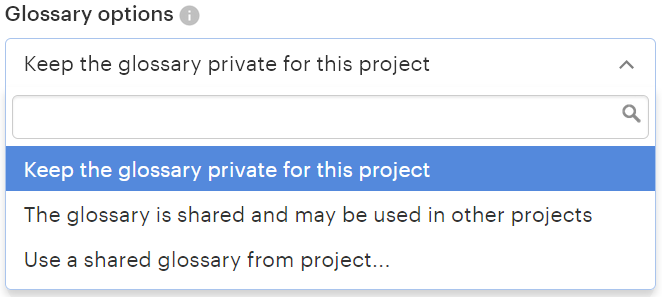
For teams managing multiple product lines or regional deployments, the Shared Glossary feature ensures a single source of truth across all projects.

Lokalise glossary maintenance

The quality of your glossary determines the quality of AI translation output. That’s why this governance infrastructure becomes load-bearing for enterprise organizations managing hundreds of glossary terms across dozens of locales. 

Get your terminology right for AI translation

Think of your glossary as a critical part of the AI translation infrastructure. Rather than a tool of passive reference, it’s the constraint layer that makes AI translation deterministic, brand-consistent, and defensible at scale.

The ROI of getting this right is direct. Glossary compliance creates deterministic, brand-aligned output. This means fewer review cycles and lower post-editing volume. And for teams expanding into multiple new markets, brand consistency at that scale is achievable with a well-governed glossary acting as a constraint layer. 

Start a free 14-day trial of Lokalise and see how glossary integration changes your AI translation output from the first run.

FAQs about AI translation with glossary

Will Lokalise's AI translation automatically use my glossary?

How do I prevent AI from translating brand names?

Can AI models like GPT-4 respect a translation glossary on their own? 

What is the difference between a glossary and a style guide in Lokalise? 

AI Translation

Author

shreelekha_singh.png

Shreelekha has spent the last 7 years helping B2B brands tell their stories through product-led content. Her ability to perform deep, journalistic research and build engaging narratives around complex topics is one of her strongest suits. 

Thanks to her collaboration with eCommerce-focused brands, she's written extensively about international growth and gained firsthand experience in localized marketing. As she researched markets across Europe, the Americas, and Asia, she developed an instinct for cultural nuances that shape how different audiences engage with content. This sparked a deeper curiosity about how people navigate the virtual world. Through her contributions to the Lokalise blog, she's pursuing this curiosity.  

Shreelekha is also skilled at creating product-led content. Her work with brands like WordPress, Backlinko, Softr, and Riverside continues to hone her skills as a writer, researcher, and marketer.

A big football and F1 fan, Shreelekha is currently learning Spanish and Japanese to feel more connected to her favorite sports and athletes.

Context is king

How to give AI translation tools more context

Why is it so hard to get translations that tick all these boxes? Sensitive to cultural normsIndustry-specificOn-brandAccurate If you’ve translated product copy, marketing content, or anything else in the past, you’ll know that it’s hard to get translations right—at least the first time around. This is where many begin asking: what is AI transl

Updated on December 5, 2023·Rachel Wolff
how AI translation works

How AI translation works (and why it’s better than you think)

Ever wondered what actually happens behind the scenes when you hit “Translate” in an app or website? AI translation tools seem almost magical. What is AI translation? It's the use of artificial intelligence to turn content from a source text into another language in seconds. But behind that quick result is a lot of clever technology doing the heavy lifting.

Updated on April 15, 2025·Mia Comic
What is AI translation

What is AI translation: 12 key questions answered

Translation doesn’t have to be slow, expensive, or manual anymore. Thanks to AI, you can translate content into multiple languages incredibly fast. But if AI translation is so great, why do we still have human translators? What’s it all about? If you’re wondering what AI translation actually is, you came to the right place. Keep reading to discover answers to ten key questions, and learn what AI translation is all about.

Updated on April 29, 2025·Mia Comic