



How to build the business case that turns localization from a line item into your highest-return growth lever.
Your board wants growth from global markets. Your competitors are already there. And your localization team has the tools to deliver. So why is localization still stuck in the "cost center" conversation?
It's a familiar tension. The data overwhelmingly shows that localization drives revenue — through discoverability, conversion, and loyalty. Yet in too many organizations, the budget sits with one team while the benefits accrue to another. The result? A fragmented story that never quite reaches the C-suite in the right shape.
That's the challenge Sophie Krishnan, CEO at Lokalise, and Sahil Gambhir, CPO at Lokalise, tackled head-on in a recent conversation with localization leaders. Their message was clear: the ROI case for localization has never been stronger — but it takes the right framing, the right proof, and the right infrastructure to land it.
Here's what they shared.
Watch webinar | The highest ROI decision in your global strategy
Lokalise's CEO and CPO on what it takes to unlock the highest ROI opportunity in your global strategy — and the product proof that it's already possible.
Localization is now a C-suite conversation — but often for the wrong reason
AI has done something unexpected for localization teams. It's pushed their work into leadership conversations. But it's often for the wrong reason.
"The question C-suites are asking is: 'Can't we just use an LLM wrapper?'" Sophie explained. "That's the wrong question — but it opens the right door."
The real opportunity isn't about replacing translators with a chatbot. It's about using the AI wave to reframe localization as what it actually is: a growth lever with measurable returns.
In a live poll during the session, the majority of attendees confirmed that the AI surge of the past 18 months has elevated localization as a C-suite priority. But confidence in making that business case? Mixed at best.
That gap — between opportunity and confidence — is exactly where the ROI conversation needs to focus.
The return side: what localization actually delivers
Let's start with the numbers.
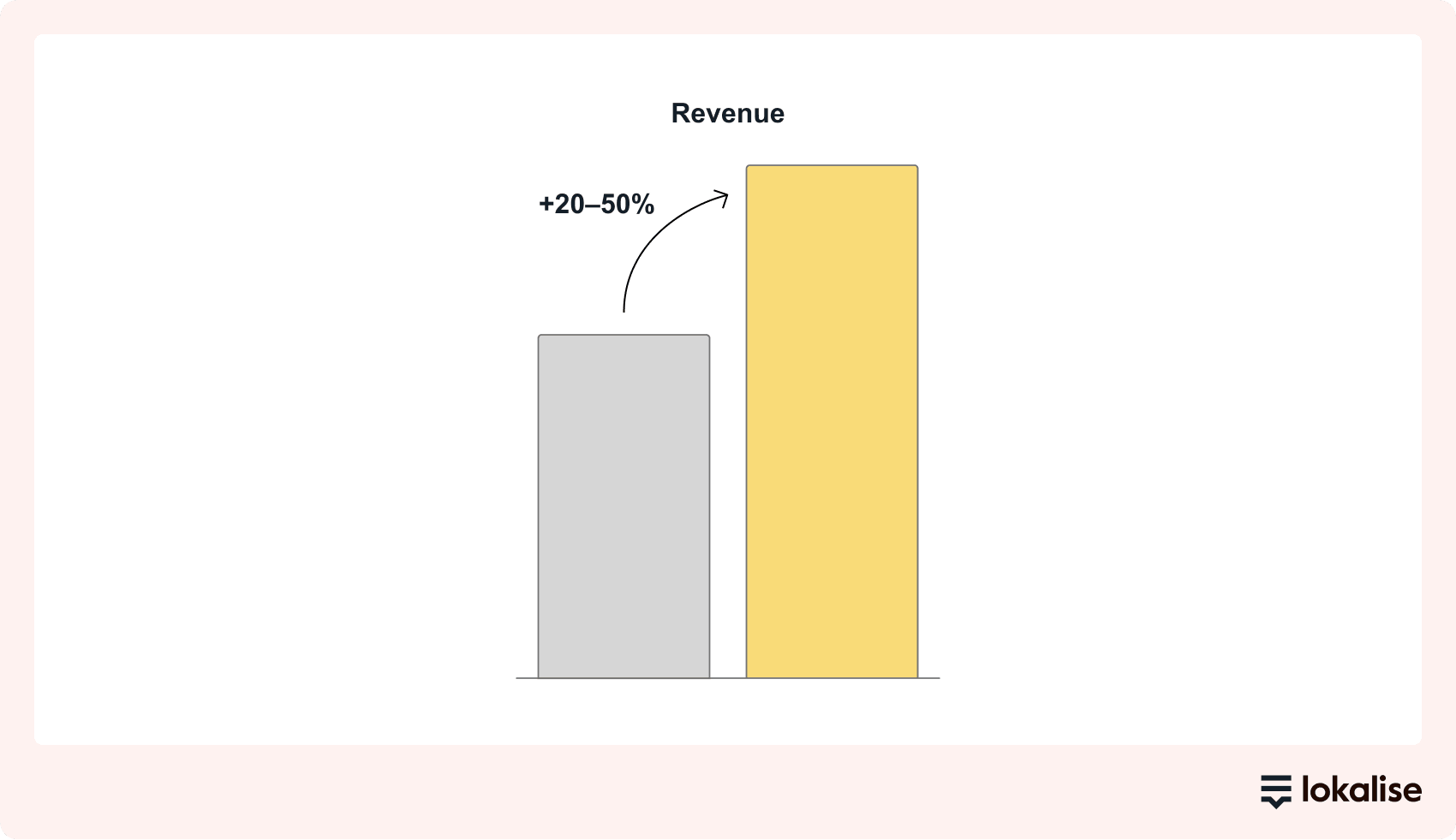
Sophie pointed to industry data showing that localization drives a 20–50% revenue increase, depending on setup, quality, and where you are in the customer journey. Among Lokalise customers, 10% report that high-quality localization contributes to more than half of their revenue growth.
Those returns come from three places:
Discoverability. As AI-powered search engines increasingly optimize for local language, content that speaks natively to users gets found first. This isn't just about SEO anymore — it's about being visible in the LLM-driven answers your buyers see.
Conversion. Seven out of ten users choose content in their native language when given the option. That's not a preference — it's a buying signal.
Trust and loyalty. According to Nimdzi research, 71% of users report a lack of trust when they encounter poorly translated content. Bad language doesn't just lose a sale — it erodes the relationship.
"Localization isn't just about reaching more markets," Sophie noted. "It's about resonating in those markets. The revenue upside is real — in visibility, conversion, engagement, and repeatability."
The investment side: from 30% to 90% cost reduction
If the return side makes the case for localization, the investment side makes it irresistible.
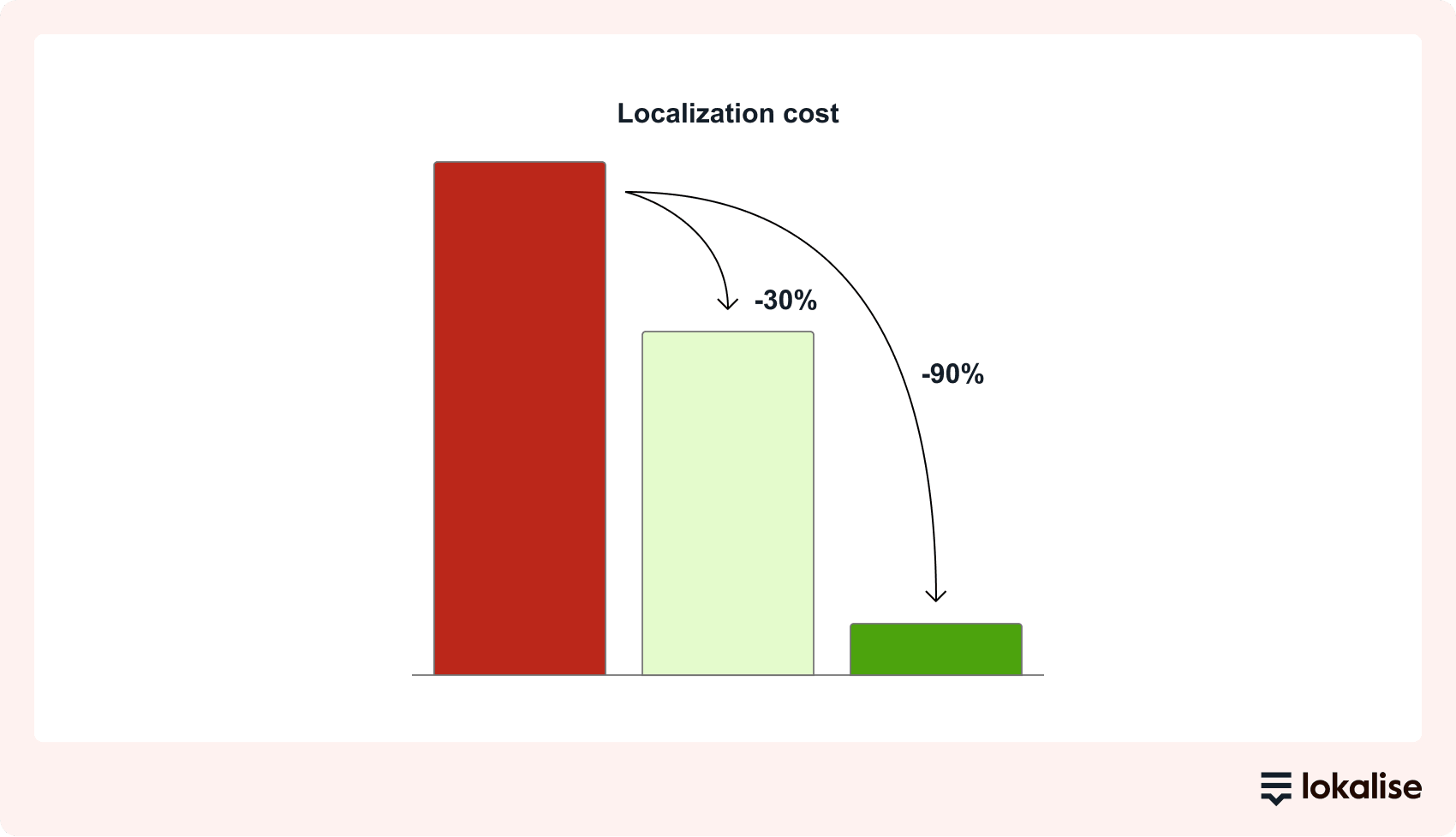
Sophie outlined a clear range: with the right setup and high-quality AI, organizations can reduce localization costs by approximately 30%. With a full infrastructure — the right platform, AI-powered quality scoring, and human review only where needed — that number climbs to around 90%.
But she was candid about the journey.
"This isn't a quick win. It's not flipping a switch. Many of our customers are at 50%+ cost savings and scaling from there. The important thing is recognizing it's a progression — and starting."
The math isn't theoretical. It's grounded in how modern localization platforms handle the work: AI handles the bulk of translation at speed, quality scoring identifies what's ready to publish and what needs a human eye, and human reviewers focus only on the content that actually requires their expertise.
The old trade-off — speed vs. quality vs. cost, pick two — is gone.
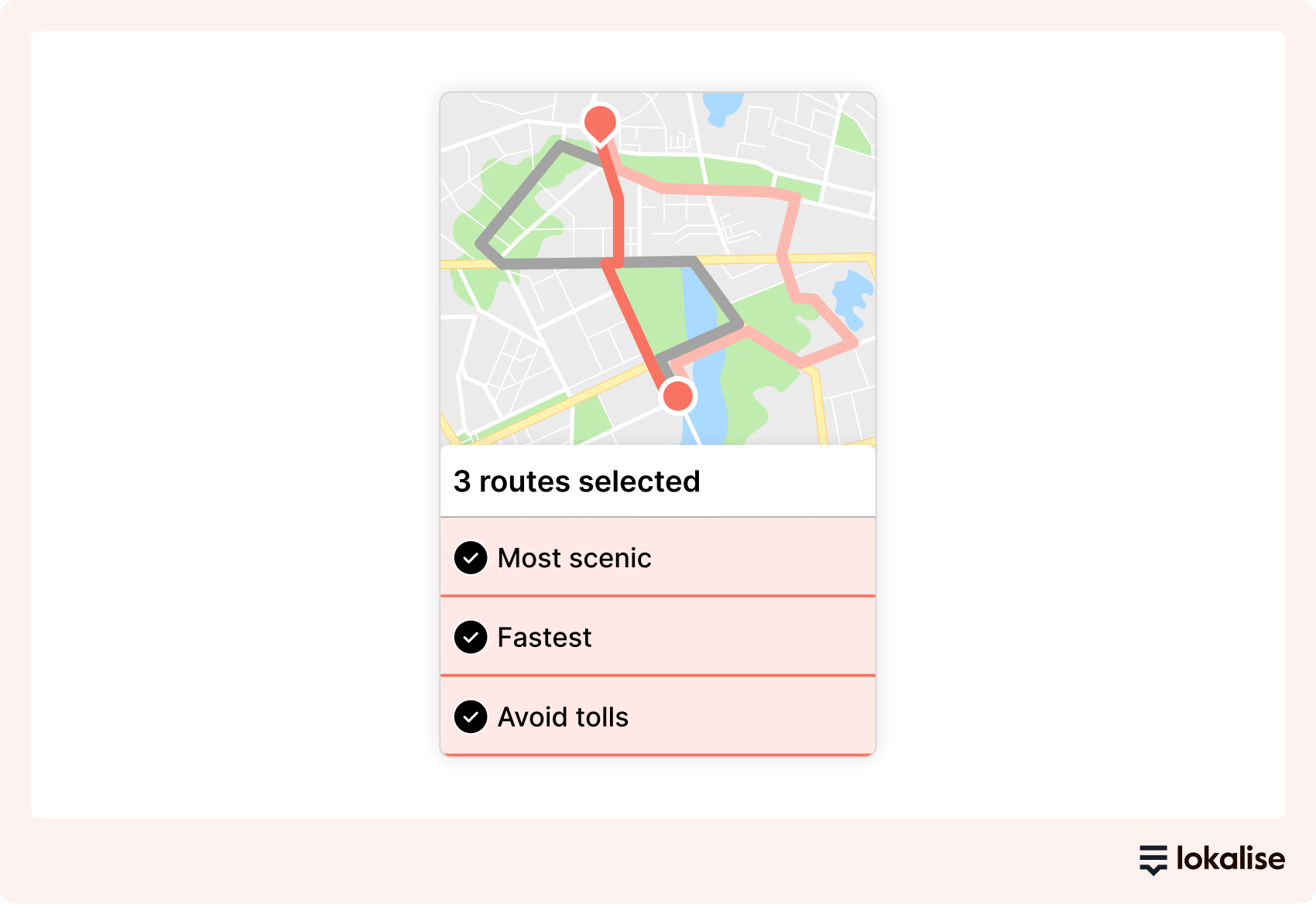
Sophie used a GPS analogy to drive the point home, the destination is the same but the way to get there has changed: "Previously, you had to choose between the highest quality, the fastest time to market, or the lowest cost. Now, with AI and the right infrastructure, you can have all three. That's what's changed."
Building the business case: one story, one platform
Here's where most localization champions get stuck. Not because the data isn't there — but because the story is fragmented.
Sophie identified the core problem: "The revenue upside sits with one team. The time savings sit with engineering. The cost reduction sits with procurement. The localization champion needs the mandate to pull all of that into one consolidated business case."
Two things make the difference:
One consolidated business case. Not three separate pitches to three different stakeholders. One story that connects revenue growth, operational efficiency, and cost savings into a single narrative your leadership can act on.
An infrastructure play, not ad hoc tools. "This isn't about plugging in an AI wrapper," Sophie emphasized. "It's about one platform that gives you quality, scale, and — critically — proof."
That last word matters. A business case without proof is a pitch. A business case with proof is a strategy.
How Lokalise makes the ROI visible
This is where the product story connects directly to the business case. Over Winter and Spring 2026, Lokalise invested heavily in two areas: building trust in AI-powered localization and making results provable.
Here's what that looks like in practice.
Intelligent routing for higher quality
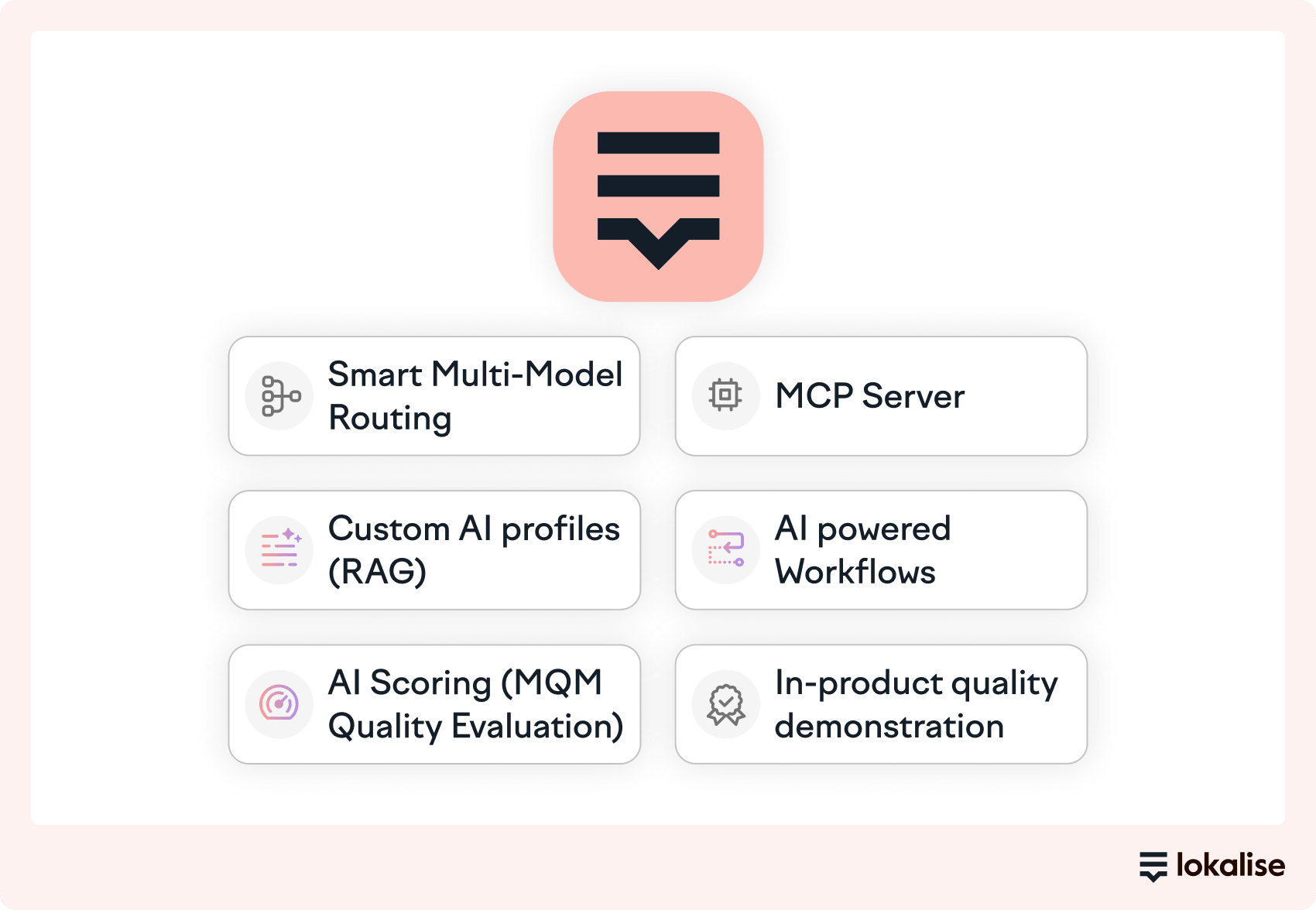
Lokalise's Language Intelligence Layer automatically selects the best-performing LLM for each language pair, domain, and content type. The result? Translation quality that's 33% higher than using ChatGPT alone — measured through real acceptance data across thousands of interactions, not lab benchmarks.
Customers can also choose their preferred LLM for compliance or legal reasons. The system adapts to you, not the other way around.
Quality scoring that saves money and time
Every translation is automatically evaluated and scored. High-confidence translations skip human review entirely. Low-confidence ones are routed to human editors with specific reasoning — so reviewers know exactly where to focus. That's smarter budget allocation and faster turnaround in one move.
Custom AI profiles for brand-level quality
Powered by RAG (Retrieval-Augmented Generation), Custom AI profiles leverage your past translations, style guides, and glossaries. The AI learns your brand voice, your terminology, your tone — and delivers translations that are contextually aware and on-brand.
The result: near 90% acceptance rates, approaching human translation quality. Customers in finance and healthcare are already seeing these results at scale.
Multiple profiles per organization mean your legal content, marketing copy, and product strings each get the right treatment.
Automation that runs itself
Lokalise's AI Workflows and MCP Server automate project management within the platform. Translation cycles that used to take weeks now take minutes — one customer translated one million words into two languages in 15 minutes.
The MCP server works with Claude, ChatGPT, and other AI tools, meaning teams can manage localization using natural language within their existing stack. No new learning curve.
In-product proof you can show your leadership
This is the feature Sahil was most emphatic about. Lokalise now includes an in-product quality demonstration that compares your results across a basic AI profile, generic machine translation (like Google Translate), and your Custom AI profile — using your own data.
"We built this specifically so you can show your leadership objective, transparent, verifiable proof of what's working," Sahil explained. "Not a slide deck. Not an assertion. Real metrics, inside the product."
For localization champions who've struggled to quantify their impact, this changes the conversation entirely.
How to start measuring ROI if you haven't yet
One of the most honest moments in the session came from a question many attendees were thinking: "We've been localizing for years across 15+ languages, but we've never measured impact. Where do we even start?"
Sophie's advice was practical:
Use new markets or new product launches as a clean baseline. Measure before and after. The fewer confounding variables, the clearer the signal.
On the cost side, patch together what you're spending across teams — translation vendors, internal review time, project management overhead — and compare it against quality metrics like acceptance rates.
On the revenue side, look at visibility, conversion rates, engagement, traffic, and customer retention in localized markets. A/B testing is ideal, but even before/after comparisons tell a story.
Time to market is a powerful and often overlooked metric. "Many of our customers went from months to days or hours," Sophie noted. "If your competitor launches in a market before you, you lose the advantage. Speed is ROI."
Sahil reinforced this with a personal example: an A/B test in South America where localizing into Brazilian Portuguese directly increased conversion rates.
The message? You don't need perfect measurement to start. You need a starting point.
Is AI Quality Good Enough for Brand-Critical Content?
This is the question every localization leader gets asked. Sahil was direct: "Out of the box? No. But with the right context — translation history, style guides, glossaries — the right LLM routing, and quality scoring with a human in the loop for sensitive content, it approaches human quality."
For very sensitive content — legal, medical, regulated — the answer is a human review step at a nominal extra cost. The system routes it there automatically.
Sophie put a number on it: "97% quality isn't a myth. It happens at scale when you combine Custom AI profiles, quality scoring, and human review for the last mile. We see it."
The Bottom Line: Localization Is Table Stakes Now
Here's the uncomfortable truth Sophie left attendees with: your competitors aren't waiting.
The brands winning in global markets have already figured this out. Their product resonates. Their message lands. Their language feels native in every market. That's not just translation — that's localization working at the highest level.
The tools are there. The AI is there. The proof is there.
The missing piece is the localization champion who brings it all together — with one unified business case, grounded in real data, and backed by infrastructure that can prove its own value.
That's not a cost center. That's the highest-ROI decision in your global strategy.
This article is based on the Lokalise webinar "The highest ROI decision in your global strategy," featuring Sophie Krishnan (CEO) and Sahil Gambhir (CPO). Watch the full session for additional insights and live Q&A.
Hi, I’m Marta, Senior Product Marketing Manager at Lokalise with 8+ years of experience across SaaS, product marketing, and global communication. I work on product launches, customer storytelling, AI localization initiatives, and go-to-market strategies that help companies connect with international audiences.
I’m especially interested in the intersection of AI, localization, and multilingual product experiences, and I regularly contribute to content and conversations around global growth and modern localization workflows. I’ve also hosted webinars and educational sessions on topics including AI translation, localization strategy, and scaling multilingual content for international teams.
I enjoy exploring creative approaches to storytelling and personal branding in tech — including a viral LinkedIn video campaign that turned my job search into a movie trailer-style product marketing launch.
I studied at Universitat de Barcelona and have worked with international teams throughout my career in tech, combining strategic communication with a strong customer and product focus.
Hi, I’m Marta, Senior Product Marketing Manager at Lokalise with 8+ years of experience across SaaS, product marketing, and global communication. I work on product launches, customer storytelling, AI localization initiatives, and go-to-market strategies that help companies connect with international audiences.
I’m especially interested in the intersection of AI, localization, and multilingual product experiences, and I regularly contribute to content and conversations around global growth and modern localization workflows. I’ve also hosted webinars and educational sessions on topics including AI translation, localization strategy, and scaling multilingual content for international teams.
I enjoy exploring creative approaches to storytelling and personal branding in tech — including a viral LinkedIn video campaign that turned my job search into a movie trailer-style product marketing launch.
I studied at Universitat de Barcelona and have worked with international teams throughout my career in tech, combining strategic communication with a strong customer and product focus.
Measuring the return on investment (ROI) of localization
There are numerous benefits of localization. But you still have to determine the impact of localization to your business to get the project approval from the various stakeholders. In this article, we'll cover how to estimate and measure the Return on Investment (ROI) of a localization project and how eff
Expert playbook for building a localization strategy
When you’re ready to expand your business globally, some ad-hoc translations won’t cut it. You need a localization strategy. A well-planned localization strategy helps you build more authentic connections with your audience, compete confidently against local players, and build a thriving global presence. But the tricky part is knowing where to start. Should you hire native experts first? Or focus on adapting the product to regional habits? Get the sequence wrong and you’ll w
Define or refine your localization strategy: insights from a localization pro
You can’t become a global brand without localization. You also can’t do localization without a solid localization strategy. As luck would have it, we hosted a webinar all about defining and refining the entire localization strategy-making process. During the