

The meeting is going well. Translation costs are down, turnaround times are shorter, and AI is taking on more of the work. Then your VP asks a question:
“How do you know the quality of AI translations is good enough?”
Most localization teams can confidently measure speed and cost, but measuring quality is far less straightforward. Reviews, spot checks, and a handful of examples help, but they don't provide a consistent basis for deciding where AI belongs inside your localization workflow.
So, how do you know the quality is good enough to scale AI beyond low-risk content? How do you prove that your personalized AI approach performs better than a generic model? And how do you make that case to leadership with something more convincing than, “Well, it looks good to us”?
This guide explains what rigorous AI translation quality evaluation looks like, why human review alone isn't enough (or sustainable) to measure quality consistently, and how enterprise teams can build the confidence to scale AI using objective, reproducible data.
📉 Scaling AI starts with evidence
Organizations no longer need to choose between quality and cost. According to Lokalise's original research, an orchestrated AI localization workflow set up with the right context can reduce total localization costs from roughly $150,000 to about $5,000 per million words, which is a remarkable 97% cost reduction compared with traditional human-only workflows.
In an enterprise context, those savings only become meaningful when teams can demonstrate that quality meets their standards. Without a rigorous AI translation quality evaluation process, faster and cheaper translations often remain stuck in pilot projects instead of scaling across the business.
It's important to establish that there are no external biases: Lokalise compares each AI method against the customer's own existing translations, not an internal benchmark, and it uses deterministic, industry-standard similarity metrics. The same translation always scores the same way.
The AI translation adoption gap nobody talks about
AI translation has reached a point where quality is no longer the main obstacle to adoption.
For example, Lokalise's Custom AI Profiles deliver up to 95% acceptance rates, matching professional human or human-reviewed translations, while reducing localization costs by up to 97% through lower reliance on human post-editing.
At Lokalise we have our own proprietary quality data. Those results come from hundreds of millions of real localization decisions, across 3,000+ companies, continuously updated with acceptance data from real translators and editors.
If that's the case, why do so many organizations still limit AI to low-risk content?
The challenge comes when it's time to use AI more broadly. Expanding into new languages, reducing human review, or trusting AI with higher-value content all require the same thing: confidence that the quality will hold up.
Most localization teams still can't answer a simple question with anything more rigorous than “it looks ok.” They know AI is faster. They know it's cheaper. But they lack a consistent way to measure whether one AI approach performs better than another, or whether the quality is good enough to support the next business decision.
🧠 Good to know
When we say “AI approach”, we refer to different ways of translating the same content within your translation management system. That could be a personalized AI model such as a Custom AI Profile in Lokalise, a generic AI model, or traditional machine translation.
The challenge with AI translation quality evaluation usually comes down to three things: 1) the struggle to measure quality consistently, 2) a lack of a framework for deciding when AI is ready for broader use, and 3) wasting too much time revisiting the same questions every time you want to expand AI into a new workflow.
1. Quality is not simple to measure
Turnaround time, cost per word, and post-editing effort all produce clear metrics. But translation quality is inherently subjective and varies depending on the customer and the evaluator. You probably still rely on sample reviews, individual feedback, or a handful of representative strings. Those approaches are useful, but they don't produce results that are easy to compare, repeat, or defend.
2. Without measurement standard, AI stays in pilot mode
Every expansion raises the same questions. Can we reduce human review? Can we use AI for marketing content? Can we roll this out to ten more languages? Without a reliable evaluation framework, every decision becomes a fresh debate instead of building on evidence gathered from previous work.
3. Teams that don't measure quality objectively struggle
Organizations without a repeatable way to evaluate AI translation spend more time debating whether AI is ready and more time deciding where to use it next. But once quality becomes measurable, scaling AI turns into a business decision instead of a leap of faith.
Why “we reviewed a sample” is not an evaluation
Most teams still start the same way: a linguist reviews a sample of AI-generated translations and decides whether the quality is acceptable.
While this is a useful quality check, it isn't enough to decide whether AI is ready for another language, another content type, or a lighter review process.
Human review has a few built-in limitations:
A sample isn't the whole picture. A handful of strings won't tell you how AI will perform across UI text, marketing campaigns, legal content, and support articles. The sample you choose influences the outcome.
There's no baseline. Three edits might represent a major improvement or a disappointing result. Without knowing how much editing your previous workflow required, the number has no context.
Different reviewers reach different conclusions. Translation involves judgement as well as accuracy. Two linguists can review the same output and make different edits. This makes the result difficult to reproduce.
First impressions last. Early experiences with a new AI model often shape later opinions, even after the model, prompts, or supporting workflows have improved.
To be clear, none of this makes human review less valuable. You still need it to assess meaning, tone, and brand voice. The difference is that human review on its own produces a judgement. It's opinionated. In contrast, an evaluation produces evidence you can repeat, compare, and use to make decisions.
What rigorous AI translation evaluation actually looks like
Rigorous AI translation quality evaluation isn't a single measurement. It combines three different layers, each designed to answer a different question. Treating them as interchangeable leads to poor decisions.
Each layer serves a different purpose, uses different data, and comes into play at a different stage of the localization workflow.
Measurement layer
Question it answers
When it's used
What it compares
Pre-production quality evaluation
Which translation method performs best for our content?
Before rollout or before expanding AI into new languages or content types
Different translation methods (such as a Custom AI Profile, a base AI model, and standard machine translation) against the same set of reviewed reference translations
In-production quality scoring
Does this specific string need human review?
During production
An individual translation against a quality threshold
Post-edit analytics
How much are we actually editing AI output in production?
After deployment
AI-generated translations against their final human-reviewed versions
Layer 1: Pre-production quality evaluation
Question it answers:Which translation method performs best for our content?
This is the decision layer. Before you expand AI into new languages or workflows, you need to know which translation method performs best on your specific type of content.
The evaluation uses the same source content and translates it using multiple methods.
In Lokalise, these include the Custom AI Profile, the base AI (Pro AI default that includes automated routing between multiple LLMs, like ChatGPT and Claude, with context from localization assets), and then standard machine translation, which doesn't include any context or linguistic assets such as a glossary or style guide. Each output is then compared against the same set of reviewed translations from your own work.
The comparison uses standardized metrics:
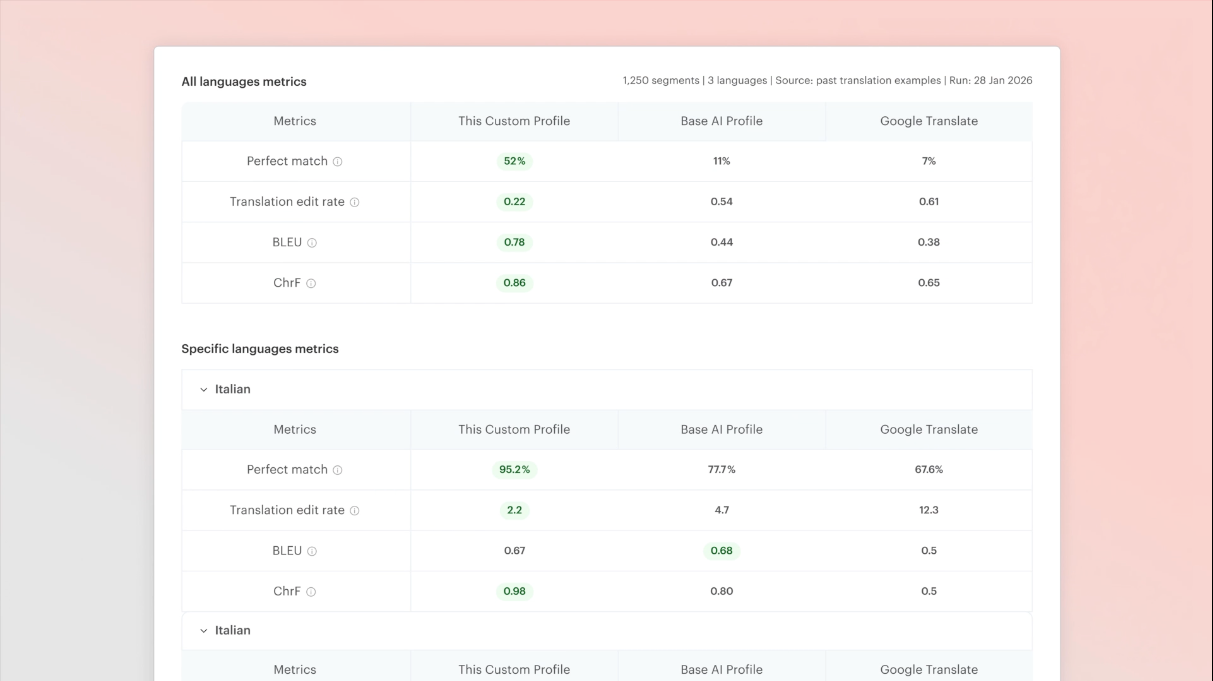
Perfect match rate: the percentage of AI translations that exactly match the reviewed reference translation.
Translation Edit Rate (TER): how much editing is needed to match the reference translation. A score of “0” means no edits are required, so lower scores are better.
BLEU and ChrF: established similarity metrics widely used in enterprise and academic machine translation evaluation.
To make this simpler to understand, let's look at a field example from Lokalise's customer pool: an internal evaluation by a localization team at a European fintech company.
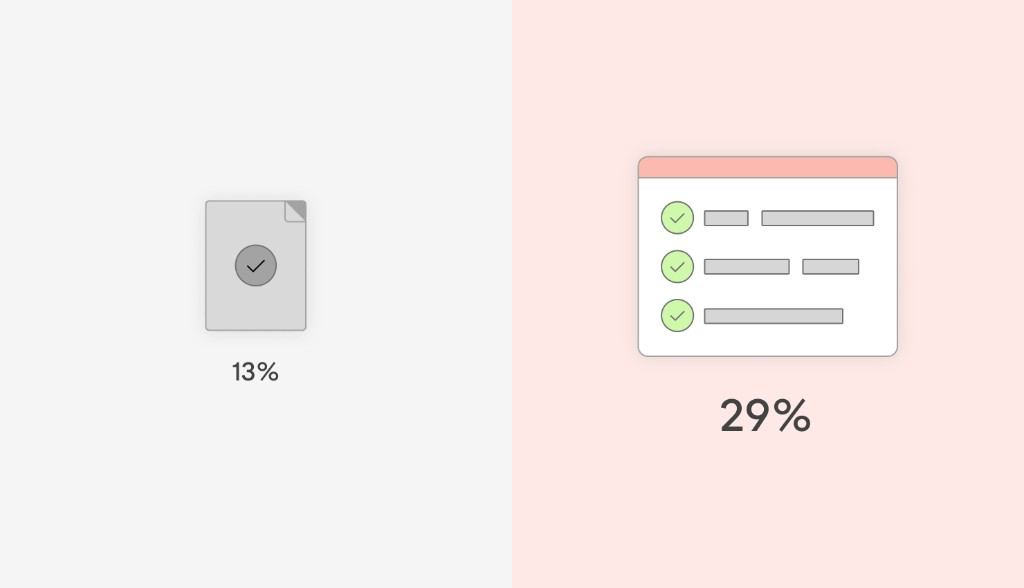
Using German engagement communications that had already been through a three-cycle human review workflow, the team compared a Custom AI Profile with the base AI model. The Custom AI Profile achieved a 49% perfect match rate, compared with 13% for the base AI model. This is a 36-point improvement driven by RAG personalization.
The value of this approach is that it isolates the effect of personalization. Because every other variable stays the same, you can see whether a Custom AI Profile delivers a measurable quality advantage over a generic AI model.
Layer 2: In-production quality scoring
Question you'll answer:Does this specific string need human review?
Once you've chosen a translation method, you'll face a new challenge. You're no longer deciding how the content should be translated, but whether this individual translation is ready to move forward.
AI quality scoring works one string at a time during the translation process. For every translated string, it estimates how likely the output is to meet your quality standards.
Translations that fall below the defined threshold are routed to a reviewer. Those that meet the threshold can move through the workflow without the same level of manual attention.
This allows reviewers to spend their time where it's most valuable instead of reviewing every translation equally. As AI handles a larger share of localization work, quality scoring helps teams scale without increasing review effort at the same pace.
🧠 Good to know
Unlike pre-production quality evaluation, this layer is not used to compare translation methods or decide which one to adopt. It acts as a quality threshold within an existing workflow.
Layer 3: Post-edit analytics
Question you'll answer:How much are we actually editing AI output in production?
The final layer looks at what happens after translations have been reviewed.
Post-edit analytics measures how much reviewers changed AI-generated translations in production. Over time, those edit rates show where AI is performing well, where reviewers consistently make changes, and which languages, content types, or workflows could benefit from further tuning.
This makes post-edit analytics useful for tracking long-term performance. For example, you might find that AI performs well on UI strings but requires more editing for marketing content, or that one language pair consistently needs more reviewer input than another.
💡 Pro tip
Watch for changes over time, not just the latest number. A sudden increase in edit rates may reflect new content, updated terminology, or a different review process rather than a drop in AI quality. Always take context into account.
The data quality problem most teams discover too late
A rigorous AI translation quality evaluation depends on one thing above all else: reliable reference data.
If your reference translations are inconsistent, outdated, or poorly matched to the content you're evaluating, the results won't tell you much about the quality of your AI translations. They will, however, tell you a lot about the quality of your data.
Three problems come up repeatedly:
Using AI-generated translations as the reference. Your benchmark should be a human-reviewed translation. If you compare one AI output against another, you can't tell whether either is actually producing the best result.
Relying on outdated translation memory. Language evolves. Products change. Your brand voice changes, too. A translation memory that no longer reflects your current terminology or style guide is a poor benchmark for evaluating today's AI output.
Mixing different types of content. UI strings, help documentation, product descriptions, and marketing copy all have different translation requirements. Evaluating them together makes it harder to understand how well AI performs on any one type of content.
The best reference data comes from human-reviewed translations that closely match the content you want to evaluate. If you're assessing AI for product UI, use reviewed UI translations. If you're evaluating marketing content, use reviewed marketing copy.
💡 Pro tip
As a minimum, Lokalise recommends preparing at least 500 reviewed translation pairs (source text and reviewed translation) for each language pair before creating and evaluating an AI Profile.
From proof to scale: what happens when you have the evidence
A quality evaluation should lead to action. The first step is understanding which translation method performs best on your content. Based on our experience, that's likely to be a Custom AI Profile, but it can also be a generic AI model, or another approach.
The important point is that the decision is based on evidence rather than assumptions. A typical progression we notice among enterprise teams testing AI orchestration in Lokalise looks like this:
The localization team evaluates different translation methods and finds that a Custom AI Profile performs best on its content.
The results are shared with leadership as evidence for expanding AI translation.
AI moves beyond low-risk strings into additional languages, content types, or workflows.
As more reviewed translations are created, the Custom AI Profile automatically benefits from a larger body of approved reference content. There's no need to retrain the underlying model.
Better translations support wider adoption, creating a cycle where each stage strengthens the next.
This is exactly how AI translation moves beyond the pilot stage. It's like a chain reaction. Evaluation provides the evidence to support the first expansion. Better results generate better reference data. Better reference data improves future translations. Over time, each step makes the next one easier.
How to start your own AI translation quality evaluation in Lokalise
A meaningful evaluation starts with reliable data and a consistent method. Before you run the evaluation, prepare:
At least 500 reviewed translation pairs for each language pair. These become your reference translations.
A consistent set of source strings. Translate the same content using each method you want to compare, such as a Custom AI Profile, the base AI model, and standard machine translation.
A standard set of evaluation metrics. Compare every output using Translation Edit Rate (TER) and perfect match rate so each translation method is measured against the same criteria.
During the evaluation, focus on the patterns. Ask yourself three key questions:
Are perfect match rates higher with the Custom AI Profile than with the base AI model?
Is Translation Edit Rate (TER) consistently lower?
Does the same trend hold across every language pair, or only some of them?
Results that fall short of expectations are often a sign that the reference data needs attention. The thing is, Custom AI Profiles learn from your reviewed translations, so inconsistent terminology, outdated content, or mixed writing styles will affect the outcome. Curating the reference data and running the evaluation again usually provides a much clearer picture.
Lokalise includes this evaluation in Custom AI Profiles. The in-product evaluation compares a Custom AI Profile, the base AI model, and standard machine translation using your own content, so you can see which approach delivers the best results for your specific use case.
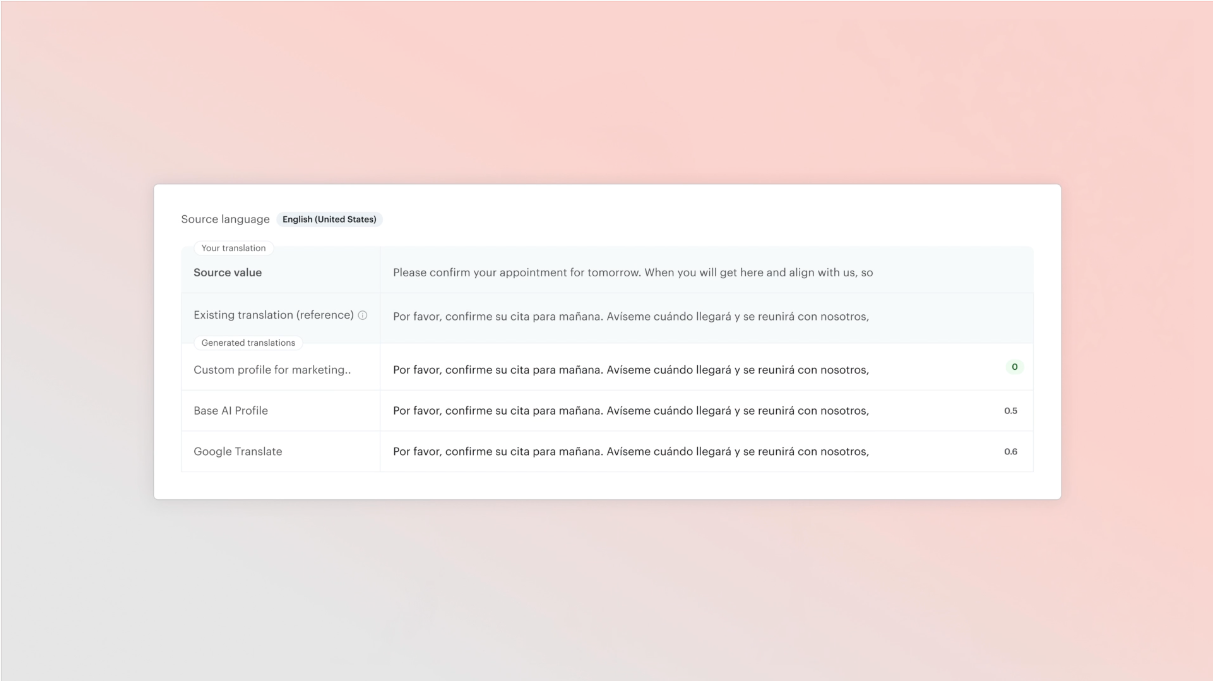
The evaluation runs automatically in less than 15 minutes and requires no external tools or support from the Lokalise team. Results combine quantitative and qualitative proof: a dashboard shows how often each translation method produces a translation identical to the reference, while side-by-side examples let you review the actual translations and judge the quality for yourself.
This makes it easy to see whether a Custom AI Profile outperforms more generic translation methods without having to interpret complex evaluation data.
Want to try it for yourself? It's available on all trials and then on higher tiers if you decide to become a paying customer. Start a free 14-day trial, no credit card required. See why IBM, JP Morgan, Roche, and 3,000+ global companies trust Lokalise as their AI localization platform.
FAQs
What is the best way to measure AI translation quality?
The best way to measure AI translation quality is to compare different translation methods against the same set of reviewed human translations before deployment. Evaluate a Custom AI Profile, a base AI model, and standard machine translation using standardized metrics such as Translation Edit Rate (TER) and perfect match rate. This produces consistent, reproducible results that go beyond subjective human review.
What is Translation Edit Rate (TER)?
Translation Edit Rate (TER) measures how many edits are needed to make an AI-generated translation match a reviewed human translation. A TER score of 0 means the translation already matches the reference. Lower TER scores indicate higher translation quality and less post-editing effort.
How do I know if my AI translation is good enough to publish?
Define your quality threshold before you evaluate. Compare AI-generated translations against reviewed reference translations using metrics such as TER and perfect match rate. During production, AI quality scoring can then apply those thresholds automatically to identify which translations should be reviewed by a linguist.
What is the difference between AI translation quality evaluation and AI scoring?
AI translation quality evaluation compares different translation methods before rollout to determine which performs best on your content. AI scoring evaluates individual translations during production to determine whether they need human review. They answer different questions and should be used for different purposes.
How much reviewed translation data do I need for a meaningful evaluation?
Prepare at least 500 reviewed translation pairs for each language pair before running an evaluation. A translation pair consists of the original source text and its reviewed human translation. More reviewed data generally produces more reliable results. Avoid using AI-generated translations as reference data, as this can produce misleading evaluation results.
Mia has 13+ years of experience in content & growth marketing in B2B SaaS. During her career, she has carried out brand awareness campaigns, led product launches and industry-specific campaigns, and conducted and documented demand generation experiments. She spent years working in the localization and translation industry.
In 2021 & 2024, Mia was selected as one of the judges for the INMA Global Media Awards thanks to her experience in native advertising. She also works as a mentor on GrowthMentor, a learning platform that gathers the world's top 3% of startup and marketing mentors.
Earning a Master's Degree in Comparative Literature helped Mia understand stories and humans better, think unconventionally, and become a really good, one-of-a-kind marketer. In her free time, she loves studying art, reading, travelling, and writing. She is currently finding her way in the EdTech industry.
Mia’s work has been published on Adweek, Forbes, The Next Web, What's New in Publishing, Publishing Executive, State of Digital Publishing, Instrumentl, Netokracija, Lokalise, Pleo.io, and other websites.
Mia has 13+ years of experience in content & growth marketing in B2B SaaS. During her career, she has carried out brand awareness campaigns, led product launches and industry-specific campaigns, and conducted and documented demand generation experiments. She spent years working in the localization and translation industry.
In 2021 & 2024, Mia was selected as one of the judges for the INMA Global Media Awards thanks to her experience in native advertising. She also works as a mentor on GrowthMentor, a learning platform that gathers the world's top 3% of startup and marketing mentors.
Earning a Master's Degree in Comparative Literature helped Mia understand stories and humans better, think unconventionally, and become a really good, one-of-a-kind marketer. In her free time, she loves studying art, reading, travelling, and writing. She is currently finding her way in the EdTech industry.
Mia’s work has been published on Adweek, Forbes, The Next Web, What's New in Publishing, Publishing Executive, State of Digital Publishing, Instrumentl, Netokracija, Lokalise, Pleo.io, and other websites.
MCP for localization: How to connect AI agents to your translation workflow
You're in Cursor, working on a new feature, and you need to add a localization key. That means leaving your IDE, opening your TMS, navigating to the right project, making the change, and coming back. Then, doing this all over again the next time you need to check untranslated strings, create a task, or touch anything localization-related. Model Context Protocol (MCP) removes this context-switching loop entirely. Instead of bouncing between tools, your AI coding assistant can inter
Read more MCP for localization: How to connect AI agents to your translation workflow
7 AI tools your localization team needs to master in the GenAI era
GenAI isn’t just changing how translations are produced. It’s reshaping the entire localization workflow. Most teams didn’t build their workflows for this shift. They’re still relying on a mix of spreadsheets, standalone MT engines, and manual file handoffs. It’s familiar, and for a while, it worked. But it was never designed for the scale teams are dealing with now.
Read more 7 AI tools your localization team needs to master in the GenAI era
AI translation with glossary support: Deterministic terminology for LLMs
LLMs are fluent in generating outputs, but they're not faithful to your brand. When a general-purpose LLM translates your product UI into 15 languages, it doesn't know which terms are trademarked, which phrases have legal restrictions, or which features are deprecated. It makes a statistical guess. At scale, this guesswork can lead to major inconsistencies, compliance risks, and a post-editing overload. The challenge: AI models’ probabilistic outputs are not ideal
Read more AI translation with glossary support: Deterministic terminology for LLMs