The plan looks good on paper. Your website goes live in eight new languages next quarter, translated with AI and reviewed where it counts. Then someone asks the question that stalls the project:
Won't Google penalize us for AI-translated pages?
It's a fair worry. Headlines about AI content penalties are everywhere, and your organic traffic is on the line.
The good news is that Google doesn't penalize pages for being AI-translated. Its spam policies target large numbers of low-value pages, whatever tool produced them.
In this guide, you'll learn:
What Google has actually said about AI translation, from its spam policies to its on-the-record statements, and why the page matters more than the method
The five ways translated sites get into trouble, from thin source content to markets with no demand, each with a practical fix
How AI answer engines treat translated pages, including what it takes to appear in Google's AI Overviews
How to build these controls into your workflow with a glossary, translation memory, Custom AI Profiles, and AI scoring
📊 What's at stake
According to Lokalise's original research, an orchestrated AI localization workflow with the right context can cut total localization costs from roughly $150,000 to about $5,000 per million words.
That 97% reduction is the ceiling for a fully orchestrated workflow without human review, and typical hybrid workflows save an average of 80%.
Savings like these only pay off if your translated pages hold up in search. The rest of this guide shows how to make sure they do.
Google penalizes sites that publish large numbers of pages with little value for readers. It doesn't matter whether a person or an AI translated those pages. Google's spam policies, its guidance on generative AI, and its public comments on translation all make the same point: a page has to be useful to the person reading it.
Google judges the page, not how it was made
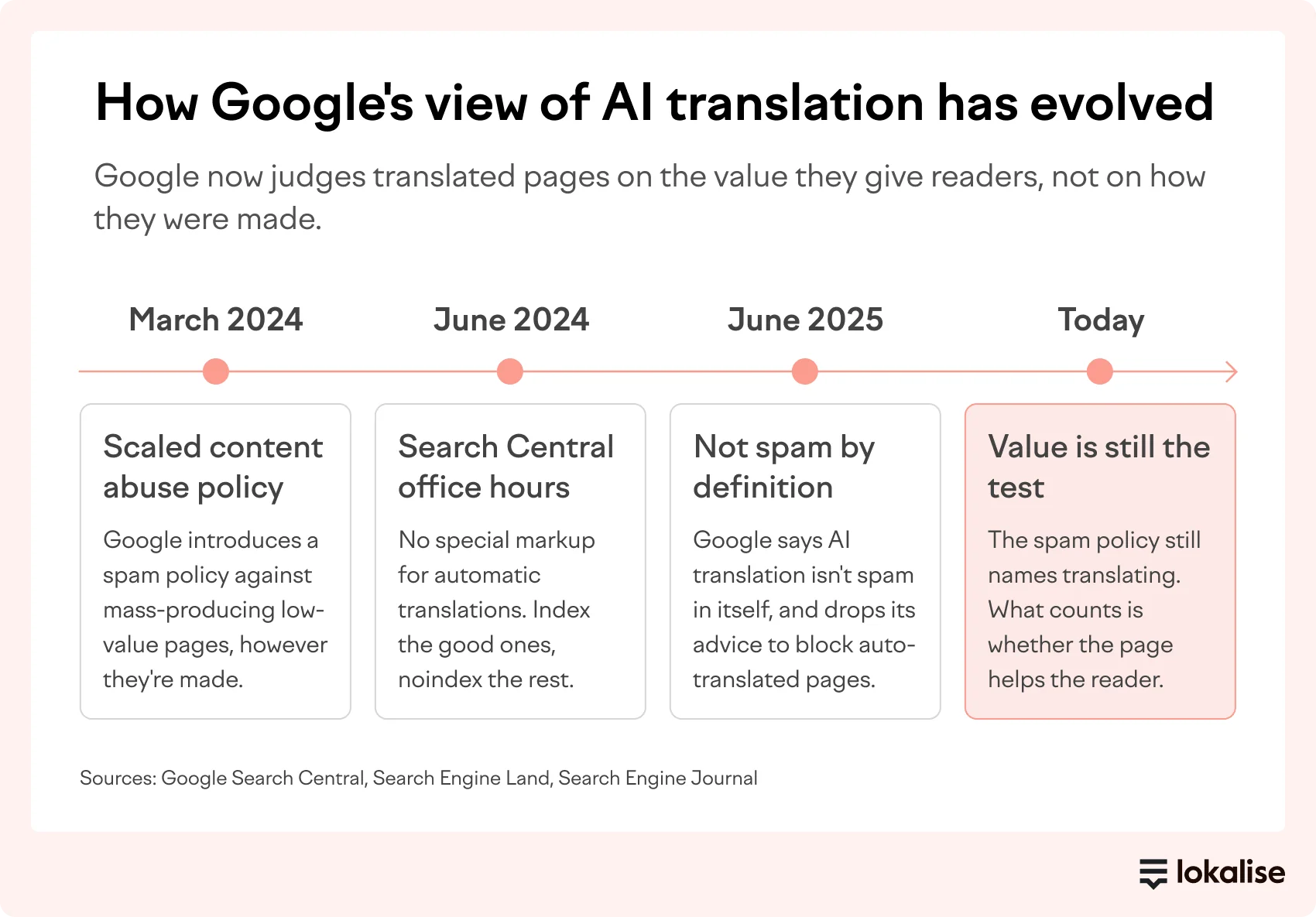
Google's guidance on generative AI content doesn't prohibit using AI. It warns that using AI to generate many pages without adding value for users may break the scaled content abuse policy.
For a localization team, that comes down to answering the following question:
Would a native speaker in this market find the page useful?
A page that answers their question in natural, accurate language is the kind of page Google wants to show, however it was produced. A page that doesn't will struggle, and polishing its wording to sound less machine-made won't change that.
Scaled content abuse is the policy that matters
Google defines scaled content abuse as generating many pages mainly to manipulate search rankings rather than to help users. Its examples include scraping content and reworking it through "automated transformations like synonymizing, translating, or other obfuscation techniques," where little value is provided.
Read that carefully, because it cuts both ways. Translation isn't banned, but it's named as one of the ways to produce unoriginal pages in bulk. The policy also says it applies no matter how the content is created, which puts a careful human translation of a thin page in the same position as a careless AI one.
What Google has said about AI translation
Google has also spoken about AI translation directly. Here's what it has said, and each point supports the scaled content abuse policy above.
No label exists
In the June 2024 Search Central office hours, John Mueller said there's no special markup to flag pages as automatic translations. If translated pages meet your own quality bar and use the right wording for the audience, making them indexable is fine. If not, he suggested a noindex robots meta tag. His closing advice: "a good localization is much more than just a translation of words and sentences."
Low quality is the risk
In the same session, Gary Illyes said a low-quality auto translation could hurt rankings, and recommended that native speakers review and fix translations so the content helps users.
AI translation isn't spam by definition
Asked about Reddit's AI-translated pages, Google told Search Engine Land that its policies "do not strictly define content that has been translated by AI as spam."
What puts translated pages at risk
What doesn't, on its own
Thousands of pages that add nothing a user can't get elsewhere
Using AI to produce the translation
Literal translations that read wrong to native speakers
Labeling, or not labeling, pages as machine translated
Indexing pages nobody has checked
Translating into many languages
Pages in markets where nobody searches for them
The tool or vendor you use
The old blocking advice is gone
In June 2025, Google removed documentation guidance on using robots.txt to block automatically translated pages, describing it as a docs-only change, as Search Engine Journal reported.
🧠 Good to know
In 2025, Reddit started using AI to translate millions of its pages into other languages, and those translated pages began ranking well in Google. That's what prompted Google's statement to Search Engine Land, and it's why many SEO teams now point to Reddit as proof that AI translation is safe.
Bear in mind the context here. Reddit’s translated pages carry real discussions and first-hand answers people actively search for, so they add something new in each language. The value of the translated page decides how it performs.
Where the real AI translation SEO risk lives
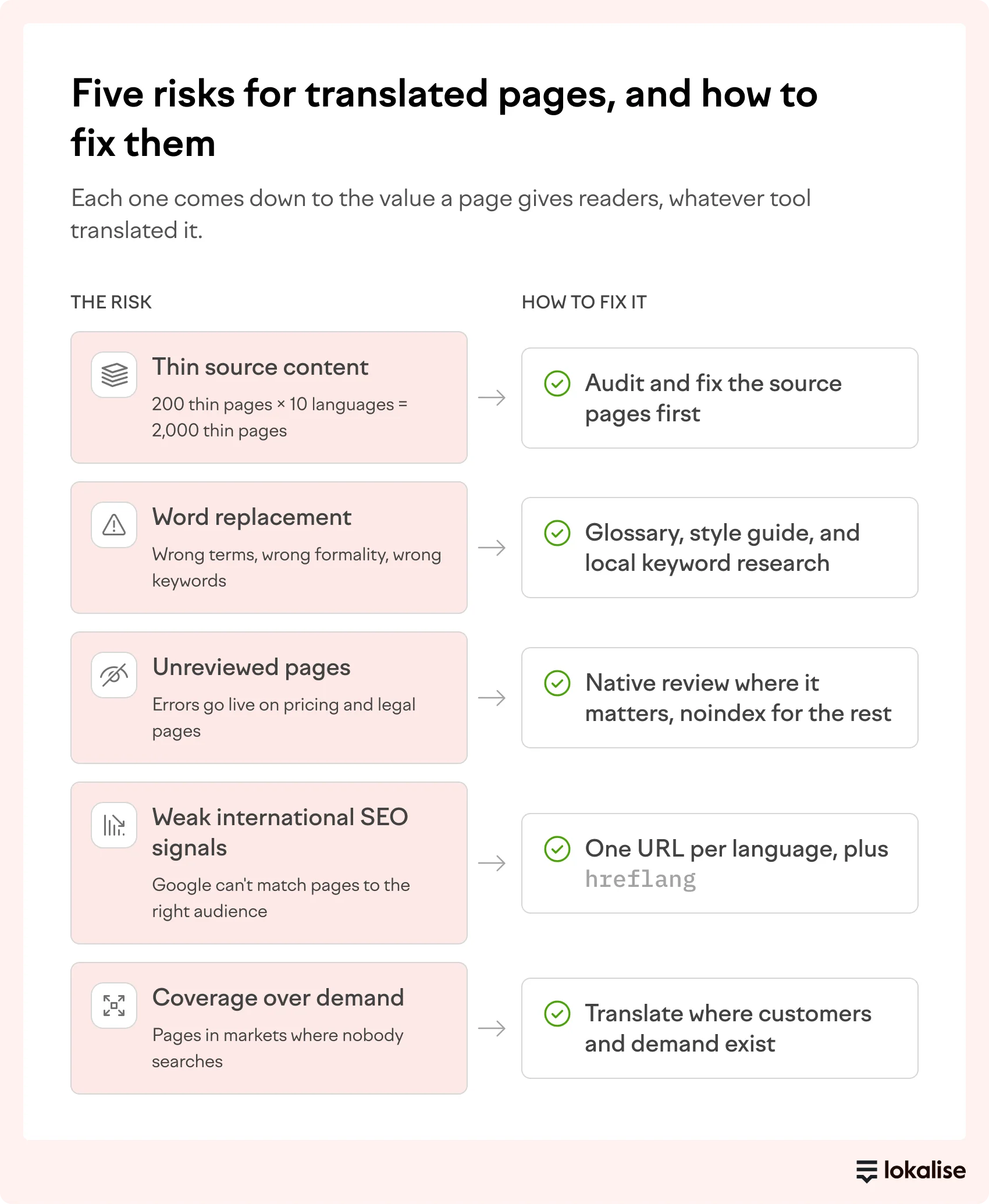
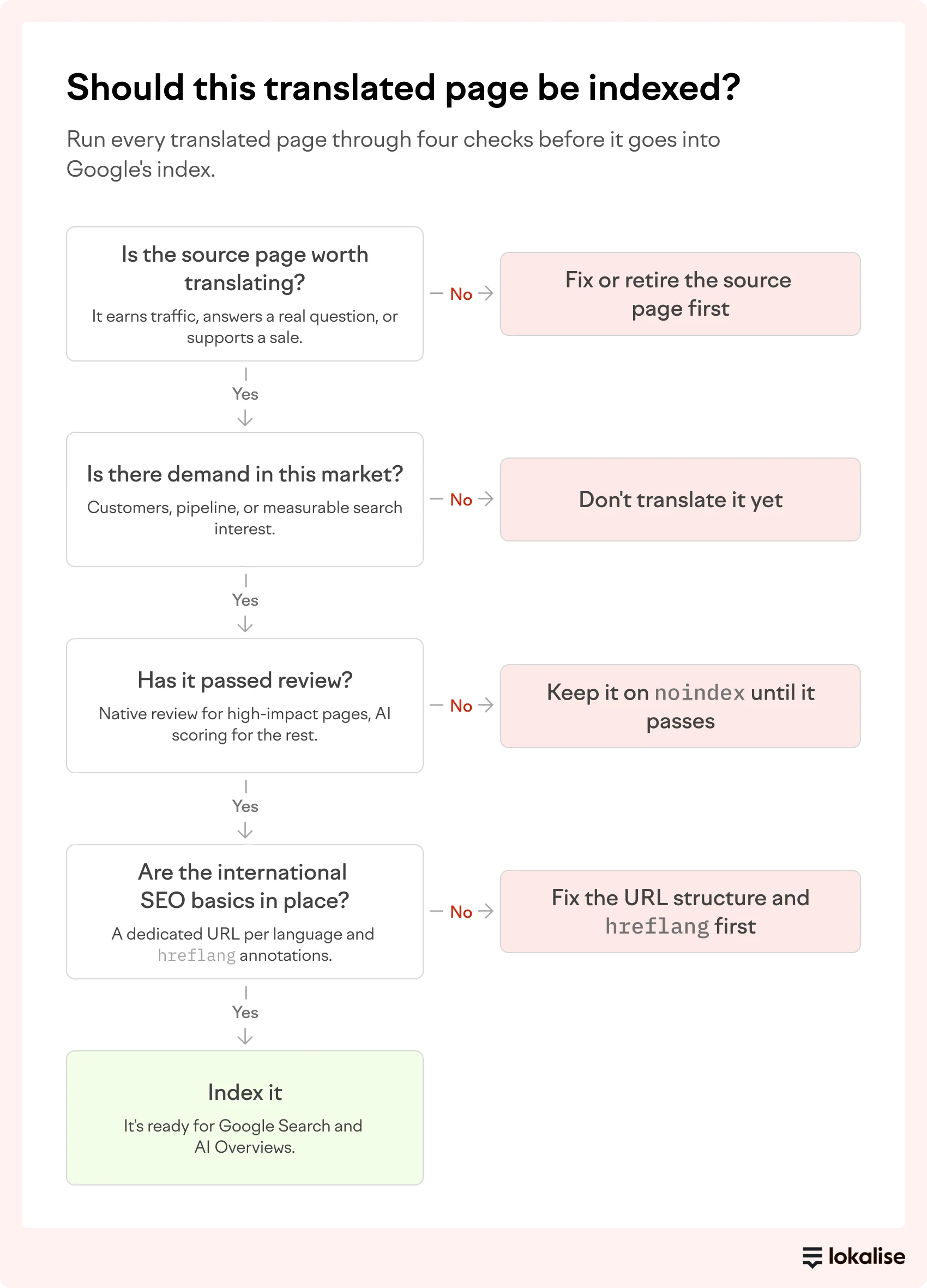
If AI isn't the problem, what is? In practice, translated sites get into trouble in five predictable ways. Each one comes with a practical fix, and none of them depends on the tool you use.
1. Thin source content, multiplied
Translating 200 thin English pages into 10 languages gives you 2,000 thin pages. Localization multiplies whatever you feed it, value or the lack of it.
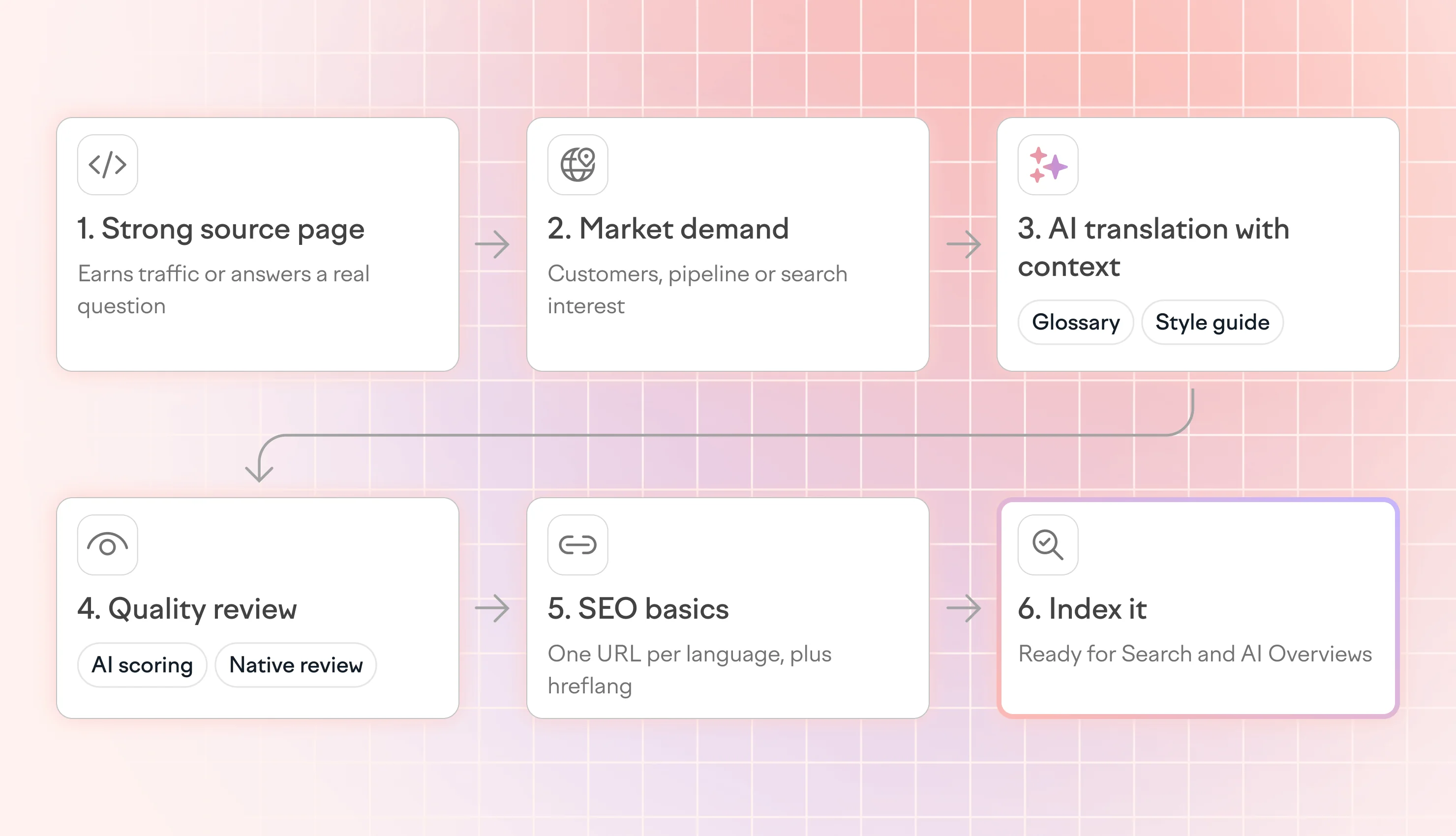
How to fix it: Audit before you translate. Pick the pages that already earn traffic, answer real questions, or support a sale, and fix or retire the rest first.
2. Word replacement instead of localization
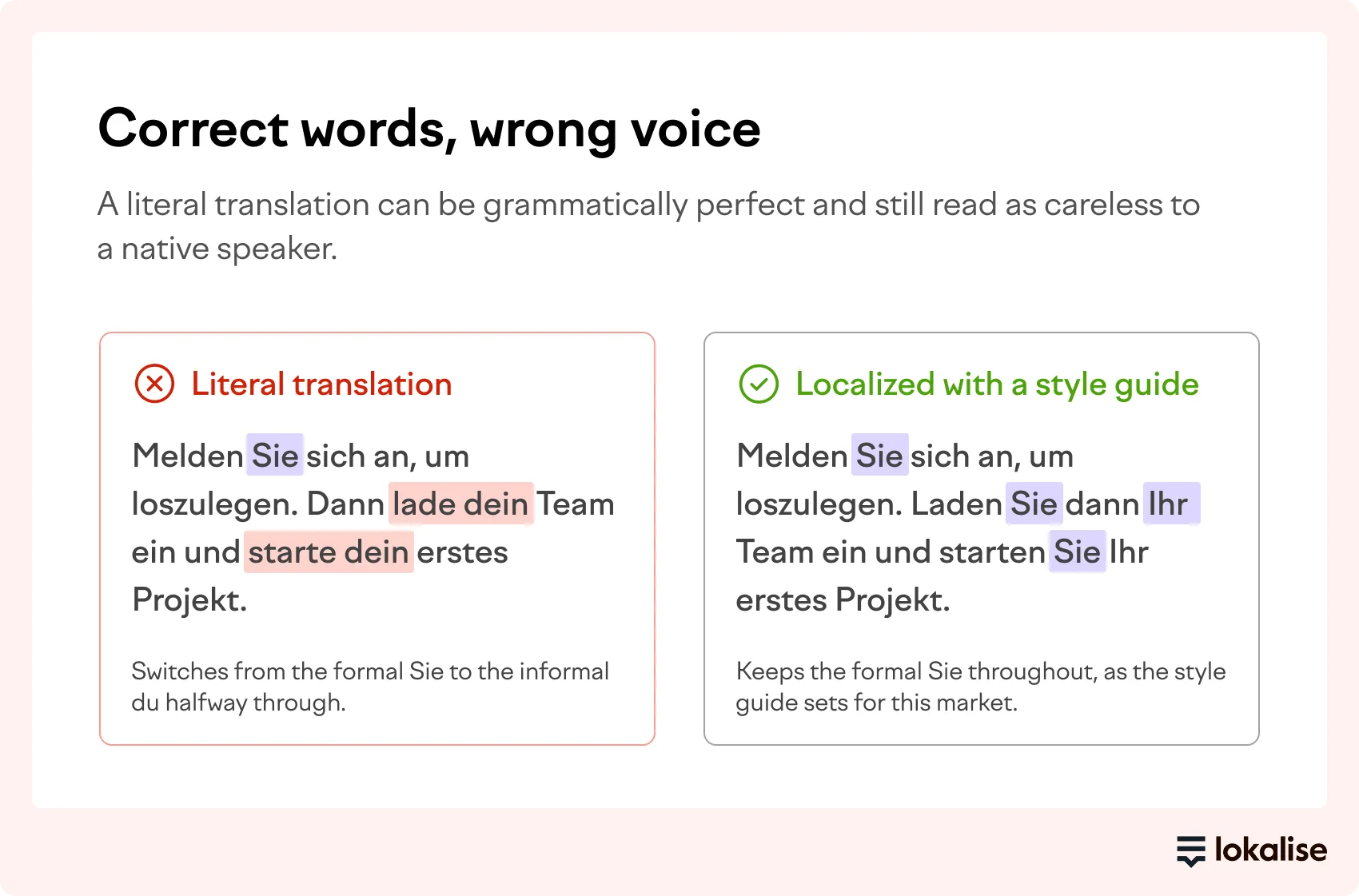
A literal translation can be grammatically perfect and still sound foreign. It uses the wrong product names, the wrong level of formality, and phrases nobody in that market searches for.
Picture a German landing page that switches between the formal “Sie” and the informal “du” from one paragraph to the next. That's the gap Mueller pointed to when he said good localization goes far beyond translating words.
How to fix it: Give translation the context a local writer would have. That means a glossary for AI translation that fixes product terms, a style guide for translators and AI that sets tone, and keyword research per market instead of translated English keywords.
📚 Further reading
Learn more about SEO localization and how it can impact your monthly revenue (provided you do it well).
3. Publishing what nobody has reviewed
The risk climbs when every translation goes live the moment it's generated. Errors in a pricing page, a legal notice, or a high-traffic landing page do more damage than a typo in an old changelog.
How to fix it: put native review where it matters most. Prioritize by traffic, revenue, and risk, and follow translation review best practices for the pages at the top of that list. Keep the rest out of the index with noindex until they pass, exactly as Google suggests.
4. Weak international SEO signals
Good translations can still underperform if Google can't tell which version belongs to which audience. Unclear URL structures and missing language annotations both make that harder.
For more on making translated pages rank in each market, see our guide to SEO translation.
5. Coverage instead of demand
AI translation tools might make it easy to launch in 30 different languages. But will anybody visit these pages and find them valuable? If you’re aiming for coverage instead of demand, it adds review and maintenance work without bringing traffic back.
How to fix it: Translate for demand. Start with markets where you have customers, pipeline, or measurable search interest, and expand when the data supports it.
💡 Pro tip
Run your page audit, market list, and review priorities together. The pages worth translating, the markets worth entering, and the pages worth reviewing usually overlap, and that overlap is where your quality effort pays off most.
What this means for AI answer engines
A translated page that does well in regular search also has a chance in Google's AI answers, because Google holds both to the same standards. Google says AI Overviews and AI Mode need no special optimization or markup: a page has to be indexed and eligible to show with a snippet, and the usual SEO best practices apply.
A translated page you've kept out of the index won't appear in AI Overviews, and a generic translation of generic copy gives an answer engine nothing worth quoting.
In our view, the same holds for ChatGPT and Perplexity. They cite pages that answer a specific question clearly, in the language the user asked in. A well-localized page that answers a real question has a chance, and a word-for-word copy of a vague one doesn't.
How these controls work inside Lokalise
The five fixes above are easy to agree on, but hard to keep up at scale.
Once you publish in several languages every week, issues can slip through the cracks. Glossaries drift out of date in spreadsheets, review depends on whoever has time, and nobody can say with confidence which pages are ready to be indexed.
Lokalise brings those controls into one workflow. Your terminology and style rules shape every AI translation, approved translations get reused automatically, and each string is scored so reviewers know where to look first. Here's how each piece works.
Style guide and glossary as AI context
Lokalise AI uses your style guide and glossary as context by default. Your product names stay fixed, your tone stays consistent, and market-specific wording comes from rules your team set.
Compare that with pasting text into a general-purpose translation tool. A tool with no access to your terminology, past translations, or style rules has to guess, and guesses produce generic copy.
Translation memory reuses translations your team has already approved. Custom AI Profiles take that further. They use retrieval-augmented generation (RAG) to pull your most relevant past translations into each request, so the AI follows today's terminology without retraining a model.
You can also check whether a profile beats the alternatives before you scale it. The built-in evaluation compares a profile against the base AI model and Google Translate, using your own reviewed translations as the reference.
In one published example, a European fintech team's profile matched its reviewed German translations exactly 49% of the time, against 13% for the base AI model. Your numbers will depend on your content and data, which is the point of testing on your own.
Custom AI Profiles are available on the Advanced and Enterprise plans. See plans here.
AI scoring and review workflows
Reviewing every string doesn't scale, and reviewing a random sample misses the strings that matter. AI scoring gives each translation a score from 0 to 100 based on the Multidimensional Quality Metrics (MQM) framework, with an explanation of any issues it finds.
In a workflow, translations scoring below your threshold (80 by default) go straight into a review task.
As a result, reviewers spend their time on flagged strings and high-priority pages, and the scores give you hard evidence of quality to build into your wider translation quality assurance process.
AI scoring is available from the Growth plan and above. See plans here.
🧠 Good to know
What we discuss above are quality controls. No tool can guarantee rankings. They help keep your translated pages in the category Google wants to show: specific, accurate, and useful to the people reading them.
What Lokalise doesn't do
A localization platform can make every translation accurate, consistent, and reviewed. The decisions that come before a page is translated, and after it's published, stay with your content, SEO, and development teams.
Give each of these a clear owner before you launch in a new market:
Choosing which pages to translate. Your content team decides which pages earn a place in each market, based on the traffic they bring, the questions they answer, and the sales they support.
Writing strong source content. Translation carries over whatever the source page says, so thin source content stays thin in every language.
Setting up URLs and hreflang. Your development or SEO team owns the URL structure and hreflang annotations in your CMS or site code.
Controlling what gets indexed. Your CMS adds noindex to pages that haven't passed review, based on the review status you track in Lokalise.
What to tell your SEO lead about AI translation and Google
Go back to the question that stalled the project:
Will Google penalize us for AI-translated pages?
The accurate answer is that Google penalizes large volumes of low-value pages, and its spam policy names translation as one way to produce them. Translated pages that read well to native speakers and answer real questions are fine to index, as Google's John Mueller has said.
The risk sits in your process, and your team controls it:
Translate the pages that already earn traffic, for markets where people search for them, and give the AI your glossary and style guide so it writes like your brand.
Put native reviewers on the pages that carry revenue or risk, and keep unreviewed pages out of the index until they pass.
With these controls in place, you can launch in new markets faster and index only the pages that are ready.
Ready to scale AI translation with quality you can check?Book a demo to see how Lokalise uses your glossary, translation memory, Custom AI Profiles, and AI scoring to keep translated pages ready to index.
FAQ
Does Google penalize AI-translated content?
No. Google has said its policies don't strictly define AI-translated content as spam. The risk comes from the scaled content abuse policy, which names translation as one way to mass-produce low-value pages, so low-quality translation at scale can still hurt you.
Do I need to disclose that my website uses AI translation?
Google has said there's no special markup to label pages as automatic translations, and no requirement to add one. What matters is whether the translated pages meet your quality bar and use the right wording for the audience. Whether to tell readers is a brand and trust decision.
Should I noindex AI-translated pages?
You should noindex only those pages that haven't passed your quality bar. Google's John Mueller suggested making well-translated pages indexable and adding a noindex robots meta tag to pages you're not happy with. A practical rule is to index reviewed pages in priority markets and keep the rest out of the index until they've been checked.
Can AI-translated pages appear in AI Overviews?
Yes, if they’re indexed and eligible to appear with a snippet. Google says AI Overviews and AI Mode need no special optimization, and standard SEO best practices apply. A translated page that answers a real question clearly, in the reader’s language, has the same chance as any other page. For practical steps, see our guide to localizing content for AEO.
What is scaled content abuse?
Scaled content abuse is a Google spam policy against publishing many pages mainly to rank in search, when those pages give readers little or no value. Google lists translation as one way to produce such pages, so a site that translates thin content into many languages can fall under it. To stay clear, publish only translated pages that are useful to readers in each market.
Hello! I'm a Senior SEO Specialist and strategic consultant with years of experience focused on scaling global organic growth for high-growth tech companies. My expertise lies in blending technical SEO proficiency with advanced content strategy, ensuring marketing initiatives meet stringent engineering and data quality standards.
My career has centered on the Berlin tech scene where I drove millions of monthly users to global platforms. My experience includes working in-house for major scale-ups and startups, such as N26, JustWatch, and currently Lokalise, where I focus on transforming performance through data-driven decisions.
My specialty is in the technical and strategic application of SEO:
Global Technical SEO: Auditing and optimizing complex architectures (including headless CMS migrations and multi-region sites).
AEO/GEO Strategy: Driving organic traffic through optimization for the new AI search ecosystem (AI Overviews and LLMs).
My authority is built on tangible, cross-industry experience:
Consulting & Audits: I have acted as a strategic consultant, successfully auditing and advising complex sites in the finance, healthcare, e-commerce and media demonstrating ability to apply SEO excellence across diverse regulated sectors.
Data-Driven Focus: Holding a background in marketing, I combines commercial strategy with deep analytical rigor, making me adept at transforming raw data into measurable business growth and ROI.
Core Focus at Lokalise: I drive organic traffic and conversion quality, ensuring global content meets the highest standards of technical SEO and AI Search visibility.
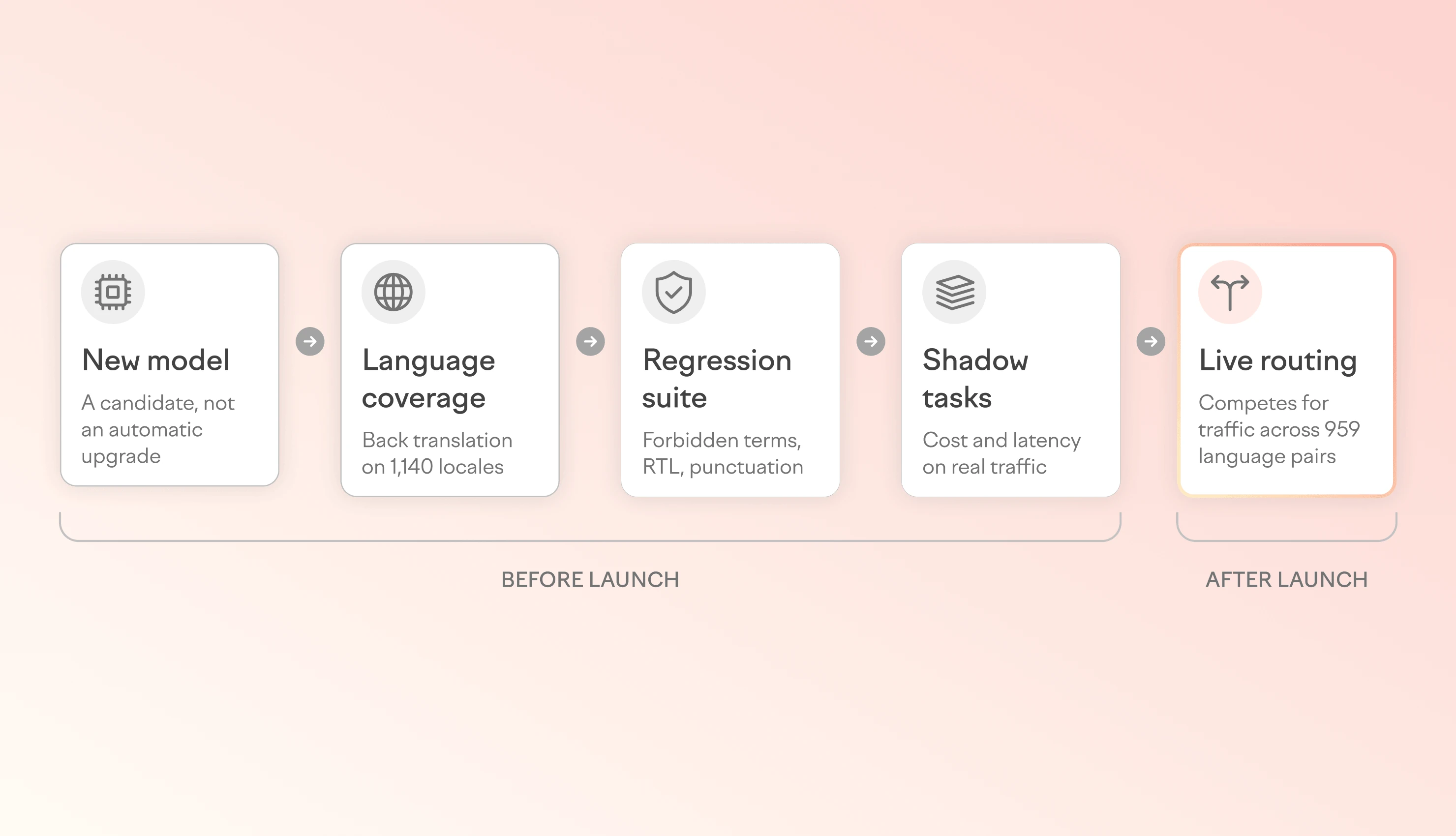
New AI models ship every few weeks. Here is how Lokalise tests each one across 959 language pairs before it touches your translations, and how models keep earning their traffic after launch.
Read more How we pick the AI model behind your translations
The model API is the cheap part. This is what it actually costs to automate AI translation, give it your company's context, learn to trust the output, and keep the system running.
Read more The real cost of building in-house AI translation
How to get data-backed proof that AI translation works — on your own content
Here's a stat that should make every localization leader uncomfortable: 57% of localization teams say their number one barrier to using AI more is that they don't trust the quality. Not that the quality is bad. That they don't trust it. The distinction matters. AI translation has improved dramatically. Models are better, context-aware systems like
Read more How to get data-backed proof that AI translation works — on your own content