

The real cost of building in-house AI translation
The model API is the cheap part. This is what it actually costs to automate AI translation, give it your company's context, learn to trust the output, and keep the system running.


Your campaign killed it at home. Then you launched it in Brazil, and the tagline became a punchline. Sound familiar? Nearly 3 in 10 marketing and company leaders say it's happened to them, and the cleanup cost thousands of dollars.
Lokalise surveyed 392 marketing and sales leaders who localize content across multiple countries and languages to find out what actually goes wrong, and what they'd do differently. What came back wasn't a polished post-mortem. It was an honest reckoning from decision-makers who've felt the burn firsthand.
Key takeaways
Localization errors come in all shapes and sizes. But the data points to some clear patterns in where things go wrong, how much it costs, and which markets make it hardest to get it right.
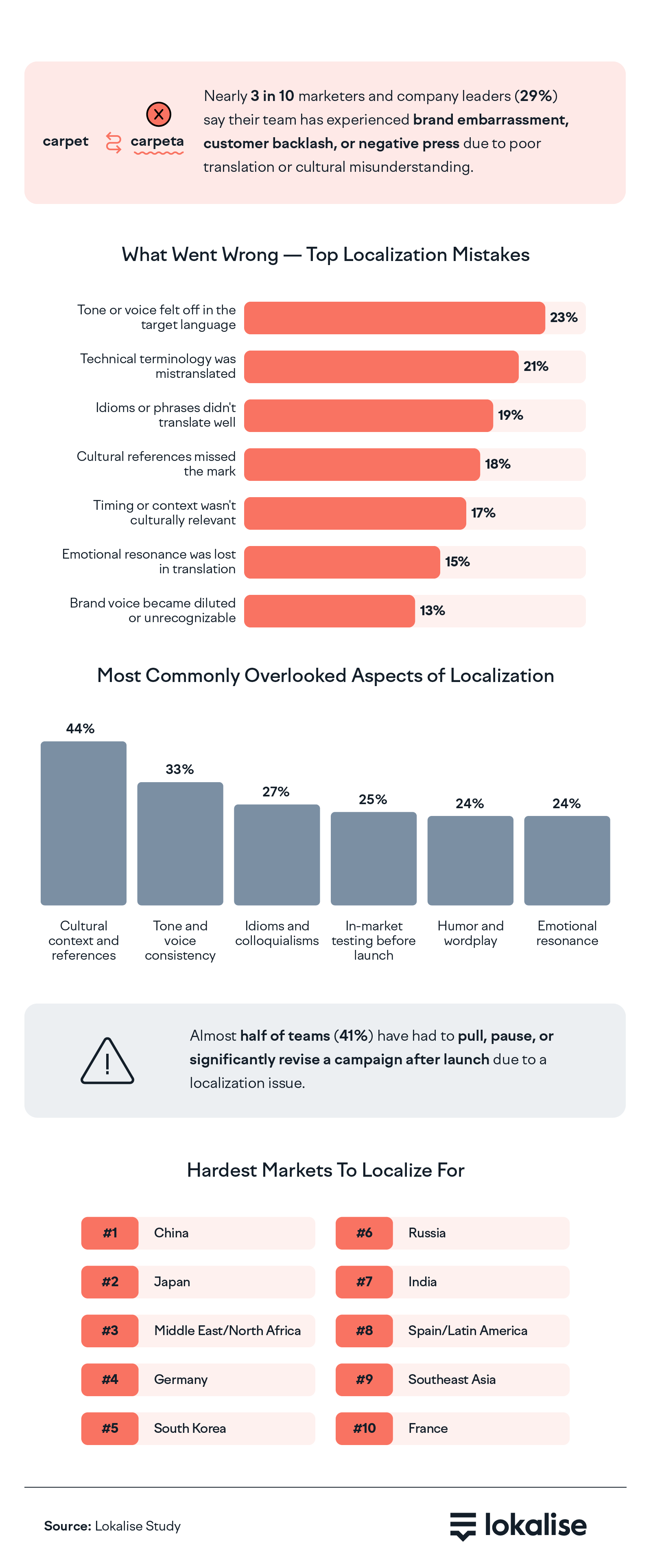
For 2 in 5 marketers and company leaders (41%), the consequences of a localization mistake were immediate and operational. They had to pull, pause, or completely revise a live campaign after a localization issue surfaced. That's not a small tweak. That's a team scrambling, a budget bleeding, and a launch derailed.
So what actually went wrong? Tone topped the list, with 23% citing messaging that felt off in the target language as their biggest mistake. Mistranslated technical terminology was next at 21%, followed by:
The spread across those numbers is surprisingly tight, suggesting that localization failure rarely comes from a single glaring error. It's usually a series of small misjudgments that compound.
Then there's the bill. For 39%, the damage crossed $10,000 once lost revenue, staff time, and reputation repair were factored in.
When asked which markets are the hardest to localize content for, respondents ranked China, Japan, the Middle East/North Africa, Germany, and South Korea as the top 5 most difficult. What makes these regions challenging isn't just the language. It's how much meaning depends on nuance, from tone to social norms. When those details are off, the message can fall flat, feel out of touch, or create unintended friction with the audience.
If you're localizing for the first time, you don't have to learn these lessons the hard way. The marketers and company leaders in this study already did. Here's their top advice.
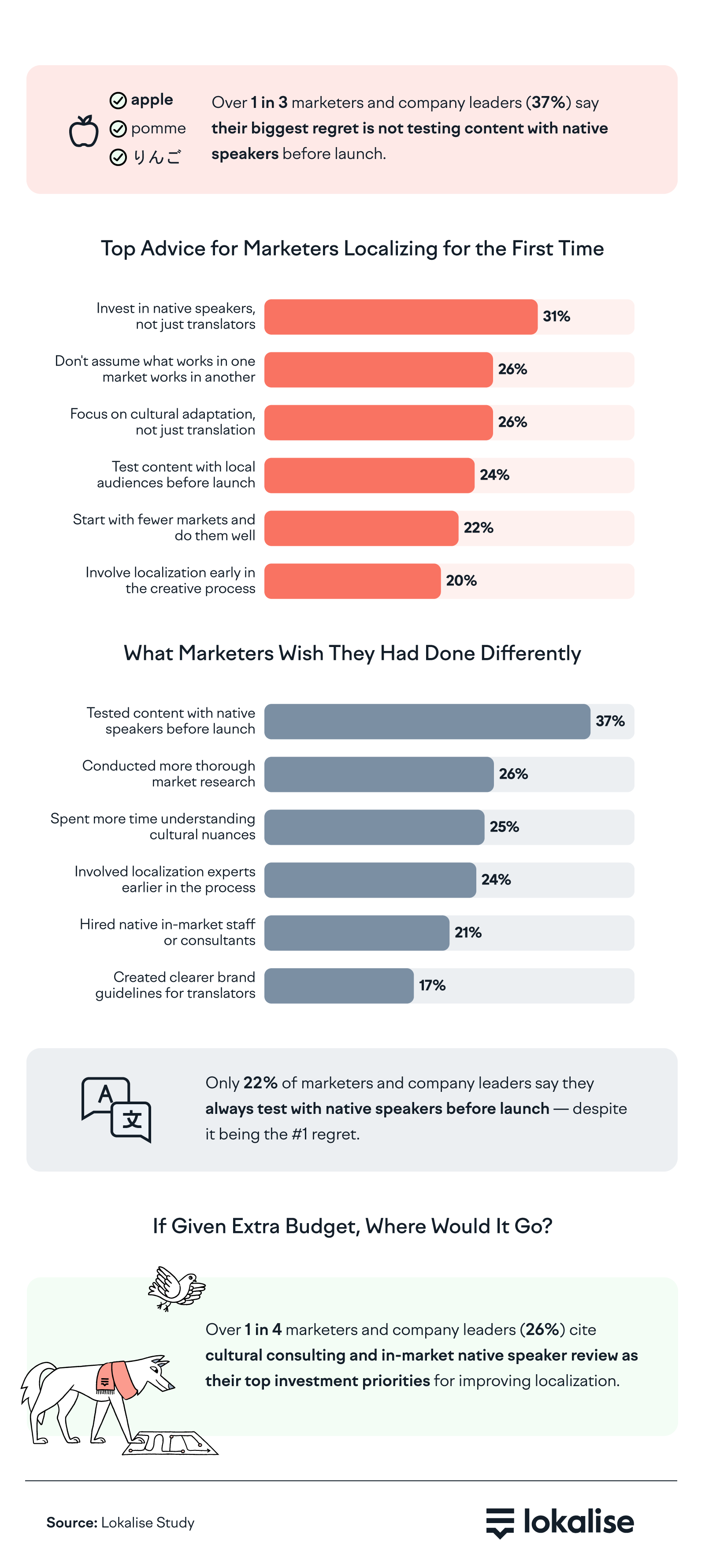
Invest in native speakers, not just translators; nearly 1 in 3 respondents (31%) put this advice above everything else. While translators handle the linguistic conversion, native speakers catch the tone, the cultural subtext, and the things that would make a local audience cringe. The next most common advice was to not assume what works in one market works in another and to focus on cultural adaptation rather than translation alone (26% each).
Testing content with local audiences before launch (24%) and starting with fewer markets and doing them well (22%) rounded out the top 5 most important pieces of advice. The underlying message across all of it is the same. Slow down before you scale.
Nearly 1 in 4 said they wished they had involved localization experts earlier in the creative process, before concepts were locked and briefs were written. The teams that get localization right don't treat it as a final step. They build it in from the start.
Great creativity doesn't always travel well. Localization can affect how much of your original vision actually makes it to a new audience. Let's explore how much creative compromise is happening, and where AI fits into the picture.
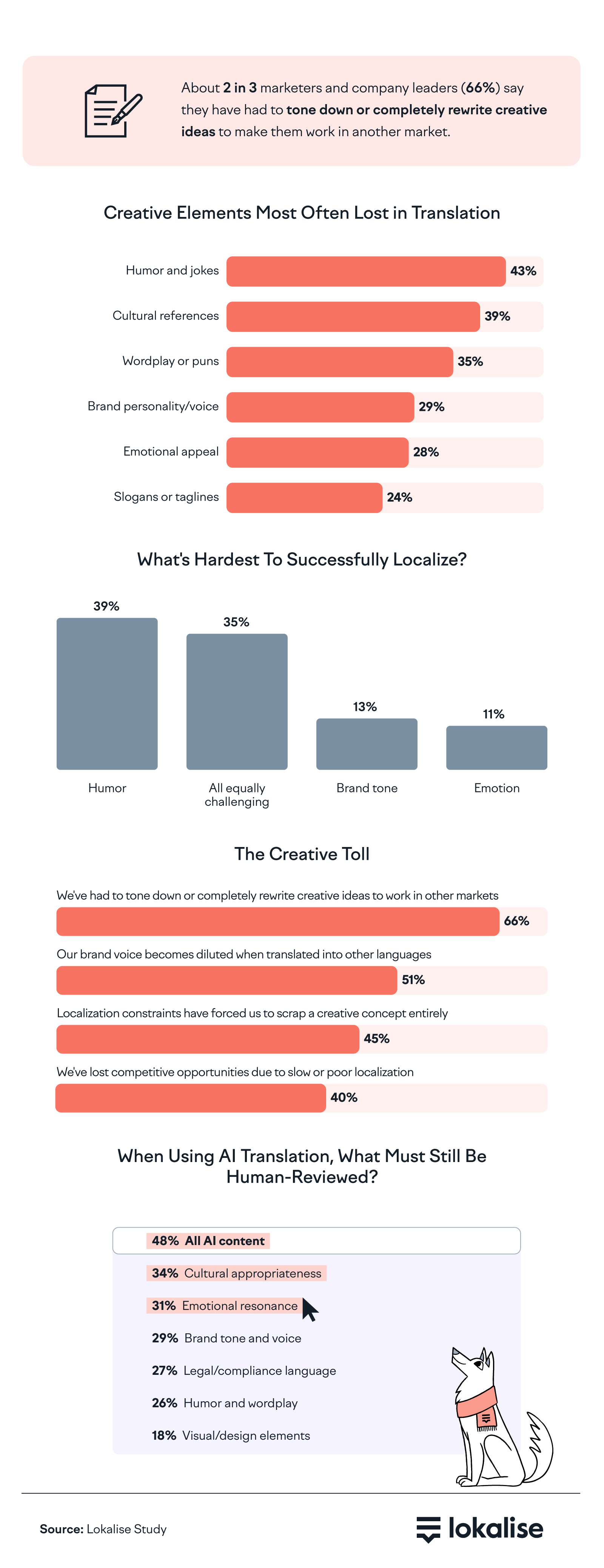
Humor is where things break down most often: 43% of marketers and company leaders said it was the creative element most frequently lost in translation, and 39% called it the single hardest thing to localize successfully. Cultural references (39%), wordplay and puns (35%), brand personality and voice (29%), and emotional appeal (28%) weren't far behind. The more a creative idea relies on cultural context, the harder it is to carry across borders.
The practical impact shows up in how teams work. About 2 in 3 respondents (66%) said they had toned down or completely rewritten creative ideas to make them work in another market. Nearly half (45%) admitted to scrapping a concept entirely because of localization constraints, and 51% said their brand voice becomes diluted when translated into other languages. For product and marketing teams investing heavily in brand, that's a significant creative compromise.
The business consequences are just as real. Around 40% said they had lost competitive opportunities due to slow or poor localization. Speed matters, but so does quality.
On the AI front, the data reveals something worth noting for teams building localization workflows. Nearly half (48%) said all AI-generated localization content should still be human-reviewed before publishing.
Cultural appropriateness (34%), emotional resonance (31%), and brand tone and voice (29%) were the areas they felt most needed a human eye. AI can accelerate the process, but human judgment remains important for the elements that matter most to audiences.
Localization mistakes are common, costly, and in most cases, preventable. But the same leaders who experienced setbacks also know what works:
The teams winning in global markets aren't the ones with the biggest budgets. They're the ones who built localization into the process from day one. That's where having the right infrastructure matters.
This report is based on an online survey of 392 marketers and company leaders who actively localize content for audiences in more than one country or language. Respondents work in marketing and sales roles or hold supervisory and leadership positions, including C-level executives, owners, directors, vice presidents, and managers. The survey was fielded in February 2026. Cost figures were analyzed using IQR-based outlier removal to produce an adjusted mean. Respondents who accounted for less than 5% of the total sample were excluded from demographic cross-tabulations.
Lokalise is an intuitive localization platform designed to help teams adapt digital content for every language and market quickly and efficiently. Trusted by Fortune 500 companies and fast-growing startups alike, Lokalise streamlines translation workflows, automates localization processes, and helps product, design, and engineering teams collaborate seamlessly. By modernizing localization, Lokalise makes it easier for businesses to deliver global-ready products and break down language barriers at scale.
We encourage journalists and content creators to use our data and graphics, with a link back to Lokalise. For full access to the data set or to interview a Lokalise expert, please contact kip@frac.tl or nicole.franco@frac.tl.
Author
With a background in brand and revenue marketing, Brittany helps global companies scale localization efforts that not only meet quality standards but also drive real business results.
The model API is the cheap part. This is what it actually costs to automate AI translation, give it your company's context, learn to trust the output, and keep the system running.

Purpose-built for campaigns and documents, embedded in the systems and tools marketing teams already use.

Here's a stat that should make every localization leader uncomfortable: 57% of localization teams say their number one barrier to using AI more is that they don't trust the quality. Not that the quality is bad. That they don't trust it. The distinction matters. AI translation has improved dramatically. Models are better, context-aware systems like







Behind the scenes of localization with one of Europe’s leading digital health providers
Read more Case studies



Localization workflow for your web and mobile apps, games and digital content.
©2017-2026
All Rights Reserved.
