
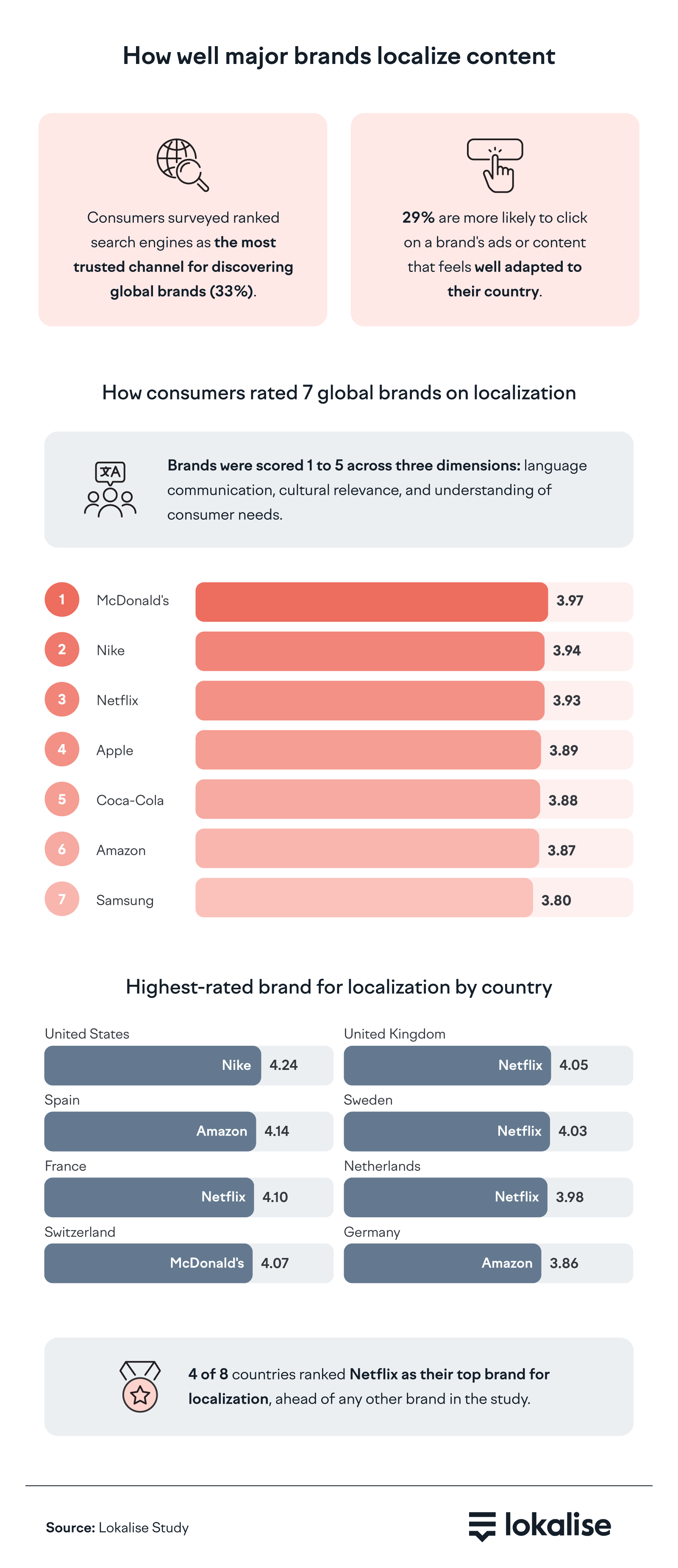


- McDonald's comes out on top with an overall score of 3.97, overtaking Nike (3.94) and Netflix (3.93). Samsung trails the pack at 3.80.
- McDonald's has built its global playbook around adapting menus and marketing to local taste. In France, the McBaguette plays on the country's bread culture. In India, where roughly 80% of the population is Hindu, the chain swaps the Big Mac for the Maharaja Mac, made with chicken instead of beef. In Japan, the Ebi Filet-O replaces the standard fish patty with shrimp. These are core menu decisions made country by country, and they show up in how consumers rated the brand for cultural relevance (3.86, the highest of any brand surveyed).
- Netflix tops the charts in 4 of 8 countries, but slips to 6th in Switzerland (3.48) and 7th in Germany (3.52), a reminder that strong global performance doesn't guarantee consistency.
- Netflix's strength in markets tracks with its investment in local-language original content: "Lupin" in France, "The Crown" in the UK, "Young Royals" in Sweden, and "Undercover" in the Netherlands.These original productions travel globally while feeling native to their home market.
- Nike claims the No. 1 spot in the United States (4.24) and scores highest of any brand on understanding consumer needs (3.91).
- Nike's lead in the US reflects decades of cultural alignment with American sports, from its NBA and NFL partnerships to high-profile campaigns like "Dream Crazy" featuring Colin Kaepernick.
- Amazon has the widest swings of any brand: No. 1 in Spain (4.14) and Germany (3.86), but in last place in the Netherlands (3.28) and Switzerland (3.13).
- Apple has the biggest gap between what it does well and where it falls short, scoring a 4.16 on language, but just 3.68 on cultural relevance.
- In the UK, Apple is in last place (3.86), with its cultural relevance score dropping to 3.71 even though its language performance stayed strong.
- Apple's UK gap points to a deeper pattern: while the brand translates content and offers local pricing, its marketing tone, product launches, and creative direction remain heavily anchored in California. In a market that prides itself on a distinct voice and dry humor, that can register as culturally distant even when the language is technically the same.
- There's a generational split, too: Baby Boomers rate brands highest overall (4.07), while Gen Z is the toughest crowd (3.85).
When localization drives (or destroys) trust and growth

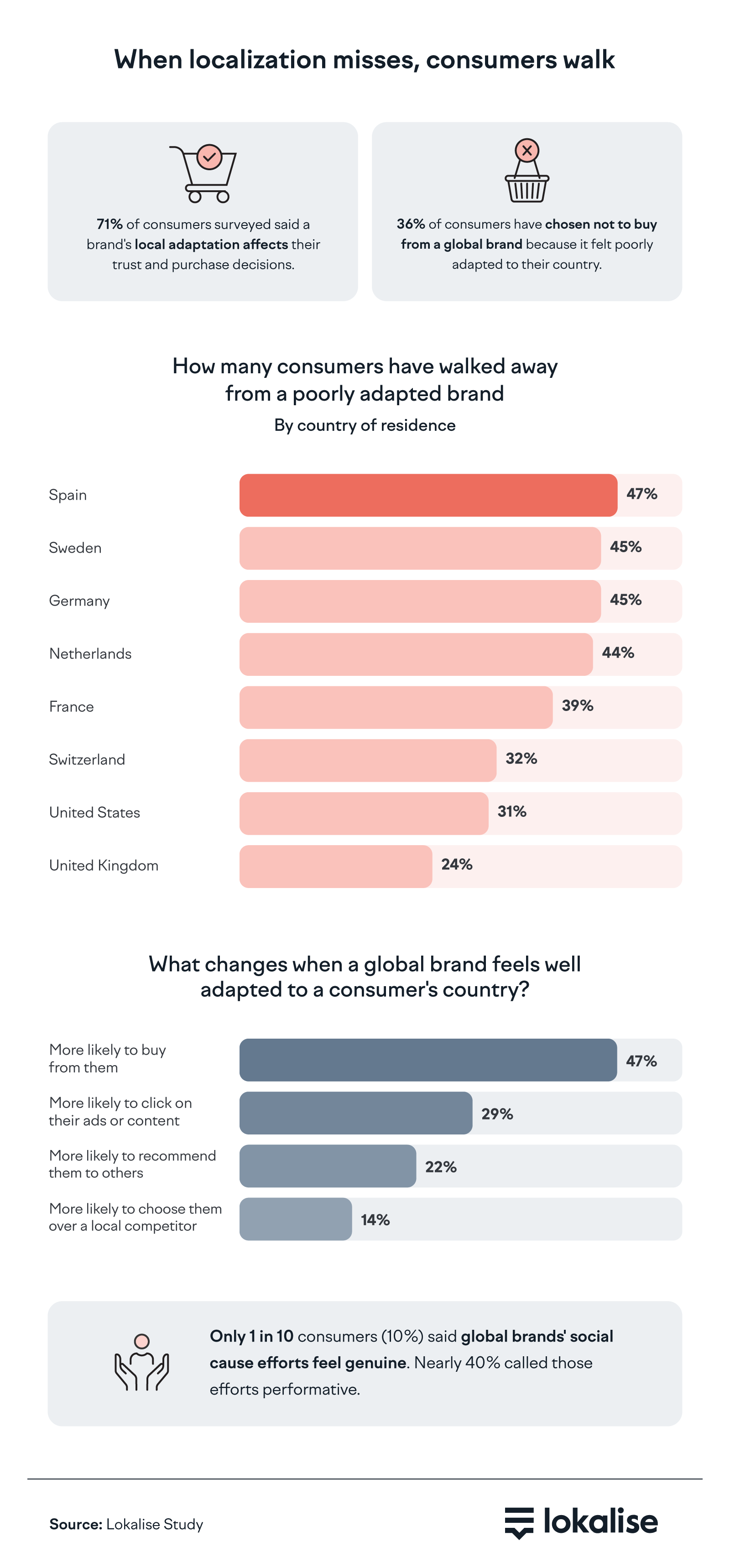
- Brands that localize well see real returns: 47% of consumers are more likely to buy, 29% are more likely to click on content, and 22% are more likely to recommend.
- On the flip side, more than a third (36%) have passed on a brand that didn't feel adapted to their market, with Spain (47%), Sweden (45%), and Germany (45%) topping that list.
- The Netherlands is a market of extremes: 55% are more likely to buy from a well-localized brand, but 44% have ditched one that missed the mark.
- Spain stands out across the board: 20% say localization is a major purchase factor, 15% feel global brands act like outsiders (vs. just 2% in the US), and 54% say brands partner with local creators—the highest rate of any market.
- When it comes to discovery, search engines (33%), word of mouth (28%), and brand websites (20%) lead the way. Gen Z flips the script, with word of mouth (29%) narrowly beating search (27%).
- Social media's role varies wildly by country: 24% of Spanish consumers call it their top discovery channel, compared to 9% in the UK and 0% in Switzerland.
- Just 1 in 10 consumers feel that global brands' social impact efforts are genuine, while 4 in 10 see them as performative, meaning they come across as marketing tactics rather than real commitment.
- 44% of Baby Boomer consumers surveyed say a well-adapted brand does not really affect what they do, compared to just 29% of Gen Z consumers.
Methodology
This study is based on an online survey of 1,000 consumers in the United States, the United Kingdom, France, Germany, Spain, Sweden, the Netherlands, and Switzerland, conducted in April 2026 via Prolific. Respondents were asked to rate the localization efforts of seven global brands (Amazon, Apple, Coca-Cola, McDonald's, Nike, Netflix, and Samsung) in language communication, cultural relevance, and understanding of consumer needs. Each factor was scored on a 1-to-5 scale, and brands were ranked using a composite average of all three scores.
By country, the sample includes the United States (21%), the United Kingdom (21%), Sweden (11%), the Netherlands (11%), Germany (11%), Spain (11%), France (10%), and Switzerland (5%). By generation, respondents include Millennials (41%), Gen Z (34%), Gen X (19%), and Baby Boomers (6%). The sample is 54% men and 45% women, with ages ranging from 18 to 83. Percentages are rounded and may not add up to 100%.
About Lokalise
Lokalise makes it refreshingly intuitive to adapt content for every market and language. As an AI-powered localization platform backed by human expertise, Lokalise is trusted by Fortune 500 companies and fast-growing startups worldwide.
It removes the trade-off between enterprise-grade power and everyday usability by connecting your entire content ecosystem, translating in your brand voice, and activating every market continuously and at scale.
For companies expanding globally, Lokalise transforms translation from an operational task into a strategic growth advantage.
Fair use statement
We encourage journalists and content creators to use our data and graphics, with a link back to Lokalise. For full access to the data set or to interview a Lokalise expert, please contact kip@frac.tl or nicole.franco@frac.tl.