
The real cost of building in-house AI translation
The model API is the cheap part. This is what it actually costs to automate AI translation, give it your company's context, learn to trust the output, and keep the system running.

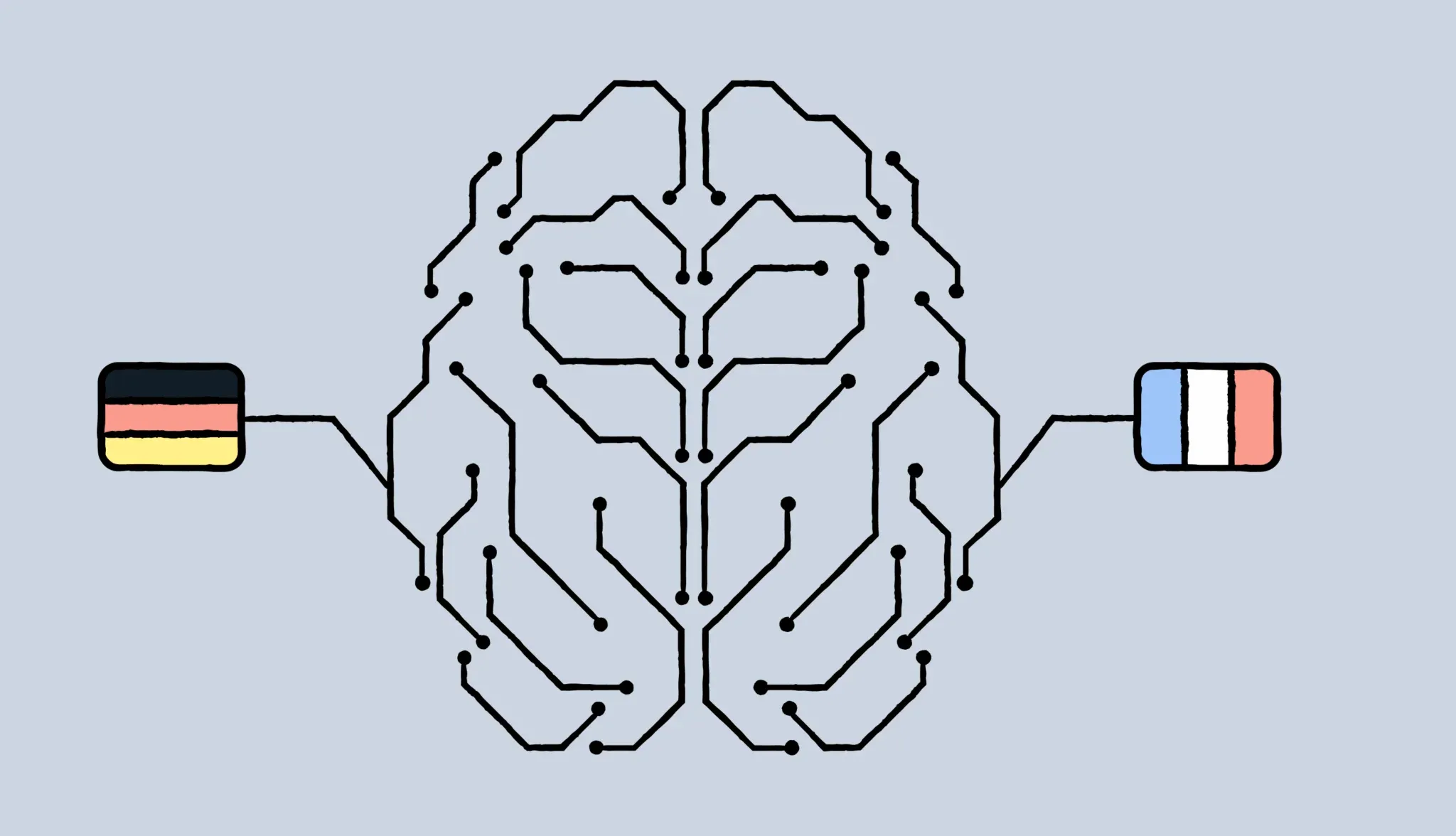
Neural machine translation (NMT) sounds technical and complex. But at its core, it’s just how modern AI translates one language into another.
If you’ve ever used Google Translate, watched subtitles appear instantly, or read a product description translated from another language, you’ve likely seen NMT in action.
In this guide, we’ll break it all down in plain English. What neural machine translation actually is, how it works behind the scenes, what it’s great at (and where it still struggles), and what makes it different from older translation methods.
🧠 Learn all about translation technology
Whether you’re just curious or digging into how the tech works under the hood, you’re in the right place. At Lokalise, we aim to bring you easy-to-understand resources about neural machine translations, large language models, and other technology advancements, so that you can discover all about the latest innovations in the industry.
Neural machine translation (NMT) is a type of artificial intelligence that translates text from one language to another. It learns how to translate by studying huge amounts of real-world text, in multiple languages.
Instead of using a list of word-for-word rules, NMT uses something called a neural network. It’s a computer system inspired by how the human brain works. This allows it to understand the context of a sentence (not just individual words), so that it can “speak human”.
🧠 How is AI trained?
It seems like AI keeps moving forward, but legislations cannot follow fast enough.
For example, in 2023, The New York Times made headlines by blocking OpenAI and other companies from using its articles to train AI models. They even updated their terms of service to make it clear: no scraping allowed. Why? To protect their original reporting from being used without permission, and to stay in control of how their content is used by AI.
At a high level, neural machine translation works a lot like how we learn languages. It looks at patterns and learns gradually.
First, the system is trained on massive amounts of bilingual text. Think movie subtitles, translated news articles, public documents, so basically anything where the same content exists in two or more languages. This helps the AI “see” how ideas are expressed differently across languages.
The system doesn’t “read” like we humans do. Instead, it converts each sentence into numbers called embedding that represent meaning and context. This magic happens inside a neural network. When you think about it, it comes down to teaching AI to think in concepts instead of just words.
Using these embeddings, the neural network predicts the most likely translation based on all the data it has been exposed to before. And it does it not just word-by-word, but it looks at entire phrases and the broader meaning. This is what makes the translations feel more fluent.
🤖 Key takeaways
Instead of doing a word swap, neural machine translation is more like:
– What is this sentence trying to say?
– How would I express that idea naturally in the target language?
Because of the way NMT is programmed, translations powered by it often feel smooth and natural (especially compared to older methods like rule-based or phrase-based translation). These older methods typically provide stiff, literal, or just weird translations that don’t make much sense.
Want to learn more about the way things work under the hood? Discover how AI translations works in our jargon-free guide.
Neural machine translation is great at making translations sound more natural because it looks at the whole sentence, not just word by word. It also keeps getting better with more data and can handle tons of languages, which makes it very useful for businesses going global.
Unlike rule-based or phrase-based systems that often create robotic or overly literal translations, NMT takes the entire sentence into account. This helps it capture the meaning and tone behind the words. Translations feel smooth and more like something an actual person would say.
NMT looks at how each word fits within the sentence. That means it can handle ambiguous phrases, idioms, or double meanings much more effectively. For example, it knows the difference between “bank of a river” and “openning a bank account”.
One of the biggest strengths of NMT is that it constantly learns from data. The more high-quality translations it’s exposed to, the more accurate it becomes. Updates don’t require reprogramming. Just feed it with more training data.
Modern NMT models like Google’s or Meta’s can translate between hundreds of languages. In some cases, they can even translate between two low-resource languages (like Swahili to Bengali) without always relying on English as a go-between.
If you’re a company dealing with international customers, NMT lets you translate huge volumes of content quickly. It won’t replace human translators for sensitive or highly nuanced work, but it’s a solid starting point for scaling content like product descriptions, FAQs, or help articles.
✨ Discover Lokalise AI
Lokalise AI is a generative AI translation tool that allows you to translate 10x faster and save up to 80% in costs. Increase speed to market and scale translations, without compromising quality.
Neural machine translation can produce fluent-sounding results that are sometimes inaccurate or miss the mark from a cultural perspective. It also relies heavily on large, high-quality datasets, and these are not always available for less common languages.
NMT is good at surface-level translation, but it often stumbles on things like sarcasm, humor, or more specific cultural references. So while it might nail the words, it can totally miss the overall tone.
These models learn by example, which means they need huge amounts of high-quality, bilingual data. For common language pairs, that’s usually not a problem. But for languages that are not as used, the system might struggle simply because it hasn’t seen enough examples.
One of the biggest issues with NMT is that it can produce fluent, natural-sounding translations that are just… wrong. That’s risky if you’re dealing with sensitive content like legal contracts, medical info, or safety instructions.
NMT models aren’t really “thinking” or reasoning. They’re just predicting the most likely next word based on patterns. This means that they don’t actually understand the world or the meaning behind the text the way a human does.
If the training data includes biased or stereotypical language (and it often does), the model can repeat those same biases in its translations. This is still a big challenge in the context of fairness and ethical use of neural machine translation technology.
Neural machine translation is used in everything from translating websites and product descriptions, to powering real-time translation in apps like Google Translate. It can help you localize content faster and even transform the way you approach your go-to-market activities.
Let’s take a look at how you can use Google Translate for website translation. It’s free to use for basic use. So let’s try it for the Lokalise website:
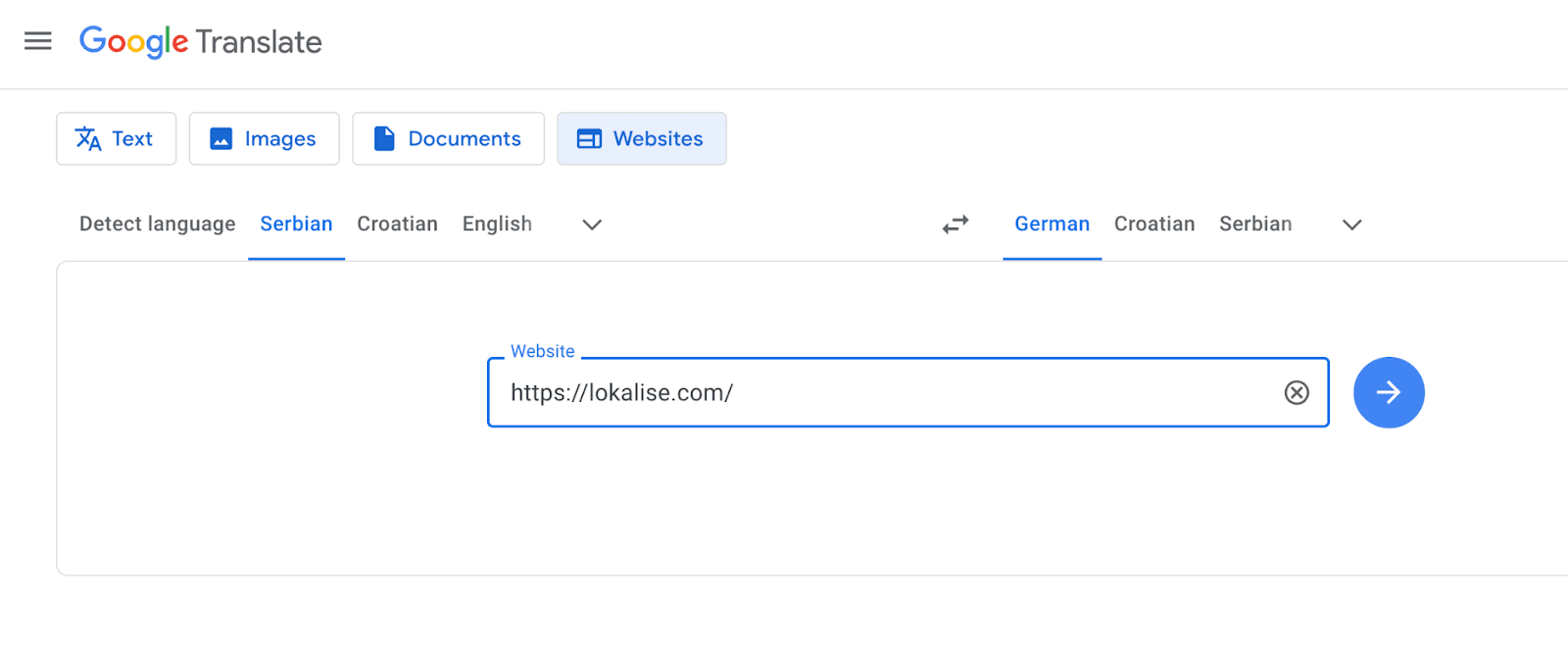
Here’s how the website appears in German through the Google Translate preview.
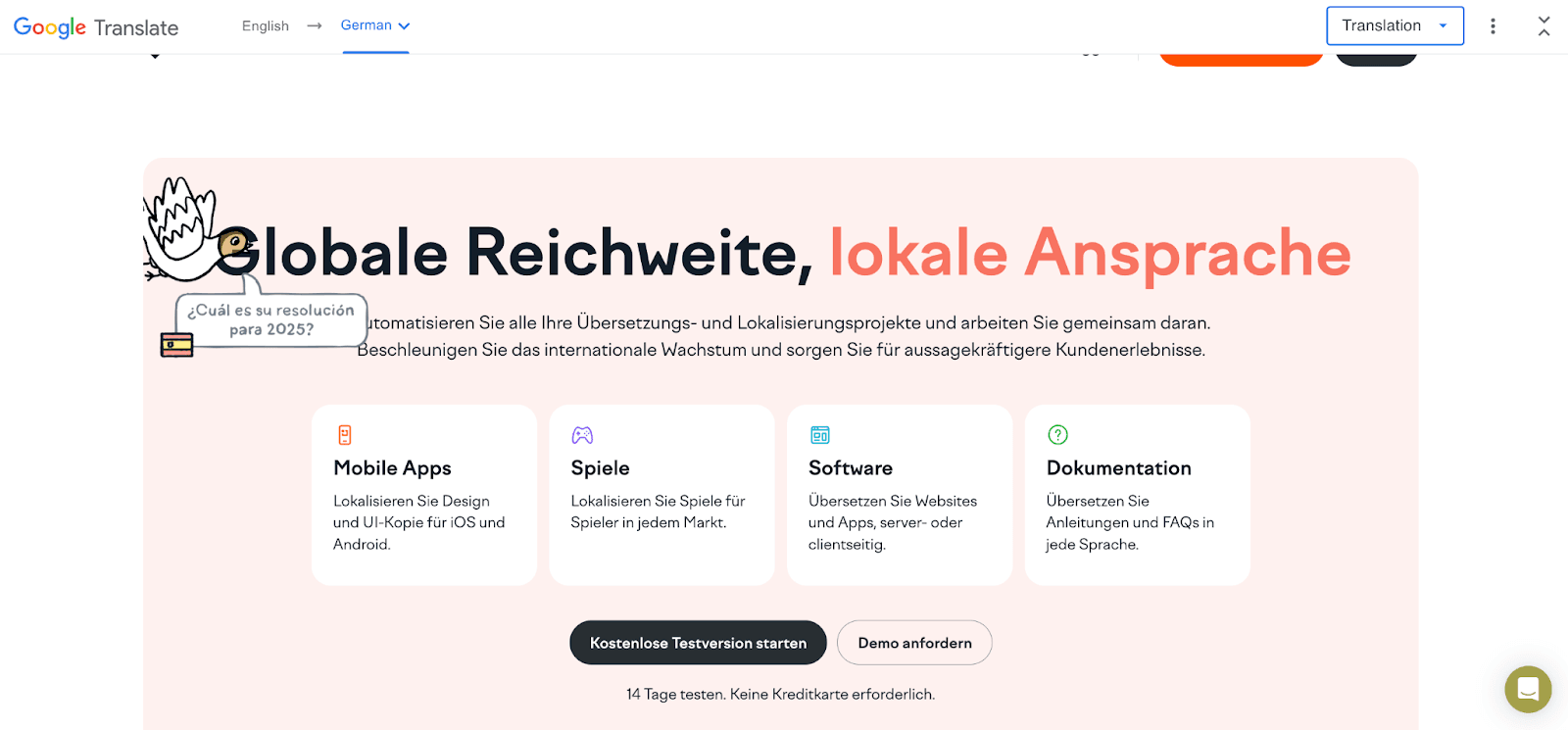
While the translation quality is decent, human intervention is needed to fix design issues and improve accuracy. You can also see that the copy doesn’t fit into the design space nicely.
In contrast, more advanced solutions like Lokalise AI allow you to feed the model with context, which leads to more accurate translations:
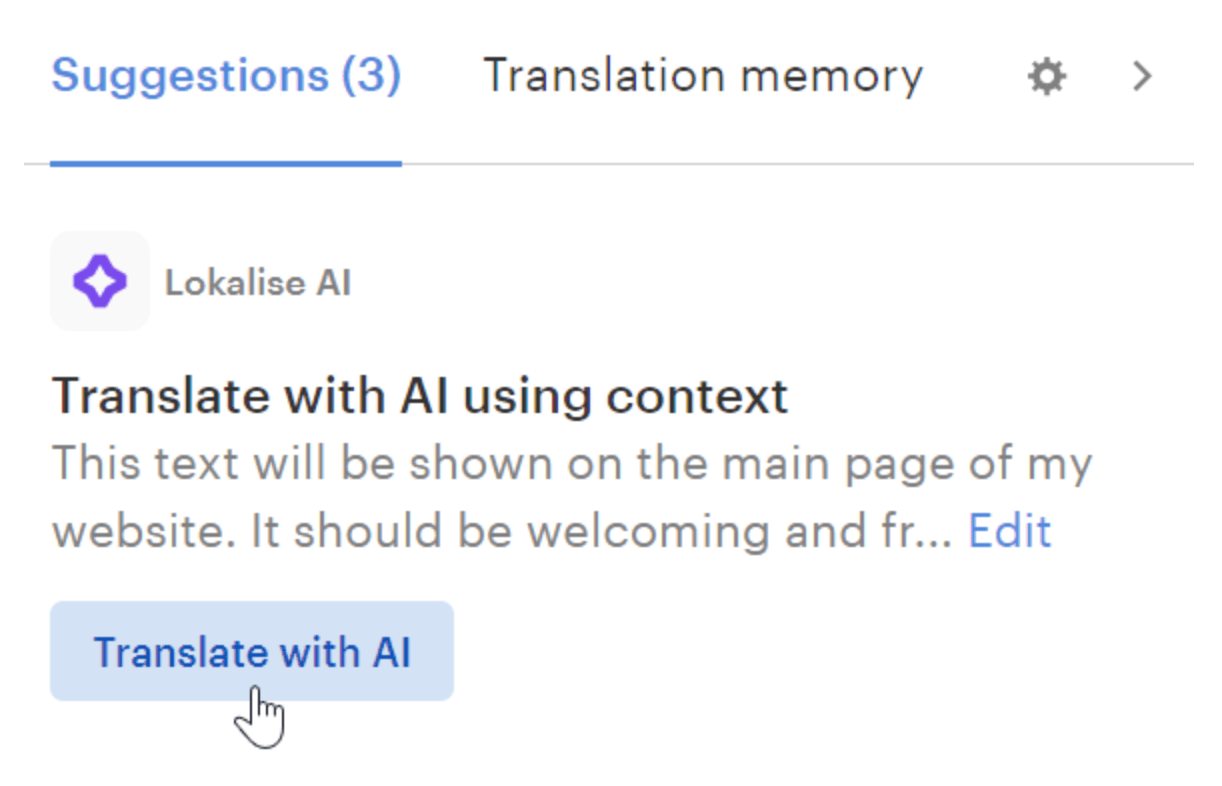
You can then approve the translation, ask the AI to try again, and manually post-edit the translated text.

It’s also possible to ask for a shorter version and iterate with AI so that you actually get a translation that works for your use case.
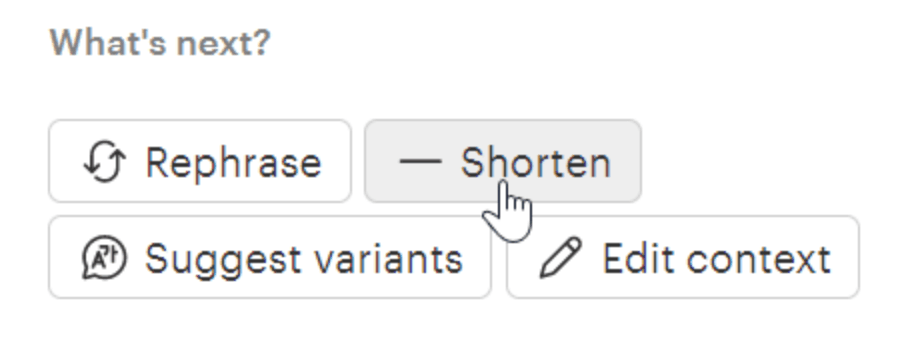
Want to learn more? Visit Lokalise AI to discover how to translate 10x faster, without compromising quality.
Apps like Google Translate and Microsoft Translator use NMT to instantly translate speech, text, or images. You might be navigating a foreign city or trying to communicate with someone in another language, and this is where machine translation tools come in handy.
Many companies use NMT to translate support tickets, chat messages, and help center content. This helps them serve customers in multiple languages without needing a large team of human agents for each one.
Online stores use neural translation to localize product listings, descriptions, reviews, and ads. It allows them to reach global markets faster and offer a more personalized experience to international shoppers.
📚 Further reading
Can you use Google Translate or DeepL to translate your Shopify store? Are they accurate enough, and what are the trade-offs? Make sure to read the linked articles.
Streaming platforms and video creators use NMT to generate subtitle translations and captions in multiple languages. It speeds up the localization process and makes content accessible to wider audiences.
Global companies also use machine translation to keep documentation, onboarding materials, and internal guides available to all employees, regardless of the languages they speak.
Before neural machine translation (NMT), machine translation was based on rules and phrases. Those older systems still exist, but NMT is way more advanced.
| Type of machine translation | How it works | Translation quality | Context awareness |
| Rule-based (RBMT) | Uses linguistic rules and dictionaries | Not so good, translations can be too literal | Very low |
| Statistical (SMT) | Uses probabilities from bilingual text | Often inconsistent | Low |
| Phrase-based (PBMT) | Translates phrases statistically | Better than SMT, but can still leave you with awkward translations | Medium |
| Neural (NMT) | Uses neural networks to understand context | Often fluent, human-like | High |
Rule-based machine translation was the earliest approach. It relied on dictionaries, grammar rules, and linguistic logic to translate text. While precise in theory, it often produced stiff, unnatural results. It also required a lot of manual work to make it work.
Statistical machine translation (SMT) looked at large amounts of bilingual text and used probability to guess the most likely translation. It was more flexible than RBMT but still limited, especially when it came to word order and sentence flow.
A subtype of SMT, phrase-based machine translation (PBMT) broke down text into short phrases rather than full sentences. This improved accuracy a bit, but still struggled with capturing context.
Neural machine translation (NMT) takes things a step further by analyzing the entire sentence, and even surrounding sentences. This is how it understands context and intent. It produces more fluent, human-like translations, and adapts better to tone, ambiguity, and grammar.
The best translation software today have some type of NMT functionality built-in, typically as generative AI translations.
📚Further reading: Want to learn more about different types of machine translation? Read our in-depth guide to discover when it makes sense to use one over the other.
Not all neural machine translation systems work the same way. Early NMT models were based on something called recurrent neural networks (RNNs), while today’s most powerful systems use transformers.
Let’s see what’s the difference between them.
| Recurrent neural networks (RNNs) | Transformer models |
| Process text word by word, from left to rightGood at “remembering” what came before a certain word in a sentenceStruggle with longer input | Process the entire sentence (or multiple sentences) at onceThey’re able to figure out which words matter most Fast, good with long sentences |
A recent study found that transformer architectures achieve significantly higher translation accuracy compared to recurrent neural networks, but they require 2-3x more training as well. You can think of it as an upfront investment for overall better translation quality and consistency.
🗒️ Key takeaway
Transformers replaced recurrent neural networks because 1) they’re faster, 2) more accurate, and 3) better at understanding complex language. Because of this, they make the machine translation post-editing process much easier for humans.
Behind every fast, accurate translation is a lot of engineering. The three main ingredients of a strong NMT engine? Data, architecture, and hardware.
Translation models learn by example, so they need a lot of bilingual text. Think millions or even billions of sentence pairs. The better the quality and variety of the data, the better the model gets at handling different topics, tones, and languages.
One clever way to improve NMT systems is by using back-translation. This means taking text from the target language (like French), automatically translating it back into the source language (like English), and then using that new sentence pair as extra training data.
Studies have shown that this helps the model get better at understanding how the two languages line up, especially when there’s not enough real bilingual content available.
Architecture refers to how the model is built, so RNNs, transformers, and all the math behind the scenes. Transformers dominate today because they’re great at handling long-range context and parallel processing. They just speed things up pretty dramatically.
Training and running NMT models requires serious computing power. GPUs (graphic processing units) and TPUs (tensor processing units) are used to process all that data quickly. For large-scale translation, companies run these models on cloud servers that can handle thousands of requests per second.
💡 Fun fact
The most powerful neural machine translation systems use something called attention mechanisms to figure out which words matter most. It’s kind of like skimming a paragraph and instantly spotting the key ideas. Models like Google Translate, OpenAI’s GPT, and DeepL function like this.
If you’ve made it this far, you probably care about building products, content, or systems that reach people, no matter what language they speak. Neural machine translation makes that more possible than ever. But knowing how it works gives you an edge.
Knowing how things work helps you spot when machine translation is enough and when it’s not. It helps you ask better questions, like what data your model was trained on, or whether your translations will reflect your tone, not just your words. And it helps you collaborate better with both technology and humans.
If you liked this article, we invite you to check out Lokalise blog where we cover all things technology, translation, and localization.
Author
Mia has 13+ years of experience in content & growth marketing in B2B SaaS. During her career, she has carried out brand awareness campaigns, led product launches and industry-specific campaigns, and conducted and documented demand generation experiments. She spent years working in the localization and translation industry.
In 2021 & 2024, Mia was selected as one of the judges for the INMA Global Media Awards thanks to her experience in native advertising. She also works as a mentor on GrowthMentor, a learning platform that gathers the world's top 3% of startup and marketing mentors.
Earning a Master's Degree in Comparative Literature helped Mia understand stories and humans better, think unconventionally, and become a really good, one-of-a-kind marketer. In her free time, she loves studying art, reading, travelling, and writing. She is currently finding her way in the EdTech industry.
Mia’s work has been published on Adweek, Forbes, The Next Web, What's New in Publishing, Publishing Executive, State of Digital Publishing, Instrumentl, Netokracija, Lokalise, Pleo.io, and other websites.
The model API is the cheap part. This is what it actually costs to automate AI translation, give it your company's context, learn to trust the output, and keep the system running.
Here's a stat that should make every localization leader uncomfortable: 57% of localization teams say their number one barrier to using AI more is that they don't trust the quality. Not that the quality is bad. That they don't trust it. The distinction matters. AI translation has improved dramatically. Models are better, context-aware systems like
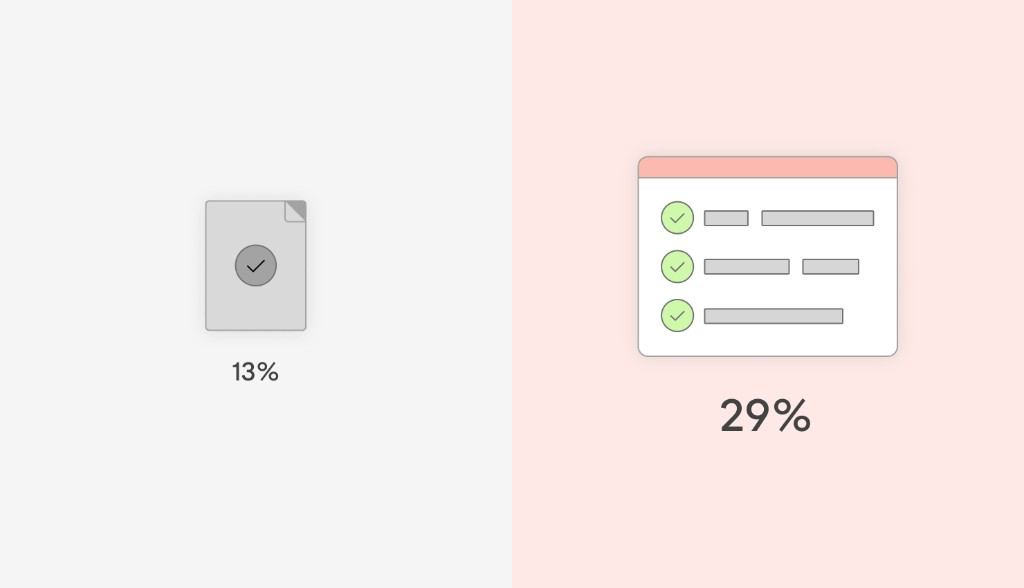
The meeting is going well. Translation costs are down, turnaround times are shorter, and AI is taking on more of the work. Then your VP asks a question: “How do you know the quality of AI translations is good enough?” The expensive part usually starts once you try to answer that question inside a system you built: the real cost of buildi








Behind the scenes of localization with one of Europe’s leading digital health providers
Read more Case studies



Localization workflow for your web and mobile apps, games and digital content.
©2017-2026
All Rights Reserved.
